

4
B. Sutcliffe and R.G. Woolley
After the discovery of the electron [2] and the triumph of the atomic, mechanistic
view of the constitution of matter, it became universally accepted that any specific
molecule consists of a certain number of electrons and nuclei in accordance with its
chemical formula. This can be translated into a microscopic model of point charged
particles interacting through Coulomb’s law with non-relativistic kinematics. These
assumptions fix the molecular Hamiltonian as precisely what Löwdin referred to as
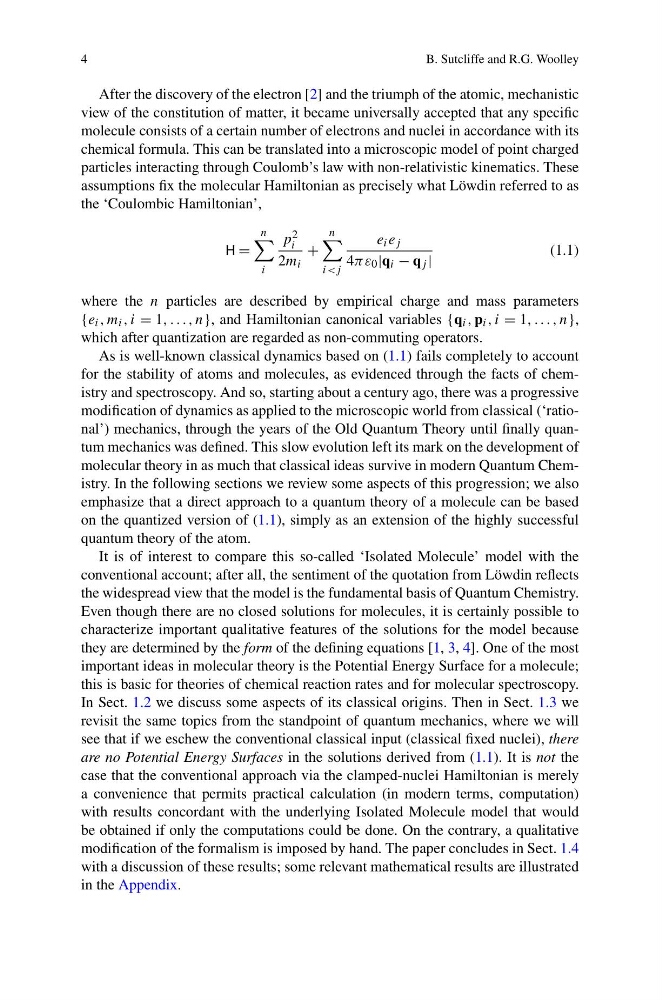
the ‘Coulombic Hamiltonian’,
H =
n
i
p 2
i
2m i
+
n
i
4πε 0 |q i − q j |
(1.1)
where the n particles are described by empirical charge and mass parameters
{e i , m i , i = 1, . . . , n}, and Hamiltonian canonical variables {q i , p i , i = 1, . . . , n},
which after quantization are regarded as non-commuting operators.
As is well-known classical dynamics based on (1.1) fails completely to account
for the stability of atoms and molecules, as evidenced through the facts of chemistry and spectroscopy. And so, starting about a century ago, there was a progressive
modification of dynamics as applied to the microscopic world from classical (‘rational’) mechanics, through the years of the Old Quantum Theory until finally quantum mechanics was defined. This slow evolution left its mark on the development of
molecular theory in as much that classical ideas survive in modern Quantum Chemistry. In the following sections we review some aspects of this progression; we also
emphasize that a direct approach to a quantum theory of a molecule can be based
on the quantized version of (1.1), simply as an extension of the highly successful
quantum theory of the atom.
It is of interest to compare this so-called ‘Isolated Molecule’ model with the
conventional account; after all, the sentiment of the quotation from Löwdin reflects
the widespread view that the model is the fundamental basis of Quantum Chemistry.
Even though there are no closed solutions for molecules, it is certainly possible to
characterize important qualitative features of the solutions for the model because
they are determined by the form of the defining equations [1, 3, 4]. One of the most
important ideas in molecular theory is the Potential Energy Surface for a molecule;
this is basic for theories of chemical reaction rates and for molecular spectroscopy.
In Sect. 1.2 we discuss some aspects of its classical origins. Then in Sect. 1.3 we
revisit the same topics from the standpoint of quantum mechanics, where we will
see that if we eschew the conventional classical input (classical fixed nuclei), there
are no Potential Energy Surfaces in the solutions derived from (1.1). It is not the
case that the conventional approach via the clamped-nuclei Hamiltonian is merely
a convenience that permits practical calculation (in modern terms, computation)
with results concordant with the underlying Isolated Molecule model that would
be obtained if only the computations could be done. On the contrary, a qualitative
modification of the formalism is imposed by hand. The paper concludes in Sect. 1.4
with a discussion of these results; some relevant mathematical results are illustrated
in the Appendix.
B. Sutcliffe and R.G. Woolley
After the discovery of the electron [2] and the triumph of the atomic, mechanistic
view of the constitution of matter, it became universally accepted that any specific
molecule consists of a certain number of electrons and nuclei in accordance with its
chemical formula. This can be translated into a microscopic model of point charged
particles interacting through Coulomb’s law with non-relativistic kinematics. These
assumptions fix the molecular Hamiltonian as precisely what Löwdin referred to as
the ‘Coulombic Hamiltonian’,
H =
n
i
p 2
i
2m i
+
n
i
4πε 0 |q i − q j |
(1.1)
where the n particles are described by empirical charge and mass parameters
{e i , m i , i = 1, . . . , n}, and Hamiltonian canonical variables {q i , p i , i = 1, . . . , n},
which after quantization are regarded as non-commuting operators.
As is well-known classical dynamics based on (1.1) fails completely to account
for the stability of atoms and molecules, as evidenced through the facts of chemistry and spectroscopy. And so, starting about a century ago, there was a progressive
modification of dynamics as applied to the microscopic world from classical (‘rational’) mechanics, through the years of the Old Quantum Theory until finally quantum mechanics was defined. This slow evolution left its mark on the development of
molecular theory in as much that classical ideas survive in modern Quantum Chemistry. In the following sections we review some aspects of this progression; we also
emphasize that a direct approach to a quantum theory of a molecule can be based
on the quantized version of (1.1), simply as an extension of the highly successful
quantum theory of the atom.
It is of interest to compare this so-called ‘Isolated Molecule’ model with the
conventional account; after all, the sentiment of the quotation from Löwdin reflects
the widespread view that the model is the fundamental basis of Quantum Chemistry.
Even though there are no closed solutions for molecules, it is certainly possible to
characterize important qualitative features of the solutions for the model because
they are determined by the form of the defining equations [1, 3, 4]. One of the most
important ideas in molecular theory is the Potential Energy Surface for a molecule;
this is basic for theories of chemical reaction rates and for molecular spectroscopy.
In Sect. 1.2 we discuss some aspects of its classical origins. Then in Sect. 1.3 we
revisit the same topics from the standpoint of quantum mechanics, where we will
see that if we eschew the conventional classical input (classical fixed nuclei), there
are no Potential Energy Surfaces in the solutions derived from (1.1). It is not the
case that the conventional approach via the clamped-nuclei Hamiltonian is merely
a convenience that permits practical calculation (in modern terms, computation)
with results concordant with the underlying Isolated Molecule model that would
be obtained if only the computations could be done. On the contrary, a qualitative
modification of the formalism is imposed by hand. The paper concludes in Sect. 1.4
with a discussion of these results; some relevant mathematical results are illustrated
in the Appendix.