

6 Charge Transfer Rate Constants
121
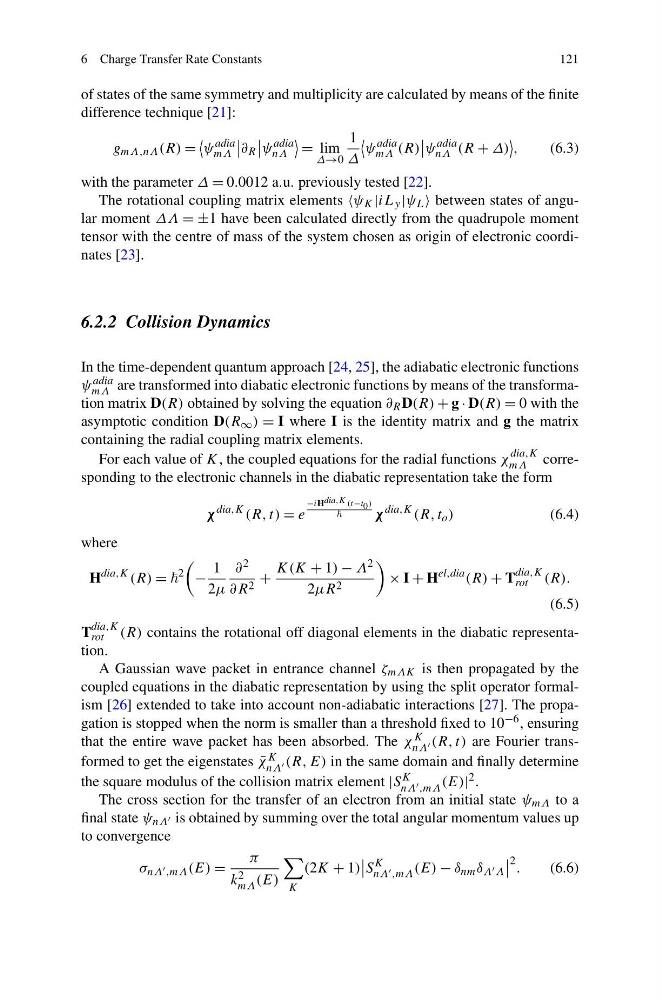
of states of the same symmetry and multiplicity are calculated by means of the finite
difference technique [21]:
g mΛ,nΛ (R) =
ψ
adia
mΛ
∂ R
ψ
adia
nΛ
= lim
Δ→0
1
Δ
ψ
adia
mΛ (R)
ψ
adia
nΛ (R + Δ)
,
(6.3)
with the parameter Δ = 0.0012 a.u. previously tested [22].
The rotational coupling matrix elements ψ K |iL y |ψ L between states of angular moment ΔΛ = ±1 have been calculated directly from the quadrupole moment
tensor with the centre of mass of the system chosen as origin of electronic coordinates [23].
6.2.2 Collision Dynamics
In the time-dependent quantum approach [24, 25], the adiabatic electronic functions
ψ adia
mΛ are transformed into diabatic electronic functions by means of the transformation matrix D(R) obtained by solving the equation ∂ R D(R) + g · D(R) = 0 with the
asymptotic condition D(R ∞ ) = I where I is the identity matrix and g the matrix
containing the radial coupling matrix elements.
For each value of K, the coupled equations for the radial functions χ
dia,K
mΛ corresponding to the electronic channels in the diabatic representation take the form
χ
dia,K (R, t) = e
−iH dia,K (t−t 0 )
χ
dia,K (R, t o )
(6.4)
where
H
dia,K (R) =
2
−
1
2μ
∂ 2
∂R 2 +
K(K + 1) − Λ 2
2μR 2
× I + H
el,dia (R) + T
dia,K
rot (R).
(6.5)
T
dia,K
rot (R) contains the rotational off diagonal elements in the diabatic representation.
A Gaussian wave packet in entrance channel ζ mΛK is then propagated by the
coupled equations in the diabatic representation by using the split operator formalism [26] extended to take into account non-adiabatic interactions [27]. The propagation is stopped when the norm is smaller than a threshold fixed to 10 −6 , ensuring
that the entire wave packet has been absorbed. The χ K
nΛ (R, t) are Fourier transformed to get the eigenstates ¯
χ K
nΛ (R, E) in the same domain and finally determine
the square modulus of the collision matrix element |S K
nΛ ,mΛ (E)| 2 .
The cross section for the transfer of an electron from an initial state ψ mΛ to a
final state ψ nΛ is obtained by summing over the total angular momentum values up
to convergence
σ nΛ ,mΛ (E) =
π
k 2
mΛ (E)
K
(2K + 1)
S
K
nΛ ,mΛ (E) − δ nm δ Λ Λ
2 .
(6.6)
121
of states of the same symmetry and multiplicity are calculated by means of the finite
difference technique [21]:
g mΛ,nΛ (R) =
ψ
adia
mΛ
∂ R
ψ
adia
nΛ
= lim
Δ→0
1
Δ
ψ
adia
mΛ (R)
ψ
adia
nΛ (R + Δ)
,
(6.3)
with the parameter Δ = 0.0012 a.u. previously tested [22].
The rotational coupling matrix elements ψ K |iL y |ψ L between states of angular moment ΔΛ = ±1 have been calculated directly from the quadrupole moment
tensor with the centre of mass of the system chosen as origin of electronic coordinates [23].
6.2.2 Collision Dynamics
In the time-dependent quantum approach [24, 25], the adiabatic electronic functions
ψ adia
mΛ are transformed into diabatic electronic functions by means of the transformation matrix D(R) obtained by solving the equation ∂ R D(R) + g · D(R) = 0 with the
asymptotic condition D(R ∞ ) = I where I is the identity matrix and g the matrix
containing the radial coupling matrix elements.
For each value of K, the coupled equations for the radial functions χ
dia,K
mΛ corresponding to the electronic channels in the diabatic representation take the form
χ
dia,K (R, t) = e
−iH dia,K (t−t 0 )
χ
dia,K (R, t o )
(6.4)
where
H
dia,K (R) =
2
−
1
2μ
∂ 2
∂R 2 +
K(K + 1) − Λ 2
2μR 2
× I + H
el,dia (R) + T
dia,K
rot (R).
(6.5)
T
dia,K
rot (R) contains the rotational off diagonal elements in the diabatic representation.
A Gaussian wave packet in entrance channel ζ mΛK is then propagated by the
coupled equations in the diabatic representation by using the split operator formalism [26] extended to take into account non-adiabatic interactions [27]. The propagation is stopped when the norm is smaller than a threshold fixed to 10 −6 , ensuring
that the entire wave packet has been absorbed. The χ K
nΛ (R, t) are Fourier transformed to get the eigenstates ¯
χ K
nΛ (R, E) in the same domain and finally determine
the square modulus of the collision matrix element |S K
nΛ ,mΛ (E)| 2 .
The cross section for the transfer of an electron from an initial state ψ mΛ to a
final state ψ nΛ is obtained by summing over the total angular momentum values up
to convergence
σ nΛ ,mΛ (E) =
π
k 2
mΛ (E)
K
(2K + 1)
S
K
nΛ ,mΛ (E) − δ nm δ Λ Λ
2 .
(6.6)