

120
M.C. Bacchus-Montabonel
is crucial in the chemistry of the photon dominated regions (PDR’s) of the interstellar medium [8] and drives the ionic carbon chemistry at the origin of the formation
of the complex carbon molecules observed in the PDR’s. The rate constant generally accepted for this process from the UMIST database [9] is 1.5 × 10 −9 cm 3 s −1
between 10 K and 41000 K, but it appears uncertain for such a large temperature
domain and accurate calculations have been performed [10, 11].
We have also investigated the charge transfer of C 2+ ions with CO and N 2 diatomic targets [7, 12]. Up to now, most of the theoretical studies involving molecular
targets have been devoted to molecular hydrogen [13, 14] and experiments between
carbon ions and diatomic targets have been performed mainly at keV collision energies [15, 16]. But recent measurements of Gao and Kwong provide a precise determination of the charge transfer rate coefficients for the C 2+ collision with CO and
N 2 targets at T equiv = 1.17 × 10 4 K [17] which may be compared with theoretical
studies.
6.2 Theoretical Approach
6.2.1 Molecular Hamiltonian
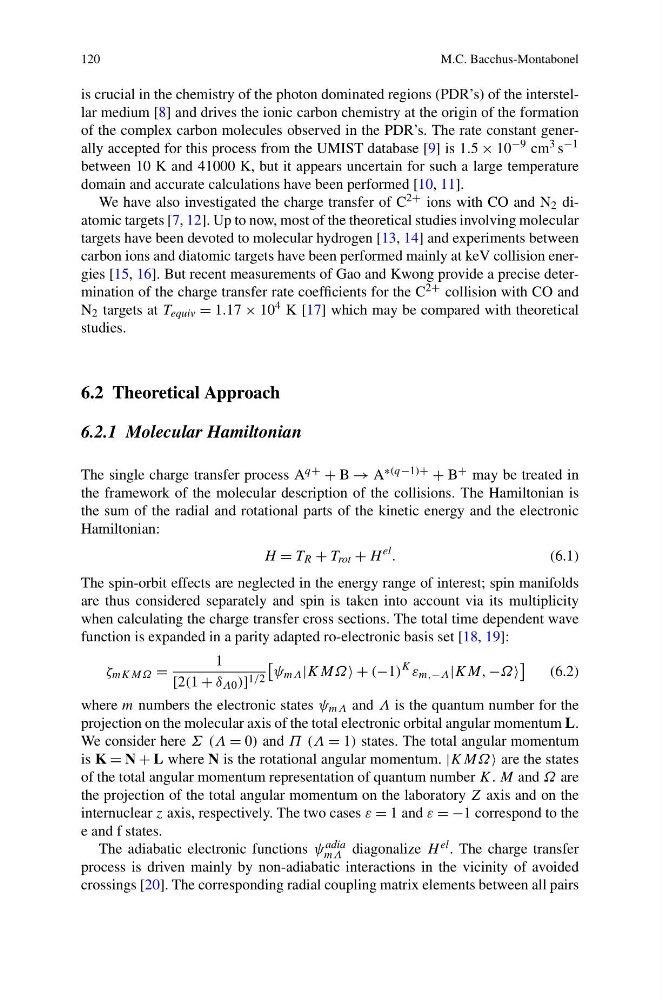
The single charge transfer process A q+ + B → A ∗(q−1)+ + B + may be treated in
the framework of the molecular description of the collisions. The Hamiltonian is
the sum of the radial and rotational parts of the kinetic energy and the electronic
Hamiltonian:
H = T R + T rot + H
el .
(6.1)
The spin-orbit effects are neglected in the energy range of interest; spin manifolds
are thus considered separately and spin is taken into account via its multiplicity
when calculating the charge transfer cross sections. The total time dependent wave
function is expanded in a parity adapted ro-electronic basis set [18, 19]:
ζ mKMΩ =
1
[2(1 + δ Λ0 )] 1/2
ψ mΛ |KMΩ + (−1)
K ε m,−Λ |KM, −Ω
(6.2)
where m numbers the electronic states ψ mΛ and Λ is the quantum number for the
projection on the molecular axis of the total electronic orbital angular momentum L.
We consider here Σ (Λ = 0) and Π (Λ = 1) states. The total angular momentum
is K = N + L where N is the rotational angular momentum. |KMΩ are the states
of the total angular momentum representation of quantum number K. M and Ω are
the projection of the total angular momentum on the laboratory Z axis and on the
internuclear z axis, respectively. The two cases ε = 1 and ε = −1 correspond to the
e and f states.
The adiabatic electronic functions ψ adia
mΛ diagonalize H el . The charge transfer
process is driven mainly by non-adiabatic interactions in the vicinity of avoided
crossings [20]. The corresponding radial coupling matrix elements between all pairs
M.C. Bacchus-Montabonel
is crucial in the chemistry of the photon dominated regions (PDR’s) of the interstellar medium [8] and drives the ionic carbon chemistry at the origin of the formation
of the complex carbon molecules observed in the PDR’s. The rate constant generally accepted for this process from the UMIST database [9] is 1.5 × 10 −9 cm 3 s −1
between 10 K and 41000 K, but it appears uncertain for such a large temperature
domain and accurate calculations have been performed [10, 11].
We have also investigated the charge transfer of C 2+ ions with CO and N 2 diatomic targets [7, 12]. Up to now, most of the theoretical studies involving molecular
targets have been devoted to molecular hydrogen [13, 14] and experiments between
carbon ions and diatomic targets have been performed mainly at keV collision energies [15, 16]. But recent measurements of Gao and Kwong provide a precise determination of the charge transfer rate coefficients for the C 2+ collision with CO and
N 2 targets at T equiv = 1.17 × 10 4 K [17] which may be compared with theoretical
studies.
6.2 Theoretical Approach
6.2.1 Molecular Hamiltonian
The single charge transfer process A q+ + B → A ∗(q−1)+ + B + may be treated in
the framework of the molecular description of the collisions. The Hamiltonian is
the sum of the radial and rotational parts of the kinetic energy and the electronic
Hamiltonian:
H = T R + T rot + H
el .
(6.1)
The spin-orbit effects are neglected in the energy range of interest; spin manifolds
are thus considered separately and spin is taken into account via its multiplicity
when calculating the charge transfer cross sections. The total time dependent wave
function is expanded in a parity adapted ro-electronic basis set [18, 19]:
ζ mKMΩ =
1
[2(1 + δ Λ0 )] 1/2
ψ mΛ |KMΩ + (−1)
K ε m,−Λ |KM, −Ω
(6.2)
where m numbers the electronic states ψ mΛ and Λ is the quantum number for the
projection on the molecular axis of the total electronic orbital angular momentum L.
We consider here Σ (Λ = 0) and Π (Λ = 1) states. The total angular momentum
is K = N + L where N is the rotational angular momentum. |KMΩ are the states
of the total angular momentum representation of quantum number K. M and Ω are
the projection of the total angular momentum on the laboratory Z axis and on the
internuclear z axis, respectively. The two cases ε = 1 and ε = −1 correspond to the
e and f states.
The adiabatic electronic functions ψ adia
mΛ diagonalize H el . The charge transfer
process is driven mainly by non-adiabatic interactions in the vicinity of avoided
crossings [20]. The corresponding radial coupling matrix elements between all pairs