

5 Application of the Uniformly Charged Sphere Stabilization
115
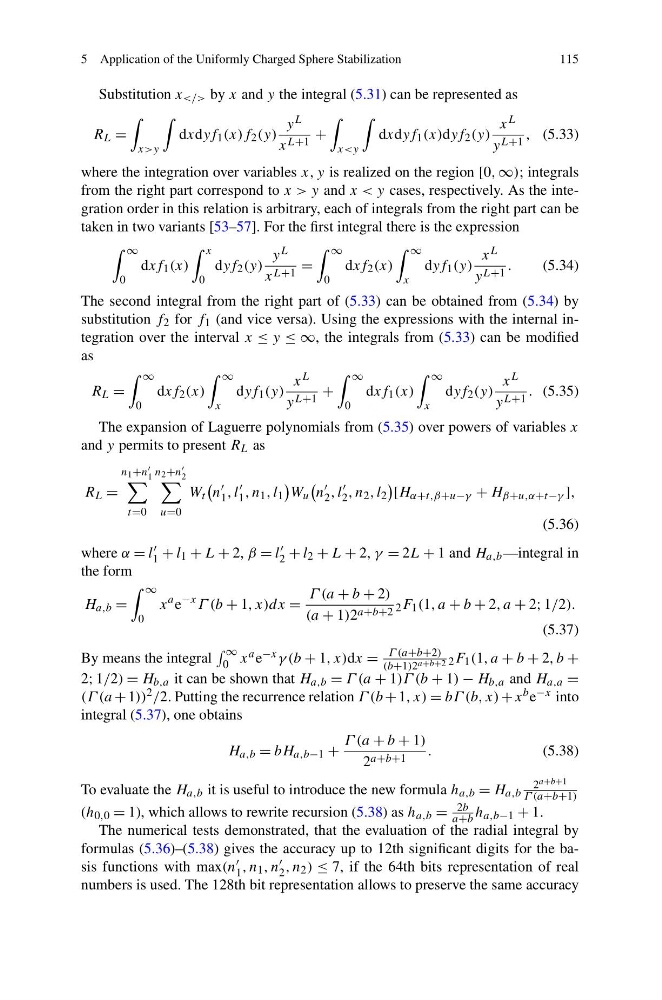
Substitution x by x and y the integral (5.31) can be represented as
R L =
x>y
dxdyf 1 (x)f 2 (y)
y L
x L+1 +
x
x L
y L+1 , (5.33)
where the integration over variables x, y is realized on the region [0, ∞); integrals
from the right part correspond to x > y and x < y cases, respectively. As the integration order in this relation is arbitrary, each of integrals from the right part can be
taken in two variants [53–57]. For the first integral there is the expression
∞
0
dxf 1 (x)
x
0
dyf 2 (y)
y L
x L+1 =
∞
0
dxf 2 (x)
∞
x
dyf 1 (y)
x L
y L+1 .
(5.34)
The second integral from the right part of (5.33) can be obtained from (5.34) by
substitution f 2 for f 1 (and vice versa). Using the expressions with the internal integration over the interval x ≤ y ≤ ∞, the integrals from (5.33) can be modified
as
R L =
∞
0
dxf 2 (x)
∞
x
dyf 1 (y)
x L
y L+1 +
∞
0
dxf 1 (x)
∞
x
dyf 2 (y)
x L
y L+1 . (5.35)
The expansion of Laguerre polynomials from (5.35) over powers of variables x
and y permits to present R L as
R L =
n 1 +n
1
t=0
n 2 +n
2
u=0
W t
n
1 , l
1 , n 1 , l 1
W u
n
2 , l
2 , n 2 , l 2
[H α+t,β+u−γ + H β+u,α+t−γ ],
(5.36)
where α = l
1 + l 1 + L + 2, β = l
2 + l 2 + L + 2, γ = 2L + 1 and H a,b —integral in
the form
H a,b =
∞
0
x
a e
−x Γ (b + 1, x)dx =
Γ (a + b + 2)
(a + 1)2 a+b+2 2 F 1 (1, a + b + 2, a + 2; 1/2).
(5.37)
By means the integral
∞
0 x a e −x γ (b + 1, x)dx =
Γ (a+b+2)
(b+1)2 a+b+2 2 F 1 (1, a + b + 2, b +
2; 1/2) = H b,a it can be shown that H a,b = Γ (a + 1)Γ (b + 1) − H b,a and H a,a =
(Γ (a + 1)) 2 /2. Putting the recurrence relation Γ (b + 1, x) = bΓ (b, x) + x b e −x into
integral (5.37), one obtains
H a,b = bH a,b−1 +
Γ (a + b + 1)
2 a+b+1 .
(5.38)
To evaluate the H a,b it is useful to introduce the new formula h a,b = H a,b
2 a+b+1
Γ (a+b+1)
(h 0,0 = 1), which allows to rewrite recursion (5.38) as h a,b =
2b
a+b h a,b−1 + 1.
The numerical tests demonstrated, that the evaluation of the radial integral by
formulas (5.36)–(5.38) gives the accuracy up to 12th significant digits for the basis functions with max(n
1 , n 1 , n
2 , n 2 ) ≤ 7, if the 64th bits representation of real
numbers is used. The 128th bit representation allows to preserve the same accuracy
115
Substitution x by x and y the integral (5.31) can be represented as
R L =
x>y
dxdyf 1 (x)f 2 (y)
y L
x L+1 +
x
x L
y L+1 , (5.33)
where the integration over variables x, y is realized on the region [0, ∞); integrals
from the right part correspond to x > y and x < y cases, respectively. As the integration order in this relation is arbitrary, each of integrals from the right part can be
taken in two variants [53–57]. For the first integral there is the expression
∞
0
dxf 1 (x)
x
0
dyf 2 (y)
y L
x L+1 =
∞
0
dxf 2 (x)
∞
x
dyf 1 (y)
x L
y L+1 .
(5.34)
The second integral from the right part of (5.33) can be obtained from (5.34) by
substitution f 2 for f 1 (and vice versa). Using the expressions with the internal integration over the interval x ≤ y ≤ ∞, the integrals from (5.33) can be modified
as
R L =
∞
0
dxf 2 (x)
∞
x
dyf 1 (y)
x L
y L+1 +
∞
0
dxf 1 (x)
∞
x
dyf 2 (y)
x L
y L+1 . (5.35)
The expansion of Laguerre polynomials from (5.35) over powers of variables x
and y permits to present R L as
R L =
n 1 +n
1
t=0
n 2 +n
2
u=0
W t
n
1 , l
1 , n 1 , l 1
W u
n
2 , l
2 , n 2 , l 2
[H α+t,β+u−γ + H β+u,α+t−γ ],
(5.36)
where α = l
1 + l 1 + L + 2, β = l
2 + l 2 + L + 2, γ = 2L + 1 and H a,b —integral in
the form
H a,b =
∞
0
x
a e
−x Γ (b + 1, x)dx =
Γ (a + b + 2)
(a + 1)2 a+b+2 2 F 1 (1, a + b + 2, a + 2; 1/2).
(5.37)
By means the integral
∞
0 x a e −x γ (b + 1, x)dx =
Γ (a+b+2)
(b+1)2 a+b+2 2 F 1 (1, a + b + 2, b +
2; 1/2) = H b,a it can be shown that H a,b = Γ (a + 1)Γ (b + 1) − H b,a and H a,a =
(Γ (a + 1)) 2 /2. Putting the recurrence relation Γ (b + 1, x) = bΓ (b, x) + x b e −x into
integral (5.37), one obtains
H a,b = bH a,b−1 +
Γ (a + b + 1)
2 a+b+1 .
(5.38)
To evaluate the H a,b it is useful to introduce the new formula h a,b = H a,b
2 a+b+1
Γ (a+b+1)
(h 0,0 = 1), which allows to rewrite recursion (5.38) as h a,b =
2b
a+b h a,b−1 + 1.
The numerical tests demonstrated, that the evaluation of the radial integral by
formulas (5.36)–(5.38) gives the accuracy up to 12th significant digits for the basis functions with max(n
1 , n 1 , n
2 , n 2 ) ≤ 7, if the 64th bits representation of real
numbers is used. The 128th bit representation allows to preserve the same accuracy