

4 Some Biochemical Reflections on Information and Communication
91
Although the diagonalisation of the degenerate subspace corresponding to the
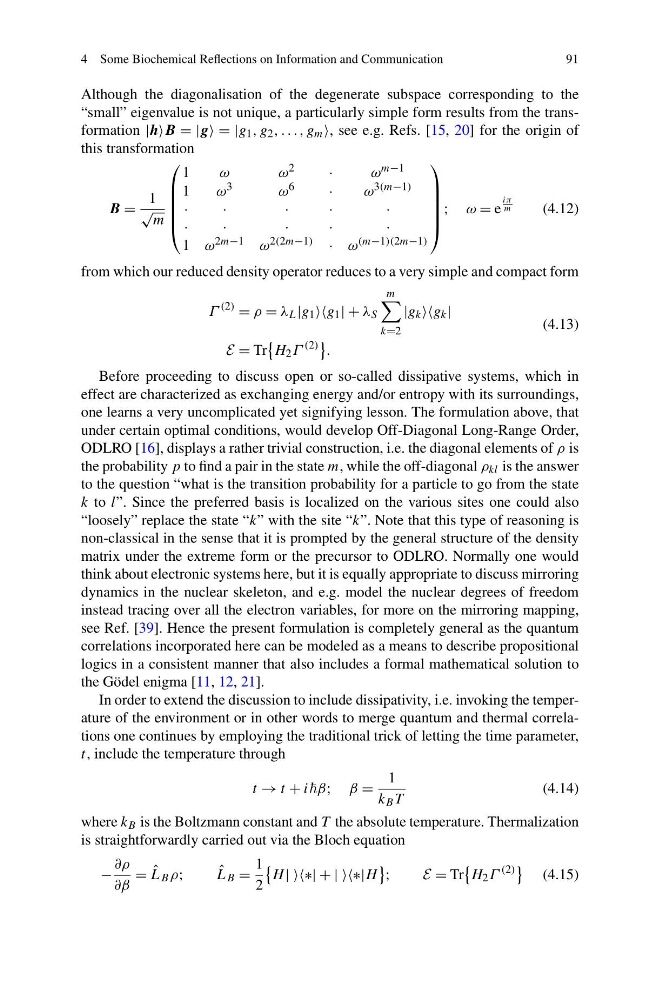
“small” eigenvalue is not unique, a particularly simple form results from the transformation |hB = |g = |g 1 , g 2 , . . . , g m , see e.g. Refs. [15, 20] for the origin of
this transformation
B =
1
√
m
⎛
⎜
⎜
⎜
⎜
⎝
1
ω
ω 2
·
ω m−1
1
ω 3
ω 6
·
ω 3(m−1)
·
·
·
·
·
·
·
·
·
·
1 ω 2m−1 ω 2(2m−1) · ω (m−1)(2m−1)
⎞
⎟
⎟
⎟
⎟
⎠
; ω = e
iπ
m
(4.12)
from which our reduced density operator reduces to a very simple and compact form
Γ
(2)
= ρ = λ L |g 1 g 1 | + λ S
m
k=2
|g k g k |
E = Tr
H 2 Γ
(2)
.
(4.13)
Before proceeding to discuss open or so-called dissipative systems, which in
effect are characterized as exchanging energy and/or entropy with its surroundings,
one learns a very uncomplicated yet signifying lesson. The formulation above, that
under certain optimal conditions, would develop Off-Diagonal Long-Range Order,
ODLRO [16], displays a rather trivial construction, i.e. the diagonal elements of ρ is
the probability p to find a pair in the state m, while the off-diagonal ρ kl is the answer
to the question “what is the transition probability for a particle to go from the state
k to l”. Since the preferred basis is localized on the various sites one could also
“loosely” replace the state “k” with the site “k”. Note that this type of reasoning is
non-classical in the sense that it is prompted by the general structure of the density
matrix under the extreme form or the precursor to ODLRO. Normally one would
think about electronic systems here, but it is equally appropriate to discuss mirroring
dynamics in the nuclear skeleton, and e.g. model the nuclear degrees of freedom
instead tracing over all the electron variables, for more on the mirroring mapping,
see Ref. [39]. Hence the present formulation is completely general as the quantum
correlations incorporated here can be modeled as a means to describe propositional
logics in a consistent manner that also includes a formal mathematical solution to
the Gödel enigma [11, 12, 21].
In order to extend the discussion to include dissipativity, i.e. invoking the temperature of the environment or in other words to merge quantum and thermal correlations one continues by employing the traditional trick of letting the time parameter,
t, include the temperature through
t → t + iβ; β =
1
k B T
(4.14)
where k B is the Boltzmann constant and T the absolute temperature. Thermalization
is straightforwardly carried out via the Bloch equation
−
∂ρ
∂β
= ˆ
L B ρ;
ˆ
L B =
1
2
H | ||∗| + | ||∗|H
;
E = Tr
H 2 Γ
(2)
(4.15)
91
Although the diagonalisation of the degenerate subspace corresponding to the
“small” eigenvalue is not unique, a particularly simple form results from the transformation |hB = |g = |g 1 , g 2 , . . . , g m , see e.g. Refs. [15, 20] for the origin of
this transformation
B =
1
√
m
⎛
⎜
⎜
⎜
⎜
⎝
1
ω
ω 2
·
ω m−1
1
ω 3
ω 6
·
ω 3(m−1)
·
·
·
·
·
·
·
·
·
·
1 ω 2m−1 ω 2(2m−1) · ω (m−1)(2m−1)
⎞
⎟
⎟
⎟
⎟
⎠
; ω = e
iπ
m
(4.12)
from which our reduced density operator reduces to a very simple and compact form
Γ
(2)
= ρ = λ L |g 1 g 1 | + λ S
m
k=2
|g k g k |
E = Tr
H 2 Γ
(2)
.
(4.13)
Before proceeding to discuss open or so-called dissipative systems, which in
effect are characterized as exchanging energy and/or entropy with its surroundings,
one learns a very uncomplicated yet signifying lesson. The formulation above, that
under certain optimal conditions, would develop Off-Diagonal Long-Range Order,
ODLRO [16], displays a rather trivial construction, i.e. the diagonal elements of ρ is
the probability p to find a pair in the state m, while the off-diagonal ρ kl is the answer
to the question “what is the transition probability for a particle to go from the state
k to l”. Since the preferred basis is localized on the various sites one could also
“loosely” replace the state “k” with the site “k”. Note that this type of reasoning is
non-classical in the sense that it is prompted by the general structure of the density
matrix under the extreme form or the precursor to ODLRO. Normally one would
think about electronic systems here, but it is equally appropriate to discuss mirroring
dynamics in the nuclear skeleton, and e.g. model the nuclear degrees of freedom
instead tracing over all the electron variables, for more on the mirroring mapping,
see Ref. [39]. Hence the present formulation is completely general as the quantum
correlations incorporated here can be modeled as a means to describe propositional
logics in a consistent manner that also includes a formal mathematical solution to
the Gödel enigma [11, 12, 21].
In order to extend the discussion to include dissipativity, i.e. invoking the temperature of the environment or in other words to merge quantum and thermal correlations one continues by employing the traditional trick of letting the time parameter,
t, include the temperature through
t → t + iβ; β =
1
k B T
(4.14)
where k B is the Boltzmann constant and T the absolute temperature. Thermalization
is straightforwardly carried out via the Bloch equation
−
∂ρ
∂β
= ˆ
L B ρ;
ˆ
L B =
1
2
H | ||∗| + | ||∗|H
;
E = Tr
H 2 Γ
(2)
(4.15)