

the catalyst prepared from 5 and MAO bears close resemblance to 1/MAO catalyst
system and behaves accordingly by efficiently polymerizing propylene to s-PP after
its activation.
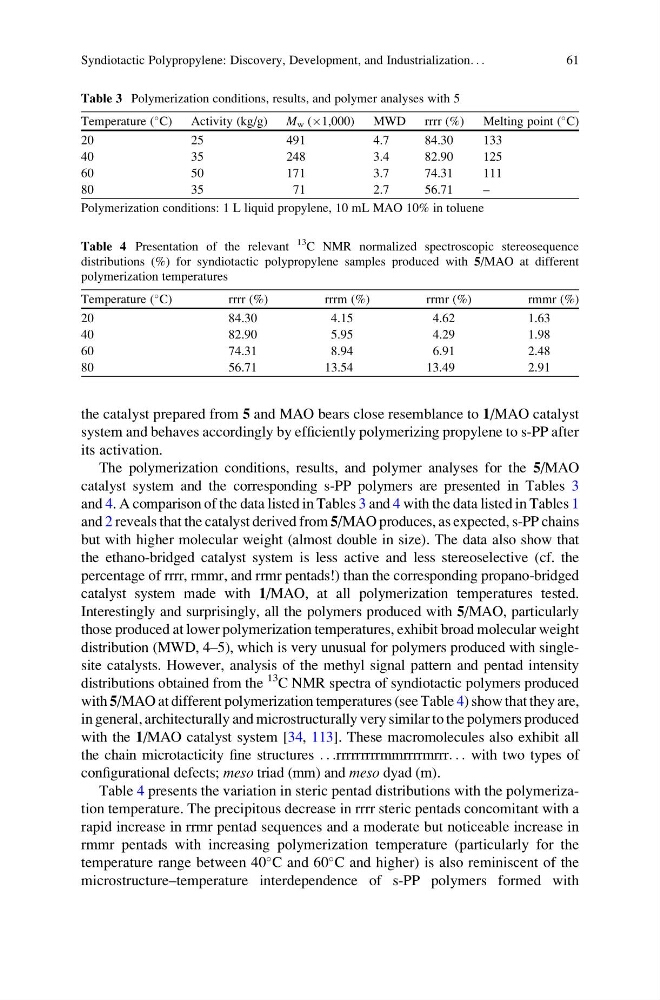
The polymerization conditions, results, and polymer analyses for the 5/MAO
catalyst system and the corresponding s-PP polymers are presented in Tables 3
and 4. A comparison of the data listed in Tables 3 and 4 with the data listed in Tables 1
and 2 reveals that the catalyst derived from 5/MAO produces, as expected, s-PP chains
but with higher molecular weight (almost double in size). The data also show that
the ethano-bridged catalyst system is less active and less stereoselective (cf. the
percentage of rrrr, rmmr, and rrmr pentads!) than the corresponding propano-bridged
catalyst system made with 1/MAO, at all polymerization temperatures tested.
Interestingly and surprisingly, all the polymers produced with 5/MAO, particularly
those produced at lower polymerization temperatures, exhibit broad molecular weight
distribution (MWD, 4–5), which is very unusual for polymers produced with singlesite catalysts. However, analysis of the methyl signal pattern and pentad intensity
distributions obtained from the
13
C NMR spectra of syndiotactic polymers produced
with 5/MAO at different polymerization temperatures (see Table 4) show that they are,
in general, architecturally and microstructurally very similar to the polymers produced
with the 1/MAO catalyst system [34, 113]. These macromolecules also exhibit all
the chain microtacticity fine structures . . .rrrrrrrrrmmrrrrmrrr. . . with two types of
configurational defects; meso triad (mm) and meso dyad (m).
Table 4 presents the variation in steric pentad distributions with the polymerization temperature. The precipitous decrease in rrrr steric pentads concomitant with a
rapid increase in rrmr pentad sequences and a moderate but noticeable increase in
rmmr pentads with increasing polymerization temperature (particularly for the
temperature range between 40
C and 60
C and higher) is also reminiscent of the
microstructure–temperature interdependence of s-PP polymers formed with
Table 3 Polymerization conditions, results, and polymer analyses with 5
Temperature (
C) Activity (kg/g) M w (Â1,000) MWD rrrr (%) Melting point (
C)
20
25
491
4.7
84.30
133
40
35
248
3.4
82.90
125
60
50
171
3.7
74.31
111
80
35
71
2.7
56.71
–
Polymerization conditions: 1 L liquid propylene, 10 mL MAO 10% in toluene
Table 4 Presentation of the relevant
13
C NMR normalized spectroscopic stereosequence
distributions (%) for syndiotactic polypropylene samples produced with 5/MAO at different
polymerization temperatures
Temperature (
C)
rrrr (%)
rrrm (%)
rrmr (%)
rmmr (%)
20
84.30
4.15
4.62
1.63
40
82.90
5.95
4.29
1.98
60
74.31
8.94
6.91
2.48
80
56.71
13.54
13.49
2.91
Syndiotactic Polypropylene: Discovery, Development, and Industrialization. . .
61
system and behaves accordingly by efficiently polymerizing propylene to s-PP after
its activation.
The polymerization conditions, results, and polymer analyses for the 5/MAO
catalyst system and the corresponding s-PP polymers are presented in Tables 3
and 4. A comparison of the data listed in Tables 3 and 4 with the data listed in Tables 1
and 2 reveals that the catalyst derived from 5/MAO produces, as expected, s-PP chains
but with higher molecular weight (almost double in size). The data also show that
the ethano-bridged catalyst system is less active and less stereoselective (cf. the
percentage of rrrr, rmmr, and rrmr pentads!) than the corresponding propano-bridged
catalyst system made with 1/MAO, at all polymerization temperatures tested.
Interestingly and surprisingly, all the polymers produced with 5/MAO, particularly
those produced at lower polymerization temperatures, exhibit broad molecular weight
distribution (MWD, 4–5), which is very unusual for polymers produced with singlesite catalysts. However, analysis of the methyl signal pattern and pentad intensity
distributions obtained from the
13
C NMR spectra of syndiotactic polymers produced
with 5/MAO at different polymerization temperatures (see Table 4) show that they are,
in general, architecturally and microstructurally very similar to the polymers produced
with the 1/MAO catalyst system [34, 113]. These macromolecules also exhibit all
the chain microtacticity fine structures . . .rrrrrrrrrmmrrrrmrrr. . . with two types of
configurational defects; meso triad (mm) and meso dyad (m).
Table 4 presents the variation in steric pentad distributions with the polymerization temperature. The precipitous decrease in rrrr steric pentads concomitant with a
rapid increase in rrmr pentad sequences and a moderate but noticeable increase in
rmmr pentads with increasing polymerization temperature (particularly for the
temperature range between 40
C and 60
C and higher) is also reminiscent of the
microstructure–temperature interdependence of s-PP polymers formed with
Table 3 Polymerization conditions, results, and polymer analyses with 5
Temperature (
C) Activity (kg/g) M w (Â1,000) MWD rrrr (%) Melting point (
C)
20
25
491
4.7
84.30
133
40
35
248
3.4
82.90
125
60
50
171
3.7
74.31
111
80
35
71
2.7
56.71
–
Polymerization conditions: 1 L liquid propylene, 10 mL MAO 10% in toluene
Table 4 Presentation of the relevant
13
C NMR normalized spectroscopic stereosequence
distributions (%) for syndiotactic polypropylene samples produced with 5/MAO at different
polymerization temperatures
Temperature (
C)
rrrr (%)
rrrm (%)
rrmr (%)
rmmr (%)
20
84.30
4.15
4.62
1.63
40
82.90
5.95
4.29
1.98
60
74.31
8.94
6.91
2.48
80
56.71
13.54
13.49
2.91
Syndiotactic Polypropylene: Discovery, Development, and Industrialization. . .
61