

approach as it passes through a wider entrance. However, the authors note that in
addition to the “purely” steric effect, some degree of electronic influence has also to
be taken into consideration to account for the overall change in catalyst behavior.
Naturally, a large opening also translates into better incorporation of higher
α-olefins and better comonomer incorporation in copolymerization reactions
involving larger comonomers.
Little was known about the influence of the bridge and bridge substituent(s) on the
catalytic performance with respect to the molecular weight of the resulting polymer
until the advent of the syndiotactic-selective metallocene catalyst systems. The
following two sections describe the modifications of the size and substituents of the
inter-annular bridge in complex 1 and their impact on the catalytic performance and
resulting s-PP.
3.2 Bridge Size Modification: 1,2-Ethano-Bridge Versus
2,2-Propano-Bridge
Syndiotactic-selective precatalyst complexes 1 and 2 have a ligand system in which
the inter-annular bridge, connecting the two aromatic rings together, is the single
carbon atom of the isopropylidene, or 2,2-dimethyl-propano group. It appeared
intriguing to know what would be the effect on the polymerization behavior of the
resulting catalyst of an increase in the number of carbon atoms of the bridge (i.e., an
increase in the size) by one additional carbon atom. To answer this question, a
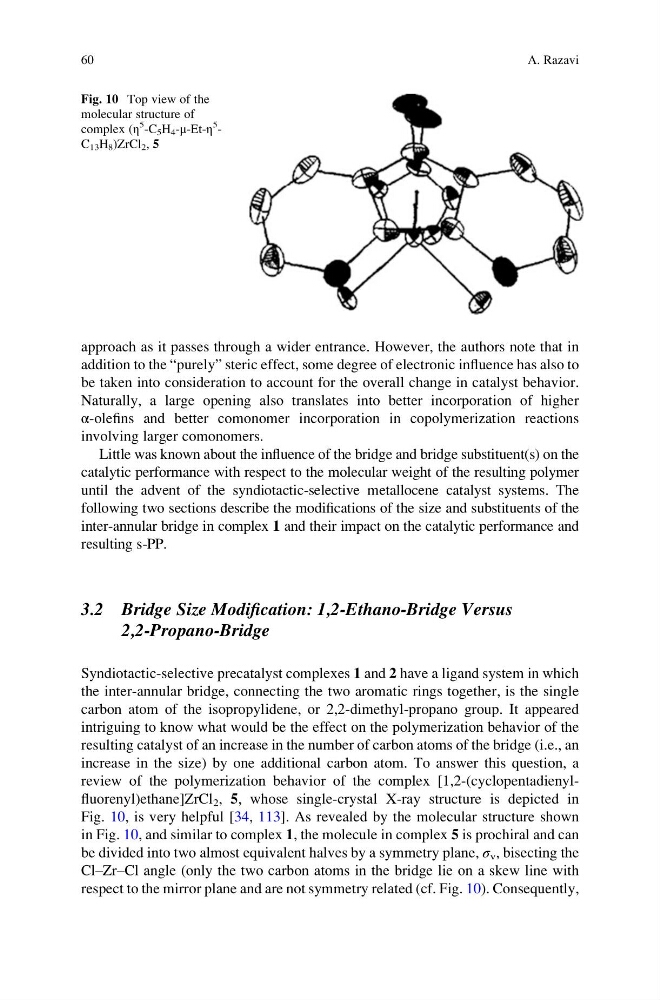
review of the polymerization behavior of the complex [1,2-(cyclopentadienylfluorenyl)ethane]ZrCl 2 , 5, whose single-crystal X-ray structure is depicted in
Fig. 10, is very helpful [34, 113]. As revealed by the molecular structure shown
in Fig. 10, and similar to complex 1, the molecule in complex 5 is prochiral and can
be divided into two almost equivalent halves by a symmetry plane, σ v , bisecting the
Cl–Zr–Cl angle (only the two carbon atoms in the bridge lie on a skew line with
respect to the mirror plane and are not symmetry related (cf. Fig. 10). Consequently,
Fig. 10 Top view of the
molecular structure of
complex (η
5
-C 5 H 4 -μ-Et-η
5
-
C 13 H 8 )ZrCl 2 , 5
60
A. Razavi
addition to the “purely” steric effect, some degree of electronic influence has also to
be taken into consideration to account for the overall change in catalyst behavior.
Naturally, a large opening also translates into better incorporation of higher
α-olefins and better comonomer incorporation in copolymerization reactions
involving larger comonomers.
Little was known about the influence of the bridge and bridge substituent(s) on the
catalytic performance with respect to the molecular weight of the resulting polymer
until the advent of the syndiotactic-selective metallocene catalyst systems. The
following two sections describe the modifications of the size and substituents of the
inter-annular bridge in complex 1 and their impact on the catalytic performance and
resulting s-PP.
3.2 Bridge Size Modification: 1,2-Ethano-Bridge Versus
2,2-Propano-Bridge
Syndiotactic-selective precatalyst complexes 1 and 2 have a ligand system in which
the inter-annular bridge, connecting the two aromatic rings together, is the single
carbon atom of the isopropylidene, or 2,2-dimethyl-propano group. It appeared
intriguing to know what would be the effect on the polymerization behavior of the
resulting catalyst of an increase in the number of carbon atoms of the bridge (i.e., an
increase in the size) by one additional carbon atom. To answer this question, a
review of the polymerization behavior of the complex [1,2-(cyclopentadienylfluorenyl)ethane]ZrCl 2 , 5, whose single-crystal X-ray structure is depicted in
Fig. 10, is very helpful [34, 113]. As revealed by the molecular structure shown
in Fig. 10, and similar to complex 1, the molecule in complex 5 is prochiral and can
be divided into two almost equivalent halves by a symmetry plane, σ v , bisecting the
Cl–Zr–Cl angle (only the two carbon atoms in the bridge lie on a skew line with
respect to the mirror plane and are not symmetry related (cf. Fig. 10). Consequently,
Fig. 10 Top view of the
molecular structure of
complex (η
5
-C 5 H 4 -μ-Et-η
5
-
C 13 H 8 )ZrCl 2 , 5
60
A. Razavi