

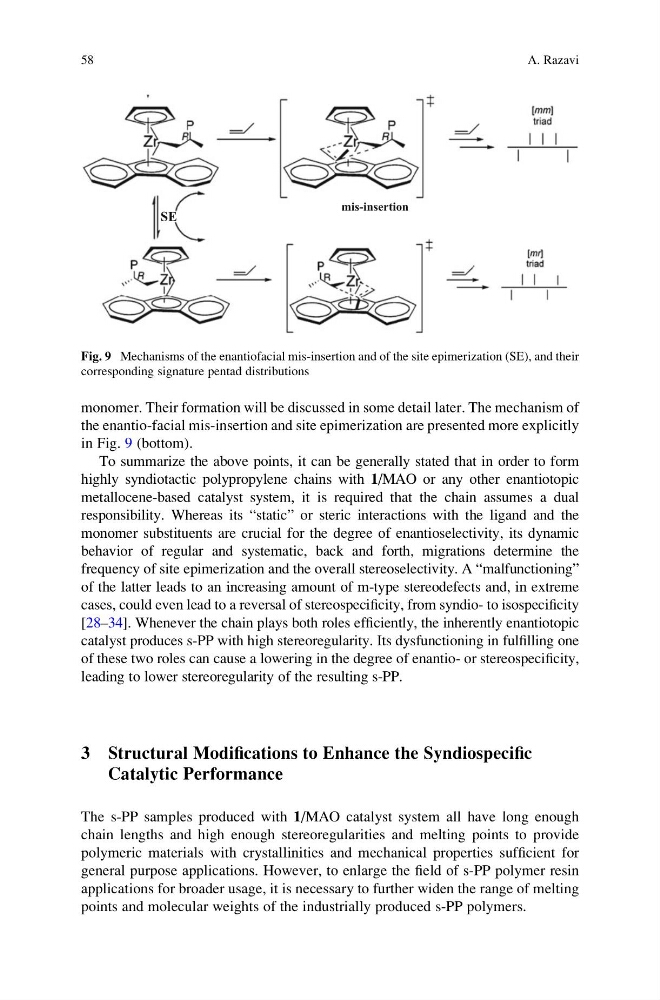
monomer. Their formation will be discussed in some detail later. The mechanism of
the enantio-facial mis-insertion and site epimerization are presented more explicitly
in Fig. 9 (bottom).
To summarize the above points, it can be generally stated that in order to form
highly syndiotactic polypropylene chains with 1/MAO or any other enantiotopic
metallocene-based catalyst system, it is required that the chain assumes a dual
responsibility. Whereas its “static” or steric interactions with the ligand and the
monomer substituents are crucial for the degree of enantioselectivity, its dynamic
behavior of regular and systematic, back and forth, migrations determine the
frequency of site epimerization and the overall stereoselectivity. A “malfunctioning”
of the latter leads to an increasing amount of m-type stereodefects and, in extreme
cases, could even lead to a reversal of stereospecificity, from syndio- to isospecificity
[28–34]. Whenever the chain plays both roles efficiently, the inherently enantiotopic
catalyst produces s-PP with high stereoregularity. Its dysfunctioning in fulfilling one
of these two roles can cause a lowering in the degree of enantio- or stereospecificity,
leading to lower stereoregularity of the resulting s-PP.
3 Structural Modifications to Enhance the Syndiospecific
Catalytic Performance
The s-PP samples produced with 1/MAO catalyst system all have long enough
chain lengths and high enough stereoregularities and melting points to provide
polymeric materials with crystallinities and mechanical properties sufficient for
general purpose applications. However, to enlarge the field of s-PP polymer resin
applications for broader usage, it is necessary to further widen the range of melting
points and molecular weights of the industrially produced s-PP polymers.
SE
mis-insertion
Fig. 9 Mechanisms of the enantiofacial mis-insertion and of the site epimerization (SE), and their
corresponding signature pentad distributions
58
A. Razavi
the enantio-facial mis-insertion and site epimerization are presented more explicitly
in Fig. 9 (bottom).
To summarize the above points, it can be generally stated that in order to form
highly syndiotactic polypropylene chains with 1/MAO or any other enantiotopic
metallocene-based catalyst system, it is required that the chain assumes a dual
responsibility. Whereas its “static” or steric interactions with the ligand and the
monomer substituents are crucial for the degree of enantioselectivity, its dynamic
behavior of regular and systematic, back and forth, migrations determine the
frequency of site epimerization and the overall stereoselectivity. A “malfunctioning”
of the latter leads to an increasing amount of m-type stereodefects and, in extreme
cases, could even lead to a reversal of stereospecificity, from syndio- to isospecificity
[28–34]. Whenever the chain plays both roles efficiently, the inherently enantiotopic
catalyst produces s-PP with high stereoregularity. Its dysfunctioning in fulfilling one
of these two roles can cause a lowering in the degree of enantio- or stereospecificity,
leading to lower stereoregularity of the resulting s-PP.
3 Structural Modifications to Enhance the Syndiospecific
Catalytic Performance
The s-PP samples produced with 1/MAO catalyst system all have long enough
chain lengths and high enough stereoregularities and melting points to provide
polymeric materials with crystallinities and mechanical properties sufficient for
general purpose applications. However, to enlarge the field of s-PP polymer resin
applications for broader usage, it is necessary to further widen the range of melting
points and molecular weights of the industrially produced s-PP polymers.
SE
mis-insertion
Fig. 9 Mechanisms of the enantiofacial mis-insertion and of the site epimerization (SE), and their
corresponding signature pentad distributions
58
A. Razavi