

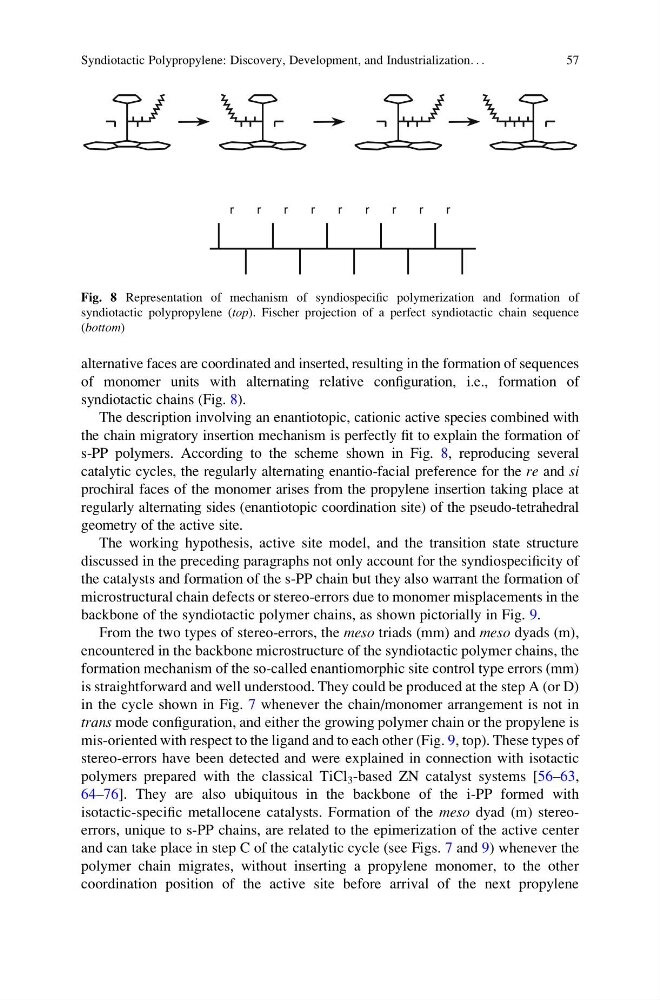
alternative faces are coordinated and inserted, resulting in the formation of sequences
of monomer units with alternating relative configuration, i.e., formation of
syndiotactic chains (Fig. 8).
The description involving an enantiotopic, cationic active species combined with
the chain migratory insertion mechanism is perfectly fit to explain the formation of
s-PP polymers. According to the scheme shown in Fig. 8, reproducing several
catalytic cycles, the regularly alternating enantio-facial preference for the re and si
prochiral faces of the monomer arises from the propylene insertion taking place at
regularly alternating sides (enantiotopic coordination site) of the pseudo-tetrahedral
geometry of the active site.
The working hypothesis, active site model, and the transition state structure
discussed in the preceding paragraphs not only account for the syndiospecificity of
the catalysts and formation of the s-PP chain but they also warrant the formation of
microstructural chain defects or stereo-errors due to monomer misplacements in the
backbone of the syndiotactic polymer chains, as shown pictorially in Fig. 9.
From the two types of stereo-errors, the meso triads (mm) and meso dyads (m),
encountered in the backbone microstructure of the syndiotactic polymer chains, the
formation mechanism of the so-called enantiomorphic site control type errors (mm)
is straightforward and well understood. They could be produced at the step A (or D)
in the cycle shown in Fig. 7 whenever the chain/monomer arrangement is not in
trans mode configuration, and either the growing polymer chain or the propylene is
mis-oriented with respect to the ligand and to each other (Fig. 9, top). These types of
stereo-errors have been detected and were explained in connection with isotactic
polymers prepared with the classical TiCl 3 -based ZN catalyst systems [56–63,
64–76]. They are also ubiquitous in the backbone of the i-PP formed with
isotactic-specific metallocene catalysts. Formation of the meso dyad (m) stereoerrors, unique to s-PP chains, are related to the epimerization of the active center
and can take place in step C of the catalytic cycle (see Figs. 7 and 9) whenever the
polymer chain migrates, without inserting a propylene monomer, to the other
coordination position of the active site before arrival of the next propylene
r
r
r
r
r
r
r
r
r
Fig. 8 Representation of mechanism of syndiospecific polymerization and formation of
syndiotactic polypropylene (top). Fischer projection of a perfect syndiotactic chain sequence
(bottom)
Syndiotactic Polypropylene: Discovery, Development, and Industrialization. . .
57
of monomer units with alternating relative configuration, i.e., formation of
syndiotactic chains (Fig. 8).
The description involving an enantiotopic, cationic active species combined with
the chain migratory insertion mechanism is perfectly fit to explain the formation of
s-PP polymers. According to the scheme shown in Fig. 8, reproducing several
catalytic cycles, the regularly alternating enantio-facial preference for the re and si
prochiral faces of the monomer arises from the propylene insertion taking place at
regularly alternating sides (enantiotopic coordination site) of the pseudo-tetrahedral
geometry of the active site.
The working hypothesis, active site model, and the transition state structure
discussed in the preceding paragraphs not only account for the syndiospecificity of
the catalysts and formation of the s-PP chain but they also warrant the formation of
microstructural chain defects or stereo-errors due to monomer misplacements in the
backbone of the syndiotactic polymer chains, as shown pictorially in Fig. 9.
From the two types of stereo-errors, the meso triads (mm) and meso dyads (m),
encountered in the backbone microstructure of the syndiotactic polymer chains, the
formation mechanism of the so-called enantiomorphic site control type errors (mm)
is straightforward and well understood. They could be produced at the step A (or D)
in the cycle shown in Fig. 7 whenever the chain/monomer arrangement is not in
trans mode configuration, and either the growing polymer chain or the propylene is
mis-oriented with respect to the ligand and to each other (Fig. 9, top). These types of
stereo-errors have been detected and were explained in connection with isotactic
polymers prepared with the classical TiCl 3 -based ZN catalyst systems [56–63,
64–76]. They are also ubiquitous in the backbone of the i-PP formed with
isotactic-specific metallocene catalysts. Formation of the meso dyad (m) stereoerrors, unique to s-PP chains, are related to the epimerization of the active center
and can take place in step C of the catalytic cycle (see Figs. 7 and 9) whenever the
polymer chain migrates, without inserting a propylene monomer, to the other
coordination position of the active site before arrival of the next propylene
r
r
r
r
r
r
r
r
r
Fig. 8 Representation of mechanism of syndiospecific polymerization and formation of
syndiotactic polypropylene (top). Fischer projection of a perfect syndiotactic chain sequence
(bottom)
Syndiotactic Polypropylene: Discovery, Development, and Industrialization. . .
57