

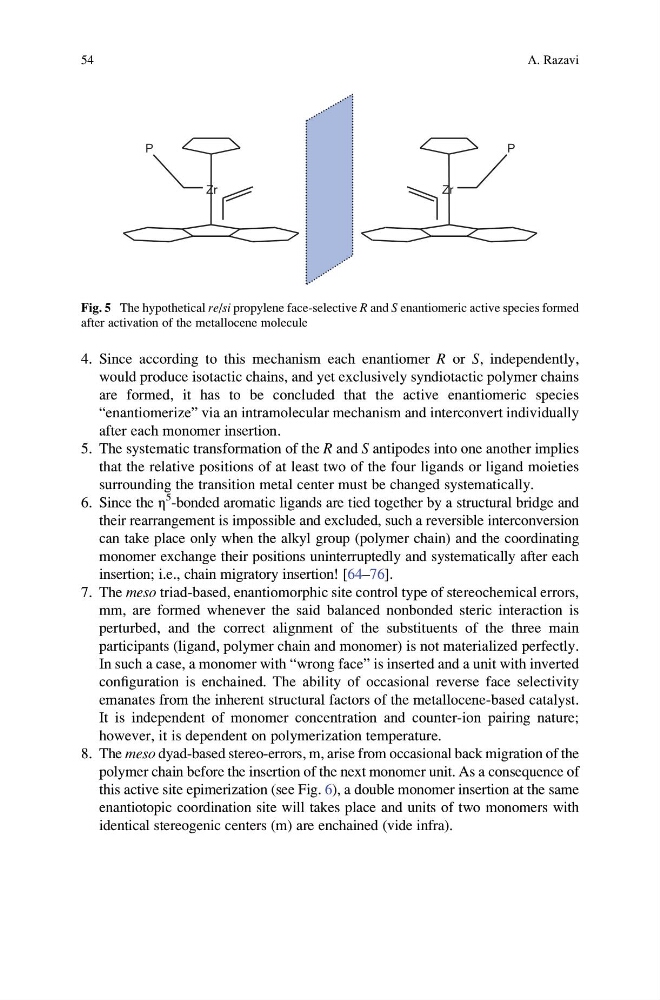
4. Since according to this mechanism each enantiomer R or S, independently,
would produce isotactic chains, and yet exclusively syndiotactic polymer chains
are formed, it has to be concluded that the active enantiomeric species
“enantiomerize” via an intramolecular mechanism and interconvert individually
after each monomer insertion.
5. The systematic transformation of the R and S antipodes into one another implies
that the relative positions of at least two of the four ligands or ligand moieties
surrounding the transition metal center must be changed systematically.
6. Since the η
5
-bonded aromatic ligands are tied together by a structural bridge and
their rearrangement is impossible and excluded, such a reversible interconversion
can take place only when the alkyl group (polymer chain) and the coordinating
monomer exchange their positions uninterruptedly and systematically after each
insertion; i.e., chain migratory insertion! [64–76].
7. The meso triad-based, enantiomorphic site control type of stereochemical errors,
mm, are formed whenever the said balanced nonbonded steric interaction is
perturbed, and the correct alignment of the substituents of the three main
participants (ligand, polymer chain and monomer) is not materialized perfectly.
In such a case, a monomer with “wrong face” is inserted and a unit with inverted
configuration is enchained. The ability of occasional reverse face selectivity
emanates from the inherent structural factors of the metallocene-based catalyst.
It is independent of monomer concentration and counter-ion pairing nature;
however, it is dependent on polymerization temperature.
8. The meso dyad-based stereo-errors, m, arise from occasional back migration of the
polymer chain before the insertion of the next monomer unit. As a consequence of
this active site epimerization (see Fig. 6), a double monomer insertion at the same
enantiotopic coordination site will takes place and units of two monomers with
identical stereogenic centers (m) are enchained (vide infra).
Zr
P
Zr
P
Fig. 5 The hypothetical re/si propylene face-selective R and S enantiomeric active species formed
after activation of the metallocene molecule
54
A. Razavi
would produce isotactic chains, and yet exclusively syndiotactic polymer chains
are formed, it has to be concluded that the active enantiomeric species
“enantiomerize” via an intramolecular mechanism and interconvert individually
after each monomer insertion.
5. The systematic transformation of the R and S antipodes into one another implies
that the relative positions of at least two of the four ligands or ligand moieties
surrounding the transition metal center must be changed systematically.
6. Since the η
5
-bonded aromatic ligands are tied together by a structural bridge and
their rearrangement is impossible and excluded, such a reversible interconversion
can take place only when the alkyl group (polymer chain) and the coordinating
monomer exchange their positions uninterruptedly and systematically after each
insertion; i.e., chain migratory insertion! [64–76].
7. The meso triad-based, enantiomorphic site control type of stereochemical errors,
mm, are formed whenever the said balanced nonbonded steric interaction is
perturbed, and the correct alignment of the substituents of the three main
participants (ligand, polymer chain and monomer) is not materialized perfectly.
In such a case, a monomer with “wrong face” is inserted and a unit with inverted
configuration is enchained. The ability of occasional reverse face selectivity
emanates from the inherent structural factors of the metallocene-based catalyst.
It is independent of monomer concentration and counter-ion pairing nature;
however, it is dependent on polymerization temperature.
8. The meso dyad-based stereo-errors, m, arise from occasional back migration of the
polymer chain before the insertion of the next monomer unit. As a consequence of
this active site epimerization (see Fig. 6), a double monomer insertion at the same
enantiotopic coordination site will takes place and units of two monomers with
identical stereogenic centers (m) are enchained (vide infra).
Zr
P
Zr
P
Fig. 5 The hypothetical re/si propylene face-selective R and S enantiomeric active species formed
after activation of the metallocene molecule
54
A. Razavi