

fluorenyl, and/or cylopentadienyl moieties it is possible to create new catalysts
systems that can produce s-PP polymers with increased molecular weights, stereoregularities, and melting points. The ligand modifications can bring about, in certain
cases, even a change in the tactic behavior of the resulting catalysts, leading to the
development of a whole range of new polypropylene macromolecules whose chain
tacticities include hemi-isotactic and stereoblock in addition to syndiotactic and
isotactic [28–34].
2 Bridged Cyclopentadienyl-Fluorenyl Metallocene
Molecules
In late 1987, a simple coupling reaction between the reagent 6,6-dimethylfuvene
and the fluorenyl anion in tetrahydrofuran (THF) led to the formation of
2-cyclopentadienyl-2-fluorenyl-propane, a new bi-functional ligand whose double
deprotonation with an alkyl lithium, and subsequent reaction with MCl 4
(M ¼ Zr, Hf) resulted in the successful synthesis of two bridged metallocene
molecules, (η
5
-C 5 H 4 -μ-CMe 2 -η
5
-C 13 H 8 ) MCl 2 , where M ¼ Zr (1) or M ¼ Hf (2).
Complexes 1 and 2, after their activation with methylaluminoxane (MAO), become
very active catalysts for olefin polymerization. More importantly, they promote the
catalytic polymerization of propylene to highly syndiotactic polypropylene.
Complexes 1 and 2 have been characterized by single-crystal X-ray diffraction
methods and NMR spectroscopy [19, 20]. Figure 2 presents two different perspective
views of the molecular structures of 1 and 2 as determined by single-crystal X-ray
diffraction. The structural characteristics of these two complexes were discussed at
length soon after their discovery in a series of publications [18–27, 28–34]. However,
some of the prominent structural features that are relevant to their catalytic performance with respect to stereoselective propylene polymerization are reiterated here
with an emphasis on the zirconium-based complex 1 as an example.
The fact that the metallocene complexes 1 and 2 are active for olefin polymerization was, of course, of no surprise; Kaminsky and Sinn had discovered in the
mid-1970s that MAO obtained from partial hydrolysis of tri-methylaluminum
(TMA) could activate metallocene dichloride complexes to very efficient olefin
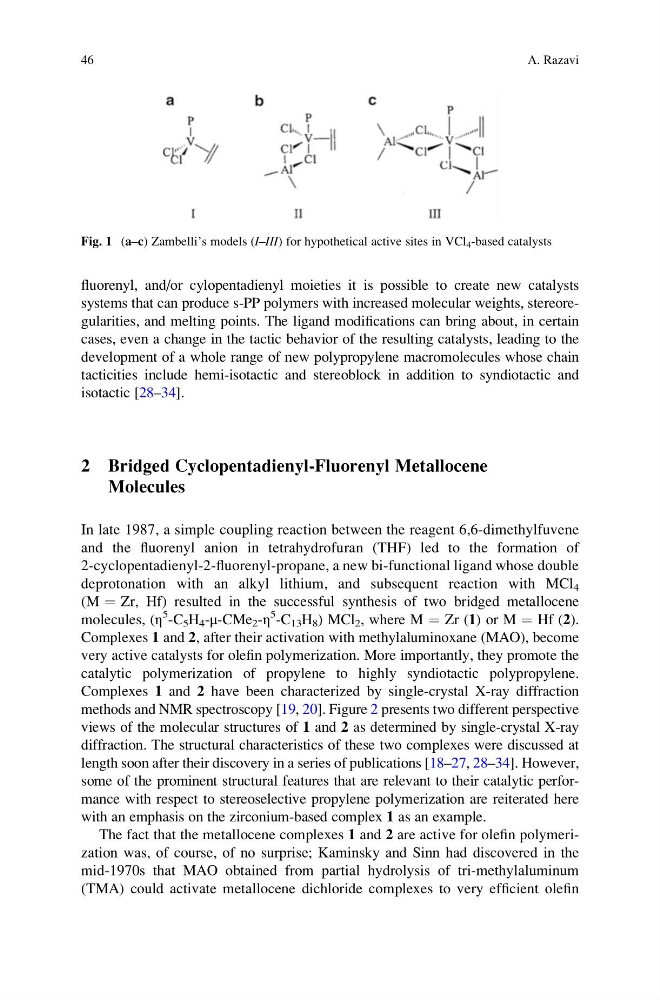
Fig. 1 (a–c) Zambelli’s models (I–III) for hypothetical active sites in VCl 4 -based catalysts
46
A. Razavi
systems that can produce s-PP polymers with increased molecular weights, stereoregularities, and melting points. The ligand modifications can bring about, in certain
cases, even a change in the tactic behavior of the resulting catalysts, leading to the
development of a whole range of new polypropylene macromolecules whose chain
tacticities include hemi-isotactic and stereoblock in addition to syndiotactic and
isotactic [28–34].
2 Bridged Cyclopentadienyl-Fluorenyl Metallocene
Molecules
In late 1987, a simple coupling reaction between the reagent 6,6-dimethylfuvene
and the fluorenyl anion in tetrahydrofuran (THF) led to the formation of
2-cyclopentadienyl-2-fluorenyl-propane, a new bi-functional ligand whose double
deprotonation with an alkyl lithium, and subsequent reaction with MCl 4
(M ¼ Zr, Hf) resulted in the successful synthesis of two bridged metallocene
molecules, (η
5
-C 5 H 4 -μ-CMe 2 -η
5
-C 13 H 8 ) MCl 2 , where M ¼ Zr (1) or M ¼ Hf (2).
Complexes 1 and 2, after their activation with methylaluminoxane (MAO), become
very active catalysts for olefin polymerization. More importantly, they promote the
catalytic polymerization of propylene to highly syndiotactic polypropylene.
Complexes 1 and 2 have been characterized by single-crystal X-ray diffraction
methods and NMR spectroscopy [19, 20]. Figure 2 presents two different perspective
views of the molecular structures of 1 and 2 as determined by single-crystal X-ray
diffraction. The structural characteristics of these two complexes were discussed at
length soon after their discovery in a series of publications [18–27, 28–34]. However,
some of the prominent structural features that are relevant to their catalytic performance with respect to stereoselective propylene polymerization are reiterated here
with an emphasis on the zirconium-based complex 1 as an example.
The fact that the metallocene complexes 1 and 2 are active for olefin polymerization was, of course, of no surprise; Kaminsky and Sinn had discovered in the
mid-1970s that MAO obtained from partial hydrolysis of tri-methylaluminum
(TMA) could activate metallocene dichloride complexes to very efficient olefin
Fig. 1 (a–c) Zambelli’s models (I–III) for hypothetical active sites in VCl 4 -based catalysts
46
A. Razavi