

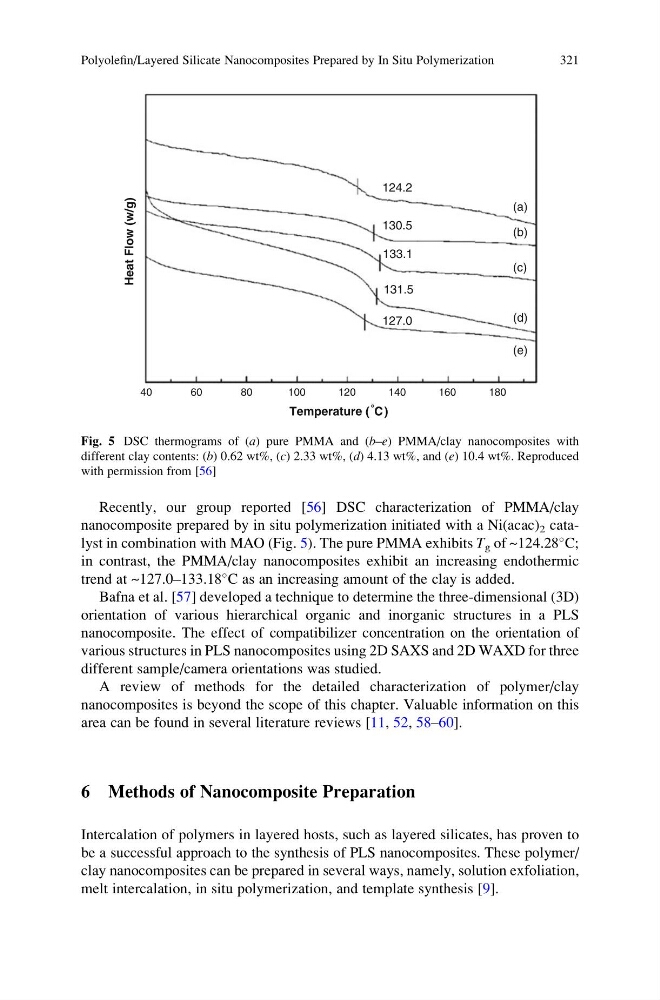
Recently, our group reported [56] DSC characterization of PMMA/clay
nanocomposite prepared by in situ polymerization initiated with a Ni(acac) 2 catalyst in combination with MAO (Fig. 5). The pure PMMA exhibits T g of ~124.28
C;
in contrast, the PMMA/clay nanocomposites exhibit an increasing endothermic
trend at ~127.0–133.18
C as an increasing amount of the clay is added.
Bafna et al. [57] developed a technique to determine the three-dimensional (3D)
orientation of various hierarchical organic and inorganic structures in a PLS
nanocomposite. The effect of compatibilizer concentration on the orientation of
various structures in PLS nanocomposites using 2D SAXS and 2D WAXD for three
different sample/camera orientations was studied.
A review of methods for the detailed characterization of polymer/clay
nanocomposites is beyond the scope of this chapter. Valuable information on this
area can be found in several literature reviews [11, 52, 58–60].
6 Methods of Nanocomposite Preparation
Intercalation of polymers in layered hosts, such as layered silicates, has proven to
be a successful approach to the synthesis of PLS nanocomposites. These polymer/
clay nanocomposites can be prepared in several ways, namely, solution exfoliation,
melt intercalation, in situ polymerization, and template synthesis [9].
Temperature (
∞ C)
120
Heat Flow (w/g)
40
60
80
100
140
160
180
124.2
130.5
133.1
131.5
127.0
(a)
(b)
(c)
(d)
(e)
Fig. 5 DSC thermograms of (a) pure PMMA and (b–e) PMMA/clay nanocomposites with
different clay contents: (b) 0.62 wt%, (c) 2.33 wt%, (d) 4.13 wt%, and (e) 10.4 wt%. Reproduced
with permission from [56]
Polyolefin/Layered Silicate Nanocomposites Prepared by In Situ Polymerization
321
nanocomposite prepared by in situ polymerization initiated with a Ni(acac) 2 catalyst in combination with MAO (Fig. 5). The pure PMMA exhibits T g of ~124.28
C;
in contrast, the PMMA/clay nanocomposites exhibit an increasing endothermic
trend at ~127.0–133.18
C as an increasing amount of the clay is added.
Bafna et al. [57] developed a technique to determine the three-dimensional (3D)
orientation of various hierarchical organic and inorganic structures in a PLS
nanocomposite. The effect of compatibilizer concentration on the orientation of
various structures in PLS nanocomposites using 2D SAXS and 2D WAXD for three
different sample/camera orientations was studied.
A review of methods for the detailed characterization of polymer/clay
nanocomposites is beyond the scope of this chapter. Valuable information on this
area can be found in several literature reviews [11, 52, 58–60].
6 Methods of Nanocomposite Preparation
Intercalation of polymers in layered hosts, such as layered silicates, has proven to
be a successful approach to the synthesis of PLS nanocomposites. These polymer/
clay nanocomposites can be prepared in several ways, namely, solution exfoliation,
melt intercalation, in situ polymerization, and template synthesis [9].
Temperature (
∞ C)
120
Heat Flow (w/g)
40
60
80
100
140
160
180
124.2
130.5
133.1
131.5
127.0
(a)
(b)
(c)
(d)
(e)
Fig. 5 DSC thermograms of (a) pure PMMA and (b–e) PMMA/clay nanocomposites with
different clay contents: (b) 0.62 wt%, (c) 2.33 wt%, (d) 4.13 wt%, and (e) 10.4 wt%. Reproduced
with permission from [56]
Polyolefin/Layered Silicate Nanocomposites Prepared by In Situ Polymerization
321