

to produce single and multilayer graphenes upon shearing [155–163]. In supercritical carbon dioxide, graphite is intercalated, causing graphite expansion when
the pressure is released [164, 165]. In mechanical delamination processes, graphene
is exfoliated by grinding of graphite [166–168].
The graphite polymerization filling technique was pioneered by Dubois who
successfully employed micron-sized graphite fillers to produce thermoplastic polyethylene/graphite composites with an effective filler dispersion [169]. However, in
non-polar media, even in the presence of catalysts, graphite is not intercalated and
does not produce dispersed graphene. Therefore, several groups have exploited FGs
as intermediates for polymerization filling, thus producing FG/polyolefin
composites such as FG/HDPE [170–172], FG/LDPE [173], FG/LLDPE [174],
and FG/iPP [175], as well as UHMWPE containing nitrogen-doped graphene
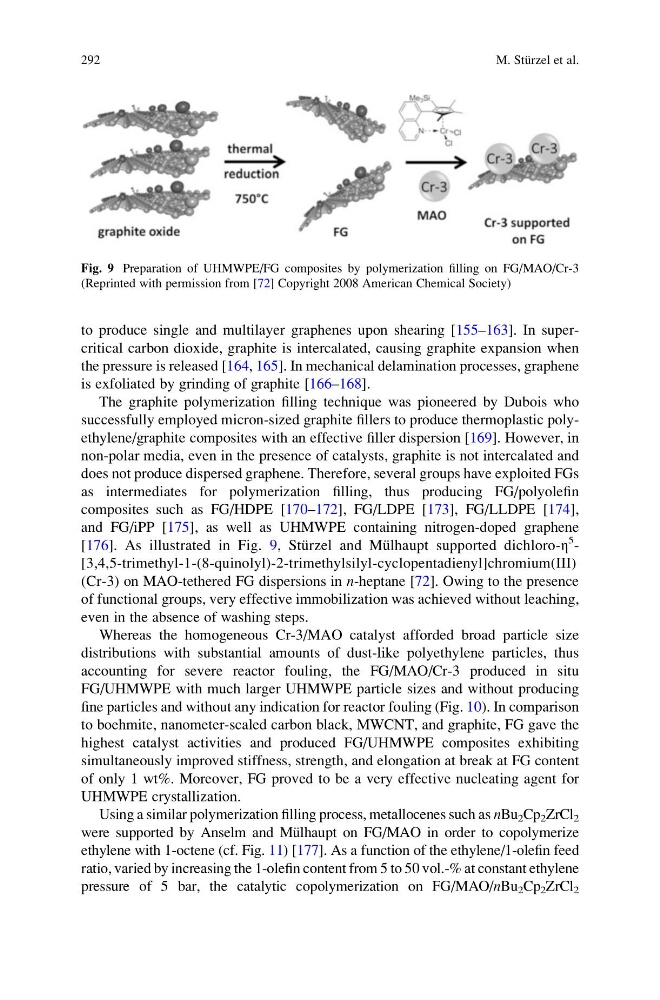
[176]. As illustrated in Fig. 9, Stu ¨rzel and Mu ¨lhaupt supported dichloro-η
5 -
[3,4,5-trimethyl-1-(8-quinolyl)-2-trimethylsilyl-cyclopentadienyl]chromium(III)
(Cr-3) on MAO-tethered FG dispersions in n-heptane [72]. Owing to the presence
of functional groups, very effective immobilization was achieved without leaching,
even in the absence of washing steps.
Whereas the homogeneous Cr-3/MAO catalyst afforded broad particle size
distributions with substantial amounts of dust-like polyethylene particles, thus
accounting for severe reactor fouling, the FG/MAO/Cr-3 produced in situ
FG/UHMWPE with much larger UHMWPE particle sizes and without producing
fine particles and without any indication for reactor fouling (Fig. 10). In comparison
to boehmite, nanometer-scaled carbon black, MWCNT, and graphite, FG gave the
highest catalyst activities and produced FG/UHMWPE composites exhibiting
simultaneously improved stiffness, strength, and elongation at break at FG content
of only 1 wt%. Moreover, FG proved to be a very effective nucleating agent for
UHMWPE crystallization.
Using a similar polymerization filling process, metallocenes such as nBu 2 Cp 2 ZrCl 2
were supported by Anselm and Mu ¨lhaupt on FG/MAO in order to copolymerize
ethylene with 1-octene (cf. Fig. 11) [177]. As a function of the ethylene/1-olefin feed
ratio, varied by increasing the 1-olefin content from 5 to 50 vol.-% at constant ethylene
pressure of 5 bar, the catalytic copolymerization on FG/MAO/nBu 2 Cp 2 ZrCl 2
Fig. 9 Preparation of UHMWPE/FG composites by polymerization filling on FG/MAO/Cr-3
(Reprinted with permission from [72] Copyright 2008 American Chemical Society)
292
M. Stu ¨rzel et al.
the pressure is released [164, 165]. In mechanical delamination processes, graphene
is exfoliated by grinding of graphite [166–168].
The graphite polymerization filling technique was pioneered by Dubois who
successfully employed micron-sized graphite fillers to produce thermoplastic polyethylene/graphite composites with an effective filler dispersion [169]. However, in
non-polar media, even in the presence of catalysts, graphite is not intercalated and
does not produce dispersed graphene. Therefore, several groups have exploited FGs
as intermediates for polymerization filling, thus producing FG/polyolefin
composites such as FG/HDPE [170–172], FG/LDPE [173], FG/LLDPE [174],
and FG/iPP [175], as well as UHMWPE containing nitrogen-doped graphene
[176]. As illustrated in Fig. 9, Stu ¨rzel and Mu ¨lhaupt supported dichloro-η
5 -
[3,4,5-trimethyl-1-(8-quinolyl)-2-trimethylsilyl-cyclopentadienyl]chromium(III)
(Cr-3) on MAO-tethered FG dispersions in n-heptane [72]. Owing to the presence
of functional groups, very effective immobilization was achieved without leaching,
even in the absence of washing steps.
Whereas the homogeneous Cr-3/MAO catalyst afforded broad particle size
distributions with substantial amounts of dust-like polyethylene particles, thus
accounting for severe reactor fouling, the FG/MAO/Cr-3 produced in situ
FG/UHMWPE with much larger UHMWPE particle sizes and without producing
fine particles and without any indication for reactor fouling (Fig. 10). In comparison
to boehmite, nanometer-scaled carbon black, MWCNT, and graphite, FG gave the
highest catalyst activities and produced FG/UHMWPE composites exhibiting
simultaneously improved stiffness, strength, and elongation at break at FG content
of only 1 wt%. Moreover, FG proved to be a very effective nucleating agent for
UHMWPE crystallization.
Using a similar polymerization filling process, metallocenes such as nBu 2 Cp 2 ZrCl 2
were supported by Anselm and Mu ¨lhaupt on FG/MAO in order to copolymerize
ethylene with 1-octene (cf. Fig. 11) [177]. As a function of the ethylene/1-olefin feed
ratio, varied by increasing the 1-olefin content from 5 to 50 vol.-% at constant ethylene
pressure of 5 bar, the catalytic copolymerization on FG/MAO/nBu 2 Cp 2 ZrCl 2
Fig. 9 Preparation of UHMWPE/FG composites by polymerization filling on FG/MAO/Cr-3
(Reprinted with permission from [72] Copyright 2008 American Chemical Society)
292
M. Stu ¨rzel et al.