

to build up pressure between the layers, causing expansion and exfoliation of
graphene. The resulting functionalized graphene (FG) has an accordion-like architecture. Preferably, the functional groups are allocated at the edges of graphene and
of graphene defects such as nanometer-sized holes (cf. Fig. 7), formed during
thermolysis. This process is paralleled by a substantial increase in the specific
surface area well above 600 m
2 /g, approaching the specific surface area of ideal
graphene (2,630 m
2 /g). The oxygen content, reflecting the presence of functional
groups, decreases from 40% to below 1% when increasing the temperature from
300
C to above 1000
C [142, 143], while simultaneously the electrical conductivity
increases. Upon shearing, preferably in low viscosity media, individual FG are
dispersed, as reflected by a massive increase in the specific surface area above
1,500 m
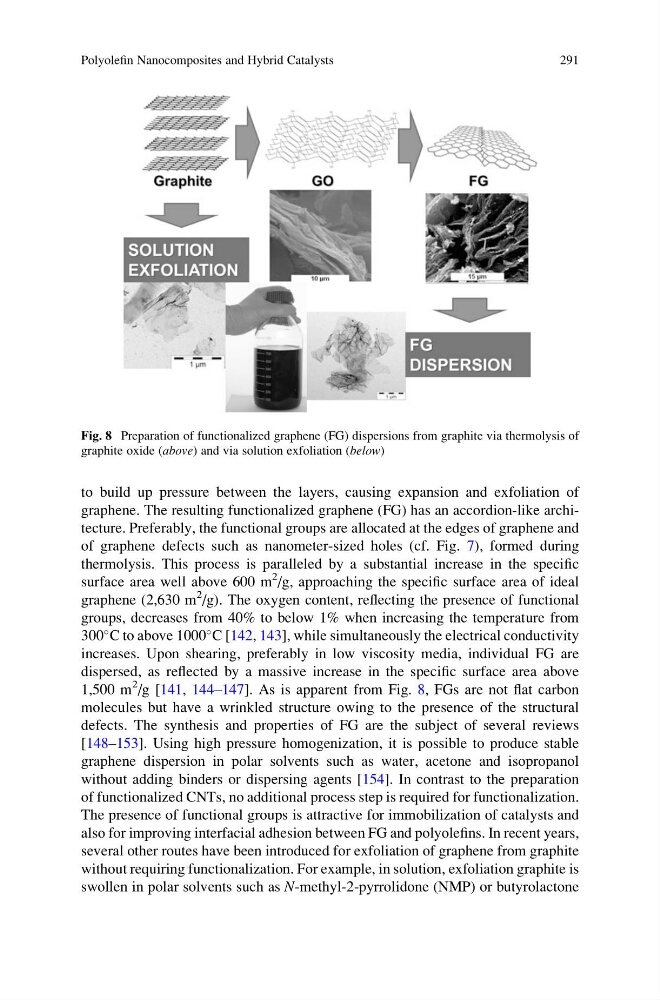
2 /g [141, 144–147]. As is apparent from Fig. 8, FGs are not flat carbon
molecules but have a wrinkled structure owing to the presence of the structural
defects. The synthesis and properties of FG are the subject of several reviews
[148–153]. Using high pressure homogenization, it is possible to produce stable
graphene dispersion in polar solvents such as water, acetone and isopropanol
without adding binders or dispersing agents [154]. In contrast to the preparation
of functionalized CNTs, no additional process step is required for functionalization.
The presence of functional groups is attractive for immobilization of catalysts and
also for improving interfacial adhesion between FG and polyolefins. In recent years,
several other routes have been introduced for exfoliation of graphene from graphite
without requiring functionalization. For example, in solution, exfoliation graphite is
swollen in polar solvents such as N-methyl-2-pyrrolidone (NMP) or butyrolactone
Fig. 8 Preparation of functionalized graphene (FG) dispersions from graphite via thermolysis of
graphite oxide (above) and via solution exfoliation (below)
Polyolefin Nanocomposites and Hybrid Catalysts
291
graphene. The resulting functionalized graphene (FG) has an accordion-like architecture. Preferably, the functional groups are allocated at the edges of graphene and
of graphene defects such as nanometer-sized holes (cf. Fig. 7), formed during
thermolysis. This process is paralleled by a substantial increase in the specific
surface area well above 600 m
2 /g, approaching the specific surface area of ideal
graphene (2,630 m
2 /g). The oxygen content, reflecting the presence of functional
groups, decreases from 40% to below 1% when increasing the temperature from
300
C to above 1000
C [142, 143], while simultaneously the electrical conductivity
increases. Upon shearing, preferably in low viscosity media, individual FG are
dispersed, as reflected by a massive increase in the specific surface area above
1,500 m
2 /g [141, 144–147]. As is apparent from Fig. 8, FGs are not flat carbon
molecules but have a wrinkled structure owing to the presence of the structural
defects. The synthesis and properties of FG are the subject of several reviews
[148–153]. Using high pressure homogenization, it is possible to produce stable
graphene dispersion in polar solvents such as water, acetone and isopropanol
without adding binders or dispersing agents [154]. In contrast to the preparation
of functionalized CNTs, no additional process step is required for functionalization.
The presence of functional groups is attractive for immobilization of catalysts and
also for improving interfacial adhesion between FG and polyolefins. In recent years,
several other routes have been introduced for exfoliation of graphene from graphite
without requiring functionalization. For example, in solution, exfoliation graphite is
swollen in polar solvents such as N-methyl-2-pyrrolidone (NMP) or butyrolactone
Fig. 8 Preparation of functionalized graphene (FG) dispersions from graphite via thermolysis of
graphite oxide (above) and via solution exfoliation (below)
Polyolefin Nanocomposites and Hybrid Catalysts
291