

[20, 28]. When MAO activates the catalyst prior to contact with filler, the resulting
catalyst is much more sensitive to catalyst poisoning by such surface groups.
Therefore, non-polar fillers are preferred when injecting the pre-activated catalyst
into the filler suspension [20]. In both approaches high catalyst activities are
required. Increased demand of catalysts and activating alkyls, paralleled by lower
catalyst activities and much higher catalyst residues, can adversely affect polyolefin
oxidative stability. The metal alkyls located on the filler surface are fairly stable but
are slowly oxidized upon exposure to air. Hence, the resulting peroxides consume
the polymer antioxidants, such as sterically hindered phenols during melt
processing, thus impairing long-term stability and processing of polyolefins.
A large variety of nanometer-scaled fillers have been employed, ranging from
inorganic nanoparticles such as silica to organophilic modified nanoparticles
including organoclay and boehmite. Ongoing research exploits the impact of
“nanomolecules” polyhedral oligomeric silsesquioxane (POSS) and graphene
(cf. Fig. 2). Whereas most in situ polymerization processes require non-polar
reaction media, Mecking et al. succeeded in preparing nanocomposites by means
of in situ ethylene polymerization in aqueous dispersions using aqueous dispersions
of nanosilica from the Sto ¨ber process together with water-borne catalyst
systems [29].
During the in situ polymerization, the filler is dispersed in the polymerization
media prior to injection of the activated catalyst component. Upon initiating olefin
polymerization, the polyolefin is formed at the filler surface, thus encapsulating the
filler particles. In the polymerization filling technique the (nano)fillers are used as
catalyst supports. Preferably, a washing step assures that all catalyst is immobilized
on the filler surface and no homogeneous catalysts are formed as byproduct by
leaching. The origins of polymerization filling date back to the early days of
Ziegler–Natta catalysis. For example, in 1964 Ziegler catalysts were supported on
cellulose to produce cellulose/polyolefin composites [30]. Since then a great variety
of fillers have been used, including graphite, metals, metal oxide, and silicates
[16]. For instance, Howard at Du Pont prepared highly filled UHMWPE composites
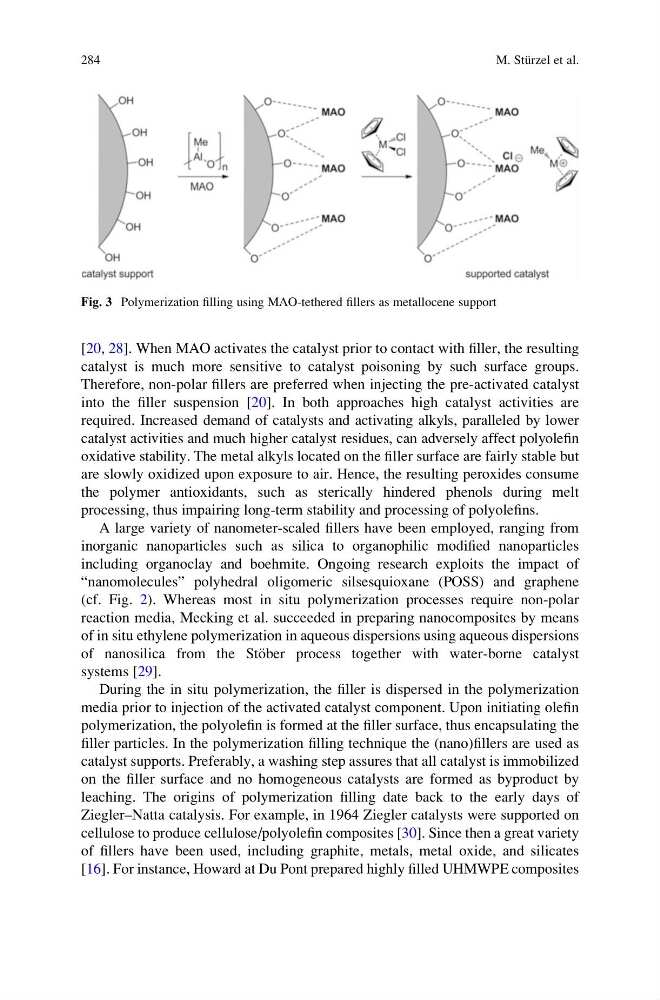
Fig. 3 Polymerization filling using MAO-tethered fillers as metallocene support
284
M. Stu ¨rzel et al.
catalyst is much more sensitive to catalyst poisoning by such surface groups.
Therefore, non-polar fillers are preferred when injecting the pre-activated catalyst
into the filler suspension [20]. In both approaches high catalyst activities are
required. Increased demand of catalysts and activating alkyls, paralleled by lower
catalyst activities and much higher catalyst residues, can adversely affect polyolefin
oxidative stability. The metal alkyls located on the filler surface are fairly stable but
are slowly oxidized upon exposure to air. Hence, the resulting peroxides consume
the polymer antioxidants, such as sterically hindered phenols during melt
processing, thus impairing long-term stability and processing of polyolefins.
A large variety of nanometer-scaled fillers have been employed, ranging from
inorganic nanoparticles such as silica to organophilic modified nanoparticles
including organoclay and boehmite. Ongoing research exploits the impact of
“nanomolecules” polyhedral oligomeric silsesquioxane (POSS) and graphene
(cf. Fig. 2). Whereas most in situ polymerization processes require non-polar
reaction media, Mecking et al. succeeded in preparing nanocomposites by means
of in situ ethylene polymerization in aqueous dispersions using aqueous dispersions
of nanosilica from the Sto ¨ber process together with water-borne catalyst
systems [29].
During the in situ polymerization, the filler is dispersed in the polymerization
media prior to injection of the activated catalyst component. Upon initiating olefin
polymerization, the polyolefin is formed at the filler surface, thus encapsulating the
filler particles. In the polymerization filling technique the (nano)fillers are used as
catalyst supports. Preferably, a washing step assures that all catalyst is immobilized
on the filler surface and no homogeneous catalysts are formed as byproduct by
leaching. The origins of polymerization filling date back to the early days of
Ziegler–Natta catalysis. For example, in 1964 Ziegler catalysts were supported on
cellulose to produce cellulose/polyolefin composites [30]. Since then a great variety
of fillers have been used, including graphite, metals, metal oxide, and silicates
[16]. For instance, Howard at Du Pont prepared highly filled UHMWPE composites
Fig. 3 Polymerization filling using MAO-tethered fillers as metallocene support
284
M. Stu ¨rzel et al.