

When using conducting nanofillers, the lower percolation threshold accounts for
electrical conductivity at a fraction of conventional fillers. Percolation of highly
anisotropic sheet-like nanofillers and their orientation in multilayer assemblies can
simultaneously improve dimensional stability, stiffness, strength, toughness, electrical conductivity, and barrier resistance. Although controlled assembly of
nanostructures is highly desirable, uncontrolled assembly and formation of large
agglomerates is highly detrimental to mechanical as well as functional properties,
causing premature mechanical failure at low stresses. Figure 2 displays important
members of nanoparticle families used for in situ composite formation. Moreover,
it should be mentioned that phase-separated polyolefin crystals of one- and
two-dimensionally aligned polyolefins are also highly effective reinforcement
agents.
In principle, two strategies are feasible for producing polyolefin nanocomposites
by means of polymerization catalysis. In the first strategy, referred to as in situ
polymerization, nanoparticles are added during catalytic polymerization. In a
variation of this strategy, in situ composite formation, nanoparticles serve as
catalyst support. The latter approach was named by Dubois as “polymerization
filling technique” [13–18]. Since in both processes polyolefins are formed on the
surface of the nanofillers, the nanoparticles are encapsulated in a polyolefin shell,
thus promoting nanoparticle dispersion by preventing their agglomeration. It is
important that nanoparticle-supported catalysts do not impair control of polyolefin
morphology, as reflected by the formation of micron-sized polyolefin particles. In
fact, the formation of sub-micron polyolefin particles can account for severe reactor
fouling and even explosion hazards when dust-like, highly electrically insulating
polyolefin nanoparticles are exposed to air and ignited by electrical discharge. Only
the effective immobilization of catalysts on the filler surface prevents catalyst
leaching, which can cause the severe reactor fouling typical for homogeneous
catalysts.
In the second strategy, oriented crystallization of polyolefins, the production of
in situ polyolefin (nano)fibers or (nano)sheets affords molecular polyolefin
composites and effective polyolefin matrix reinforcement without requiring any
alien fiber or fillers. Moreover, polyolefin reactor blends containing ultrahigh
molecular weight (UHMW) polyolefin can produce in situ UHMW polyolefin
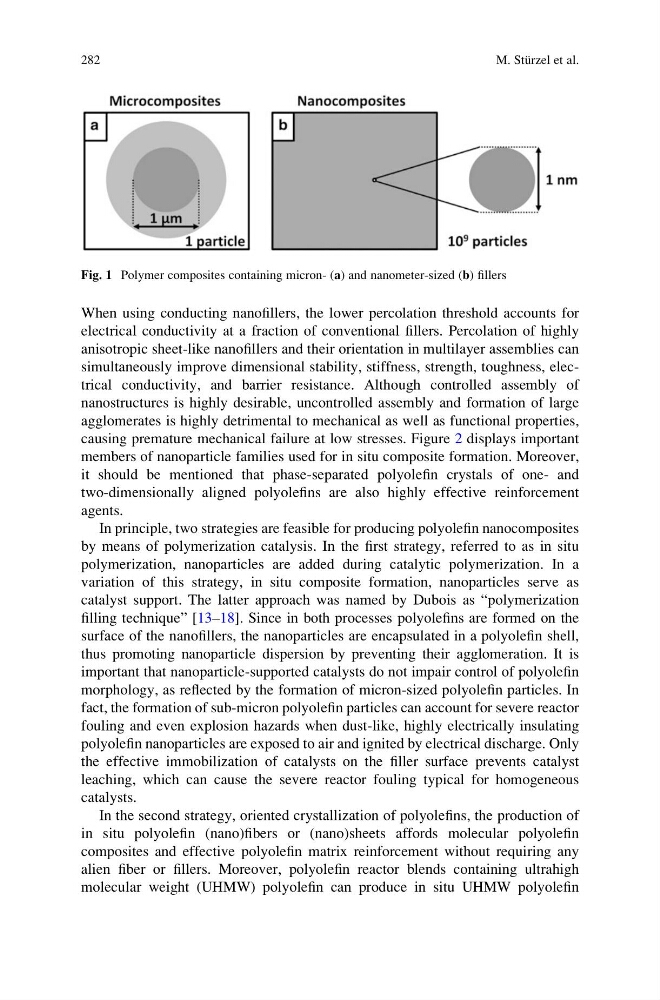
Fig. 1 Polymer composites containing micron- (a) and nanometer-sized (b) fillers
282
M. Stu ¨rzel et al.
electrical conductivity at a fraction of conventional fillers. Percolation of highly
anisotropic sheet-like nanofillers and their orientation in multilayer assemblies can
simultaneously improve dimensional stability, stiffness, strength, toughness, electrical conductivity, and barrier resistance. Although controlled assembly of
nanostructures is highly desirable, uncontrolled assembly and formation of large
agglomerates is highly detrimental to mechanical as well as functional properties,
causing premature mechanical failure at low stresses. Figure 2 displays important
members of nanoparticle families used for in situ composite formation. Moreover,
it should be mentioned that phase-separated polyolefin crystals of one- and
two-dimensionally aligned polyolefins are also highly effective reinforcement
agents.
In principle, two strategies are feasible for producing polyolefin nanocomposites
by means of polymerization catalysis. In the first strategy, referred to as in situ
polymerization, nanoparticles are added during catalytic polymerization. In a
variation of this strategy, in situ composite formation, nanoparticles serve as
catalyst support. The latter approach was named by Dubois as “polymerization
filling technique” [13–18]. Since in both processes polyolefins are formed on the
surface of the nanofillers, the nanoparticles are encapsulated in a polyolefin shell,
thus promoting nanoparticle dispersion by preventing their agglomeration. It is
important that nanoparticle-supported catalysts do not impair control of polyolefin
morphology, as reflected by the formation of micron-sized polyolefin particles. In
fact, the formation of sub-micron polyolefin particles can account for severe reactor
fouling and even explosion hazards when dust-like, highly electrically insulating
polyolefin nanoparticles are exposed to air and ignited by electrical discharge. Only
the effective immobilization of catalysts on the filler surface prevents catalyst
leaching, which can cause the severe reactor fouling typical for homogeneous
catalysts.
In the second strategy, oriented crystallization of polyolefins, the production of
in situ polyolefin (nano)fibers or (nano)sheets affords molecular polyolefin
composites and effective polyolefin matrix reinforcement without requiring any
alien fiber or fillers. Moreover, polyolefin reactor blends containing ultrahigh
molecular weight (UHMW) polyolefin can produce in situ UHMW polyolefin
Fig. 1 Polymer composites containing micron- (a) and nanometer-sized (b) fillers
282
M. Stu ¨rzel et al.