

exhibited very poor incorporation of styrenic monomers. Although Me 2 Si
(Ind) 2 ZrCl 2 and[C 5 Me 4 (SiMe 2 N
t
Bu)]TiCl 2 , with open active sites, can incorporate
styrene, the copolymers produced are largely insoluble. Evidently, both olefinic
groups in DVB involve an enchainment reaction to form the crosslinked PE
products. On the other hand, rac-Et(Ind) 2 ZrCl 2 /MAO is a suitable catalyst that
shows good DVB incorporation. All poly(ethylene-co-1,4-divinylbenzene)
copolymers obtained were completely soluble in common organic solvents, such
as toluene and xylene, at elevated temperatures.
Figure 6 shows GPC curves of several ethylene/DVB copolymers. The polymer
molecular weight systematically decreases with increasing DVB content, due to the
lower polymerization reactivity of styrene and the increased rate of the chain transfer
reaction after 2,1-insertion of the styrene unit. All copolymers exhibit narrow
molecular weight distribution (M w /M n ~ 2.3), implying a single-site polymerization
mechanism. Figure 7 shows an
1 H NMR spectrum of poly(ethylene-co-1,4divinylbenzene) containing 7.2 mol% DVB units. In addition to the major peak at
1.3 ppm corresponding to ethylene units, several chemical shifts were observed at
5.2 and 5.7 ppm (doublet, CH¼CH 2 ) and 6.7 ppm (doublet of doublet, CH¼CH 2 );
aromatic proton peaks occurred at 7.1 and 7.4 ppm (C 6 H 4 ). The peak intensity ratios
indicate that the mole ratio of the vinyl group to the phenyl group is near unity.
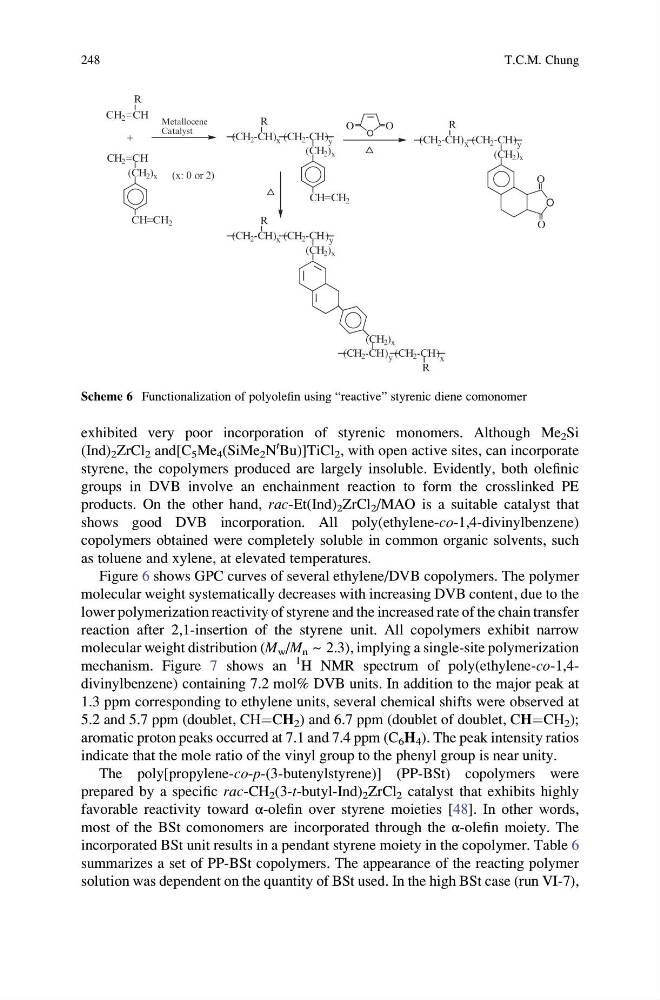
The poly[propylene-co-p-(3-butenylstyrene)] (PP-BSt) copolymers were
prepared by a specific rac-CH 2 (3-t-butyl-Ind) 2 ZrCl 2 catalyst that exhibits highly
favorable reactivity toward α-olefin over styrene moieties [48]. In other words,
most of the BSt comonomers are incorporated through the α-olefin moiety. The
incorporated BSt unit results in a pendant styrene moiety in the copolymer. Table 6
summarizes a set of PP-BSt copolymers. The appearance of the reacting polymer
solution was dependent on the quantity of BSt used. In the high BSt case (run VI-7),
CH 2 =CH
R
CH 2 =CH
CH=CH 2
(CH 2 ) x (x: 0 or 2)
+
(CH 2 -CH) (CH 2 -CH)
R
CH=CH 2
(CH 2 ) x
x
y
Metallocene
Catalyst
(CH 2 -CH) (CH 2 -CH)
R
(CH 2 ) x
x
y
O
O
O
O
O
O
(CH 2 -CH) (CH 2 -CH)
R
(CH 2 ) x
x
y
(CH 2 -CH) (CH 2 -CH)
R
(CH 2 ) x
x
y
Scheme 6 Functionalization of polyolefin using “reactive” styrenic diene comonomer
248
T.C.M. Chung
(Ind) 2 ZrCl 2 and[C 5 Me 4 (SiMe 2 N
t
Bu)]TiCl 2 , with open active sites, can incorporate
styrene, the copolymers produced are largely insoluble. Evidently, both olefinic
groups in DVB involve an enchainment reaction to form the crosslinked PE
products. On the other hand, rac-Et(Ind) 2 ZrCl 2 /MAO is a suitable catalyst that
shows good DVB incorporation. All poly(ethylene-co-1,4-divinylbenzene)
copolymers obtained were completely soluble in common organic solvents, such
as toluene and xylene, at elevated temperatures.
Figure 6 shows GPC curves of several ethylene/DVB copolymers. The polymer
molecular weight systematically decreases with increasing DVB content, due to the
lower polymerization reactivity of styrene and the increased rate of the chain transfer
reaction after 2,1-insertion of the styrene unit. All copolymers exhibit narrow
molecular weight distribution (M w /M n ~ 2.3), implying a single-site polymerization
mechanism. Figure 7 shows an
1 H NMR spectrum of poly(ethylene-co-1,4divinylbenzene) containing 7.2 mol% DVB units. In addition to the major peak at
1.3 ppm corresponding to ethylene units, several chemical shifts were observed at
5.2 and 5.7 ppm (doublet, CH¼CH 2 ) and 6.7 ppm (doublet of doublet, CH¼CH 2 );
aromatic proton peaks occurred at 7.1 and 7.4 ppm (C 6 H 4 ). The peak intensity ratios
indicate that the mole ratio of the vinyl group to the phenyl group is near unity.
The poly[propylene-co-p-(3-butenylstyrene)] (PP-BSt) copolymers were
prepared by a specific rac-CH 2 (3-t-butyl-Ind) 2 ZrCl 2 catalyst that exhibits highly
favorable reactivity toward α-olefin over styrene moieties [48]. In other words,
most of the BSt comonomers are incorporated through the α-olefin moiety. The
incorporated BSt unit results in a pendant styrene moiety in the copolymer. Table 6
summarizes a set of PP-BSt copolymers. The appearance of the reacting polymer
solution was dependent on the quantity of BSt used. In the high BSt case (run VI-7),
CH 2 =CH
R
CH 2 =CH
CH=CH 2
(CH 2 ) x (x: 0 or 2)
+
(CH 2 -CH) (CH 2 -CH)
R
CH=CH 2
(CH 2 ) x
x
y
Metallocene
Catalyst
(CH 2 -CH) (CH 2 -CH)
R
(CH 2 ) x
x
y
O
O
O
O
O
O
(CH 2 -CH) (CH 2 -CH)
R
(CH 2 ) x
x
y
(CH 2 -CH) (CH 2 -CH)
R
(CH 2 ) x
x
y
Scheme 6 Functionalization of polyolefin using “reactive” styrenic diene comonomer
248
T.C.M. Chung