

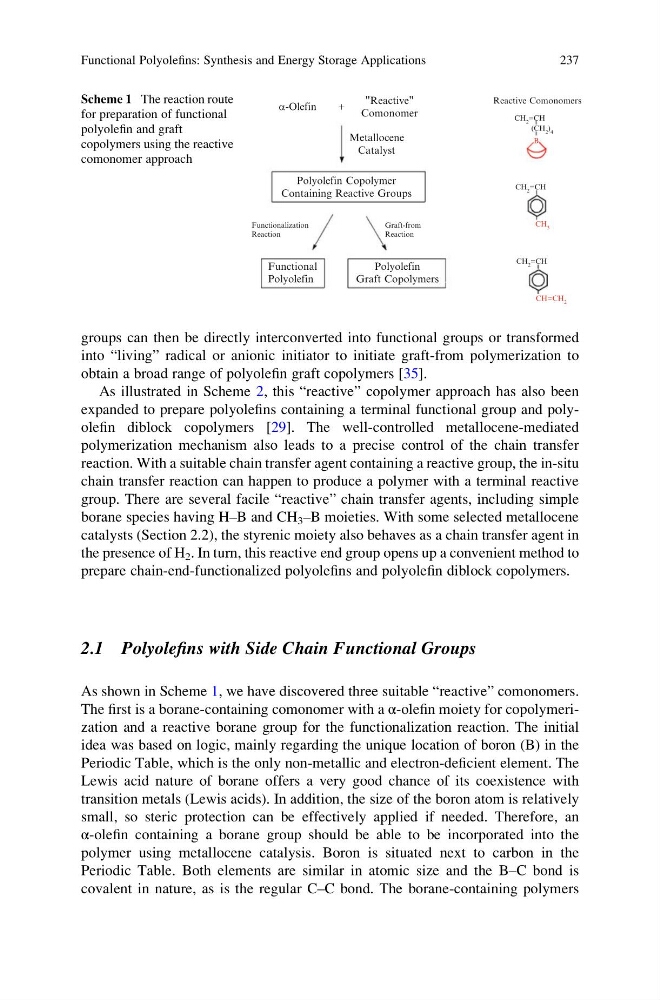
groups can then be directly interconverted into functional groups or transformed
into “living” radical or anionic initiator to initiate graft-from polymerization to
obtain a broad range of polyolefin graft copolymers [35].
As illustrated in Scheme 2, this “reactive” copolymer approach has also been
expanded to prepare polyolefins containing a terminal functional group and polyolefin diblock copolymers [29]. The well-controlled metallocene-mediated
polymerization mechanism also leads to a precise control of the chain transfer
reaction. With a suitable chain transfer agent containing a reactive group, the in-situ
chain transfer reaction can happen to produce a polymer with a terminal reactive
group. There are several facile “reactive” chain transfer agents, including simple
borane species having H–B and CH 3 –B moieties. With some selected metallocene
catalysts (Section 2.2), the styrenic moiety also behaves as a chain transfer agent in
the presence of H 2 . In turn, this reactive end group opens up a convenient method to
prepare chain-end-functionalized polyolefins and polyolefin diblock copolymers.
2.1 Polyolefins with Side Chain Functional Groups
As shown in Scheme 1, we have discovered three suitable “reactive” comonomers.
The first is a borane-containing comonomer with a α-olefin moiety for copolymerization and a reactive borane group for the functionalization reaction. The initial
idea was based on logic, mainly regarding the unique location of boron (B) in the
Periodic Table, which is the only non-metallic and electron-deficient element. The
Lewis acid nature of borane offers a very good chance of its coexistence with
transition metals (Lewis acids). In addition, the size of the boron atom is relatively
small, so steric protection can be effectively applied if needed. Therefore, an
α-olefin containing a borane group should be able to be incorporated into the
polymer using metallocene catalysis. Boron is situated next to carbon in the
Periodic Table. Both elements are similar in atomic size and the B–C bond is
covalent in nature, as is the regular C–C bond. The borane-containing polymers
α-Olefin
"Reactive"
Comonomer
Metallocene
Catalyst
+
Polyolefin Copolymer
Containing Reactive Groups
Functionalization
Reaction
Graft-from
Reaction
Functional
Polyolefin
Polyolefin
Graft Copolymers
Reactive Comonomers
CH 2 =CH
CH 2 =CH
CH 2 =CH
CH=CH 2
(CH 2 ) 4
CH 3
B
Scheme 1 The reaction route
for preparation of functional
polyolefin and graft
copolymers using the reactive
comonomer approach
Functional Polyolefins: Synthesis and Energy Storage Applications
237
into “living” radical or anionic initiator to initiate graft-from polymerization to
obtain a broad range of polyolefin graft copolymers [35].
As illustrated in Scheme 2, this “reactive” copolymer approach has also been
expanded to prepare polyolefins containing a terminal functional group and polyolefin diblock copolymers [29]. The well-controlled metallocene-mediated
polymerization mechanism also leads to a precise control of the chain transfer
reaction. With a suitable chain transfer agent containing a reactive group, the in-situ
chain transfer reaction can happen to produce a polymer with a terminal reactive
group. There are several facile “reactive” chain transfer agents, including simple
borane species having H–B and CH 3 –B moieties. With some selected metallocene
catalysts (Section 2.2), the styrenic moiety also behaves as a chain transfer agent in
the presence of H 2 . In turn, this reactive end group opens up a convenient method to
prepare chain-end-functionalized polyolefins and polyolefin diblock copolymers.
2.1 Polyolefins with Side Chain Functional Groups
As shown in Scheme 1, we have discovered three suitable “reactive” comonomers.
The first is a borane-containing comonomer with a α-olefin moiety for copolymerization and a reactive borane group for the functionalization reaction. The initial
idea was based on logic, mainly regarding the unique location of boron (B) in the
Periodic Table, which is the only non-metallic and electron-deficient element. The
Lewis acid nature of borane offers a very good chance of its coexistence with
transition metals (Lewis acids). In addition, the size of the boron atom is relatively
small, so steric protection can be effectively applied if needed. Therefore, an
α-olefin containing a borane group should be able to be incorporated into the
polymer using metallocene catalysis. Boron is situated next to carbon in the
Periodic Table. Both elements are similar in atomic size and the B–C bond is
covalent in nature, as is the regular C–C bond. The borane-containing polymers
α-Olefin
"Reactive"
Comonomer
Metallocene
Catalyst
+
Polyolefin Copolymer
Containing Reactive Groups
Functionalization
Reaction
Graft-from
Reaction
Functional
Polyolefin
Polyolefin
Graft Copolymers
Reactive Comonomers
CH 2 =CH
CH 2 =CH
CH 2 =CH
CH=CH 2
(CH 2 ) 4
CH 3
B
Scheme 1 The reaction route
for preparation of functional
polyolefin and graft
copolymers using the reactive
comonomer approach
Functional Polyolefins: Synthesis and Energy Storage Applications
237