

4.1.2 Copolymerization Behavior of Nitrogen-Functional Alkenes
Thirteen differently substituted long-chain amide- and amine-functional
comonomers (Fig. 15) were studied in ethylene and propylene copolymerizations
carried out with catalyst rac-Et(Ind) 2 ZrCl 2 (for ethylene) or rac-Me 2 Si
(2-MeInd) 2 ZrCl 2 (for propylene) [22]. As for the oxygen-functional comonomers,
MAO was used as cocatalyst. Amide-functional comonomers were found to depress
the catalyst activity even with high excess of MAO (Al/comonomer 40–80 mol/mol).
Slightly less poisonous were monomers 19 and 20, which contain active hydrogens
OH
OH
OH
4
6
5
OH
OH
7
8
O
12
O
Si
13
OH
O
O
O
16
15
O
O
O
17
18
9
OH
10
OH
11
OH
O
14
Si
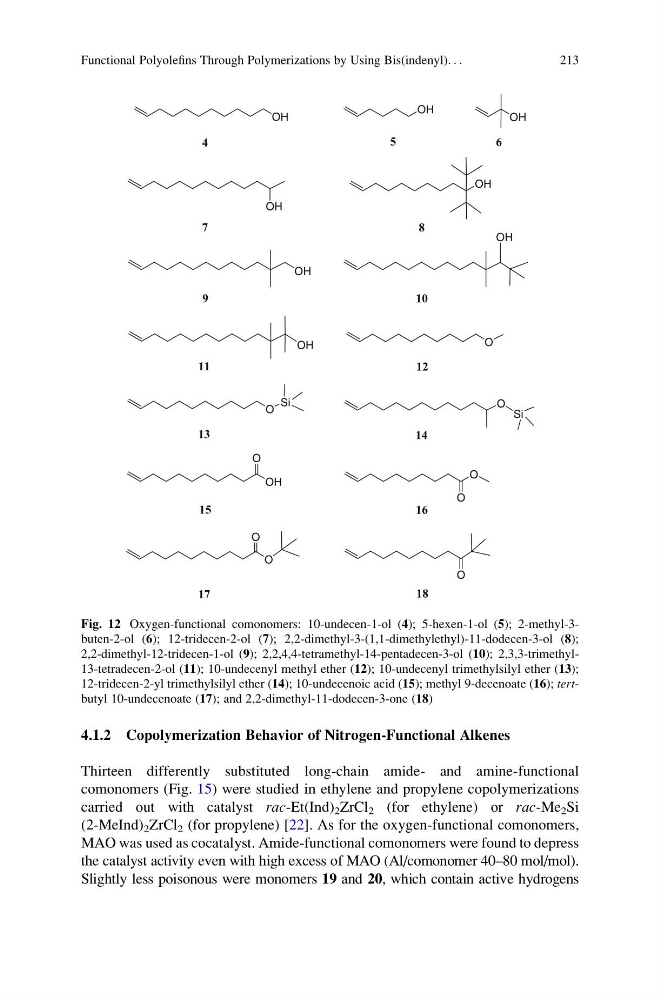
Fig. 12 Oxygen-functional comonomers: 10-undecen-1-ol (4); 5-hexen-1-ol (5); 2-methyl-3buten-2-ol (6); 12-tridecen-2-ol (7); 2,2-dimethyl-3-(1,1-dimethylethyl)-11-dodecen-3-ol (8);
2,2-dimethyl-12-tridecen-1-ol (9); 2,2,4,4-tetramethyl-14-pentadecen-3-ol (10); 2,3,3-trimethyl13-tetradecen-2-ol (11); 10-undecenyl methyl ether (12); 10-undecenyl trimethylsilyl ether (13);
12-tridecen-2-yl trimethylsilyl ether (14); 10-undecenoic acid (15); methyl 9-decenoate (16); tertbutyl 10-undecenoate (17); and 2,2-dimethyl-11-dodecen-3-one (18)
Functional Polyolefins Through Polymerizations by Using Bis(indenyl). . .
213
Thirteen differently substituted long-chain amide- and amine-functional
comonomers (Fig. 15) were studied in ethylene and propylene copolymerizations
carried out with catalyst rac-Et(Ind) 2 ZrCl 2 (for ethylene) or rac-Me 2 Si
(2-MeInd) 2 ZrCl 2 (for propylene) [22]. As for the oxygen-functional comonomers,
MAO was used as cocatalyst. Amide-functional comonomers were found to depress
the catalyst activity even with high excess of MAO (Al/comonomer 40–80 mol/mol).
Slightly less poisonous were monomers 19 and 20, which contain active hydrogens
OH
OH
OH
4
6
5
OH
OH
7
8
O
12
O
Si
13
OH
O
O
O
16
15
O
O
O
17
18
9
OH
10
OH
11
OH
O
14
Si
Fig. 12 Oxygen-functional comonomers: 10-undecen-1-ol (4); 5-hexen-1-ol (5); 2-methyl-3buten-2-ol (6); 12-tridecen-2-ol (7); 2,2-dimethyl-3-(1,1-dimethylethyl)-11-dodecen-3-ol (8);
2,2-dimethyl-12-tridecen-1-ol (9); 2,2,4,4-tetramethyl-14-pentadecen-3-ol (10); 2,3,3-trimethyl13-tetradecen-2-ol (11); 10-undecenyl methyl ether (12); 10-undecenyl trimethylsilyl ether (13);
12-tridecen-2-yl trimethylsilyl ether (14); 10-undecenoic acid (15); methyl 9-decenoate (16); tertbutyl 10-undecenoate (17); and 2,2-dimethyl-11-dodecen-3-one (18)
Functional Polyolefins Through Polymerizations by Using Bis(indenyl). . .
213