

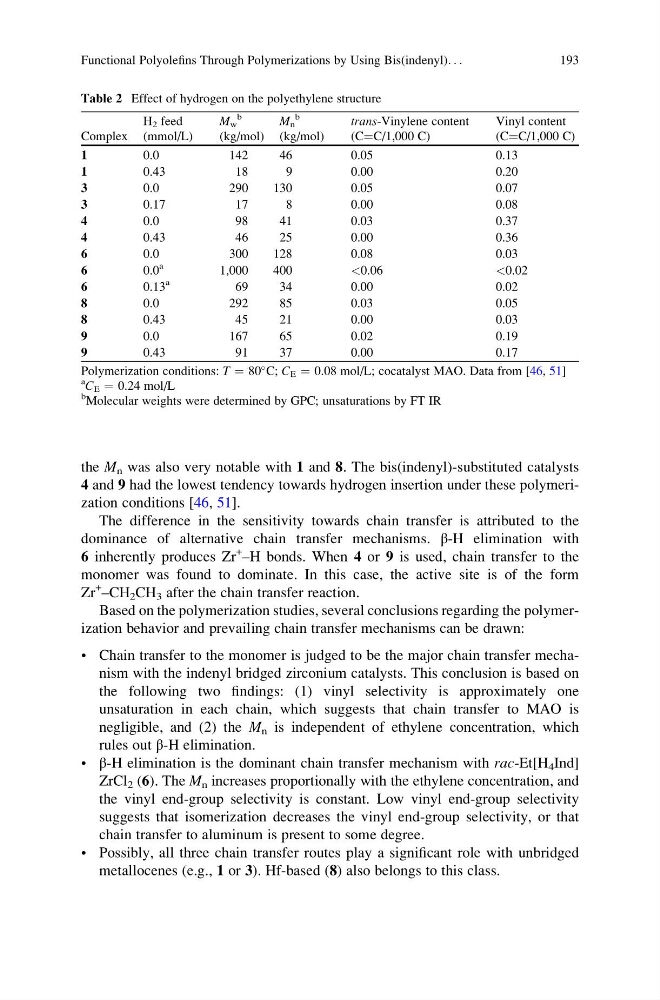
the M n was also very notable with 1 and 8. The bis(indenyl)-substituted catalysts
4 and 9 had the lowest tendency towards hydrogen insertion under these polymerization conditions [46, 51].
The difference in the sensitivity towards chain transfer is attributed to the
dominance of alternative chain transfer mechanisms. β-H elimination with
6 inherently produces Zr
+
–H bonds. When 4 or 9 is used, chain transfer to the
monomer was found to dominate. In this case, the active site is of the form
Zr
+
–CH 2 CH 3 after the chain transfer reaction.
Based on the polymerization studies, several conclusions regarding the polymerization behavior and prevailing chain transfer mechanisms can be drawn:
• Chain transfer to the monomer is judged to be the major chain transfer mechanism with the indenyl bridged zirconium catalysts. This conclusion is based on
the following two findings: (1) vinyl selectivity is approximately one
unsaturation in each chain, which suggests that chain transfer to MAO is
negligible, and (2) the M n is independent of ethylene concentration, which
rules out β-H elimination.
• β-H elimination is the dominant chain transfer mechanism with rac-Et[H 4 Ind]
ZrCl 2 (6). The M n increases proportionally with the ethylene concentration, and
the vinyl end-group selectivity is constant. Low vinyl end-group selectivity
suggests that isomerization decreases the vinyl end-group selectivity, or that
chain transfer to aluminum is present to some degree.
• Possibly, all three chain transfer routes play a significant role with unbridged
metallocenes (e.g., 1 or 3). Hf-based (8) also belongs to this class.
Table 2 Effect of hydrogen on the polyethylene structure
Complex
H 2 feed
(mmol/L)
M w
b
(kg/mol)
M n
b
(kg/mol)
trans-Vinylene content
(C¼C/1,000 C)
Vinyl content
(C¼C/1,000 C)
1
0.0
142
46
0.05
0.13
1
0.43
18
9
0.00
0.20
3
0.0
290
130
0.05
0.07
3
0.17
17
8
0.00
0.08
4
0.0
98
41
0.03
0.37
4
0.43
46
25
0.00
0.36
6
0.0
300
128
0.08
0.03
6
0.0
a
1,000
400
<0.06
<0.02
6
0.13
a
69
34
0.00
0.02
8
0.0
292
85
0.03
0.05
8
0.43
45
21
0.00
0.03
9
0.0
167
65
0.02
0.19
9
0.43
91
37
0.00
0.17
Polymerization conditions: T ¼ 80
C; C E ¼ 0.08 mol/L; cocatalyst MAO. Data from [46, 51]
a
C E ¼ 0.24 mol/L
b
Molecular weights were determined by GPC; unsaturations by FT IR
Functional Polyolefins Through Polymerizations by Using Bis(indenyl). . .
193
4 and 9 had the lowest tendency towards hydrogen insertion under these polymerization conditions [46, 51].
The difference in the sensitivity towards chain transfer is attributed to the
dominance of alternative chain transfer mechanisms. β-H elimination with
6 inherently produces Zr
+
–H bonds. When 4 or 9 is used, chain transfer to the
monomer was found to dominate. In this case, the active site is of the form
Zr
+
–CH 2 CH 3 after the chain transfer reaction.
Based on the polymerization studies, several conclusions regarding the polymerization behavior and prevailing chain transfer mechanisms can be drawn:
• Chain transfer to the monomer is judged to be the major chain transfer mechanism with the indenyl bridged zirconium catalysts. This conclusion is based on
the following two findings: (1) vinyl selectivity is approximately one
unsaturation in each chain, which suggests that chain transfer to MAO is
negligible, and (2) the M n is independent of ethylene concentration, which
rules out β-H elimination.
• β-H elimination is the dominant chain transfer mechanism with rac-Et[H 4 Ind]
ZrCl 2 (6). The M n increases proportionally with the ethylene concentration, and
the vinyl end-group selectivity is constant. Low vinyl end-group selectivity
suggests that isomerization decreases the vinyl end-group selectivity, or that
chain transfer to aluminum is present to some degree.
• Possibly, all three chain transfer routes play a significant role with unbridged
metallocenes (e.g., 1 or 3). Hf-based (8) also belongs to this class.
Table 2 Effect of hydrogen on the polyethylene structure
Complex
H 2 feed
(mmol/L)
M w
b
(kg/mol)
M n
b
(kg/mol)
trans-Vinylene content
(C¼C/1,000 C)
Vinyl content
(C¼C/1,000 C)
1
0.0
142
46
0.05
0.13
1
0.43
18
9
0.00
0.20
3
0.0
290
130
0.05
0.07
3
0.17
17
8
0.00
0.08
4
0.0
98
41
0.03
0.37
4
0.43
46
25
0.00
0.36
6
0.0
300
128
0.08
0.03
6
0.0
a
1,000
400
<0.06
<0.02
6
0.13
a
69
34
0.00
0.02
8
0.0
292
85
0.03
0.05
8
0.43
45
21
0.00
0.03
9
0.0
167
65
0.02
0.19
9
0.43
91
37
0.00
0.17
Polymerization conditions: T ¼ 80
C; C E ¼ 0.08 mol/L; cocatalyst MAO. Data from [46, 51]
a
C E ¼ 0.24 mol/L
b
Molecular weights were determined by GPC; unsaturations by FT IR
Functional Polyolefins Through Polymerizations by Using Bis(indenyl). . .
193