

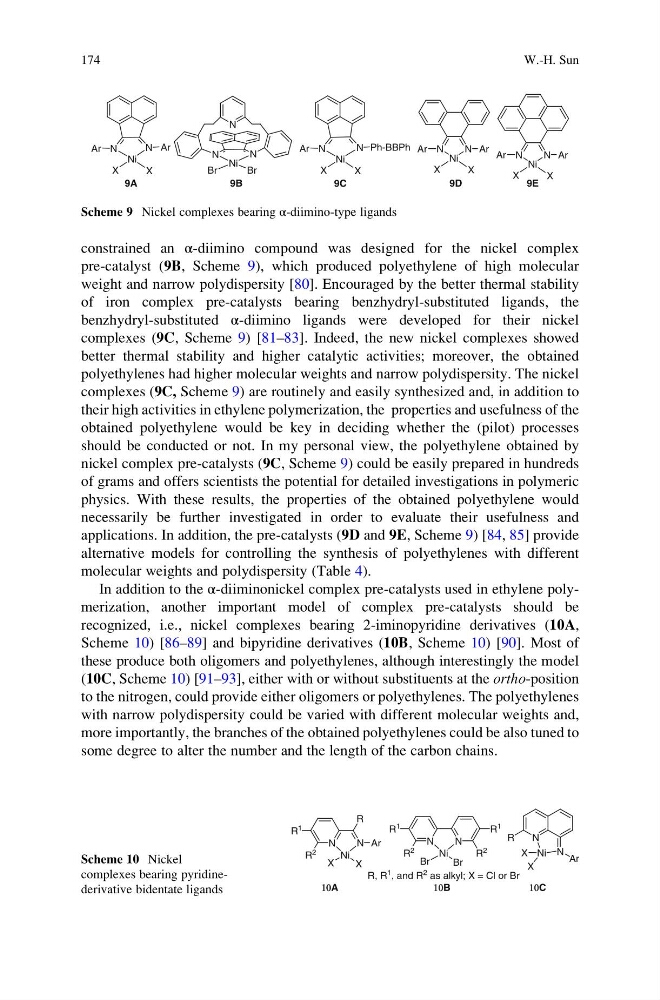
constrained an α-diimino compound was designed for the nickel complex
pre-catalyst (9B, Scheme 9), which produced polyethylene of high molecular
weight and narrow polydispersity [80]. Encouraged by the better thermal stability
of iron complex pre-catalysts bearing benzhydryl-substituted ligands, the
benzhydryl-substituted α-diimino ligands were developed for their nickel
complexes (9C, Scheme 9) [81–83]. Indeed, the new nickel complexes showed
better thermal stability and higher catalytic activities; moreover, the obtained
polyethylenes had higher molecular weights and narrow polydispersity. The nickel
complexes (9C, Scheme 9) are routinely and easily synthesized and, in addition to
their high activities in ethylene polymerization, the properties and usefulness of the
obtained polyethylene would be key in deciding whether the (pilot) processes
should be conducted or not. In my personal view, the polyethylene obtained by
nickel complex pre-catalysts (9C, Scheme 9) could be easily prepared in hundreds
of grams and offers scientists the potential for detailed investigations in polymeric
physics. With these results, the properties of the obtained polyethylene would
necessarily be further investigated in order to evaluate their usefulness and
applications. In addition, the pre-catalysts (9D and 9E, Scheme 9) [84, 85] provide
alternative models for controlling the synthesis of polyethylenes with different
molecular weights and polydispersity (Table 4).
In addition to the α-diiminonickel complex pre-catalysts used in ethylene polymerization, another important model of complex pre-catalysts should be
recognized, i.e., nickel complexes bearing 2-iminopyridine derivatives (10A,
Scheme 10) [86–89] and bipyridine derivatives (10B, Scheme 10) [90]. Most of
these produce both oligomers and polyethylenes, although interestingly the model
(10C, Scheme 10) [91–93], either with or without substituents at the ortho-position
to the nitrogen, could provide either oligomers or polyethylenes. The polyethylenes
with narrow polydispersity could be varied with different molecular weights and,
more importantly, the branches of the obtained polyethylenes could be also tuned to
some degree to alter the number and the length of the carbon chains.
N
N
Ar
Ar
Ni
X
X
N
N
Ni
Br
Br
N
N
N
Ar
Ph-BBPh
Ni
X
X
N
N
Ar
Ar
Ni
X
X
N
N
Ar
Ar
Ni
X
X
9A
9B
9C
9D
9E
Scheme 9 Nickel complexes bearing α-diimino-type ligands
N
N
R
Ar
Ni
R
1
R
2
X
X
N
N
R
1
R
2
R
1
R
2
N
R
N
Ni
Ar
Br
Br
X
X Ni
10A
10B
10C
R, R
1 , and R
2 as alkyl; X = Cl or Br
Scheme 10 Nickel
complexes bearing pyridinederivative bidentate ligands
174
W.-H. Sun
pre-catalyst (9B, Scheme 9), which produced polyethylene of high molecular
weight and narrow polydispersity [80]. Encouraged by the better thermal stability
of iron complex pre-catalysts bearing benzhydryl-substituted ligands, the
benzhydryl-substituted α-diimino ligands were developed for their nickel
complexes (9C, Scheme 9) [81–83]. Indeed, the new nickel complexes showed
better thermal stability and higher catalytic activities; moreover, the obtained
polyethylenes had higher molecular weights and narrow polydispersity. The nickel
complexes (9C, Scheme 9) are routinely and easily synthesized and, in addition to
their high activities in ethylene polymerization, the properties and usefulness of the
obtained polyethylene would be key in deciding whether the (pilot) processes
should be conducted or not. In my personal view, the polyethylene obtained by
nickel complex pre-catalysts (9C, Scheme 9) could be easily prepared in hundreds
of grams and offers scientists the potential for detailed investigations in polymeric
physics. With these results, the properties of the obtained polyethylene would
necessarily be further investigated in order to evaluate their usefulness and
applications. In addition, the pre-catalysts (9D and 9E, Scheme 9) [84, 85] provide
alternative models for controlling the synthesis of polyethylenes with different
molecular weights and polydispersity (Table 4).
In addition to the α-diiminonickel complex pre-catalysts used in ethylene polymerization, another important model of complex pre-catalysts should be
recognized, i.e., nickel complexes bearing 2-iminopyridine derivatives (10A,
Scheme 10) [86–89] and bipyridine derivatives (10B, Scheme 10) [90]. Most of
these produce both oligomers and polyethylenes, although interestingly the model
(10C, Scheme 10) [91–93], either with or without substituents at the ortho-position
to the nitrogen, could provide either oligomers or polyethylenes. The polyethylenes
with narrow polydispersity could be varied with different molecular weights and,
more importantly, the branches of the obtained polyethylenes could be also tuned to
some degree to alter the number and the length of the carbon chains.
N
N
Ar
Ar
Ni
X
X
N
N
Ni
Br
Br
N
N
N
Ar
Ph-BBPh
Ni
X
X
N
N
Ar
Ar
Ni
X
X
N
N
Ar
Ar
Ni
X
X
9A
9B
9C
9D
9E
Scheme 9 Nickel complexes bearing α-diimino-type ligands
N
N
R
Ar
Ni
R
1
R
2
X
X
N
N
R
1
R
2
R
1
R
2
N
R
N
Ni
Ar
Br
Br
X
X Ni
10A
10B
10C
R, R
1 , and R
2 as alkyl; X = Cl or Br
Scheme 10 Nickel
complexes bearing pyridinederivative bidentate ligands
174
W.-H. Sun