

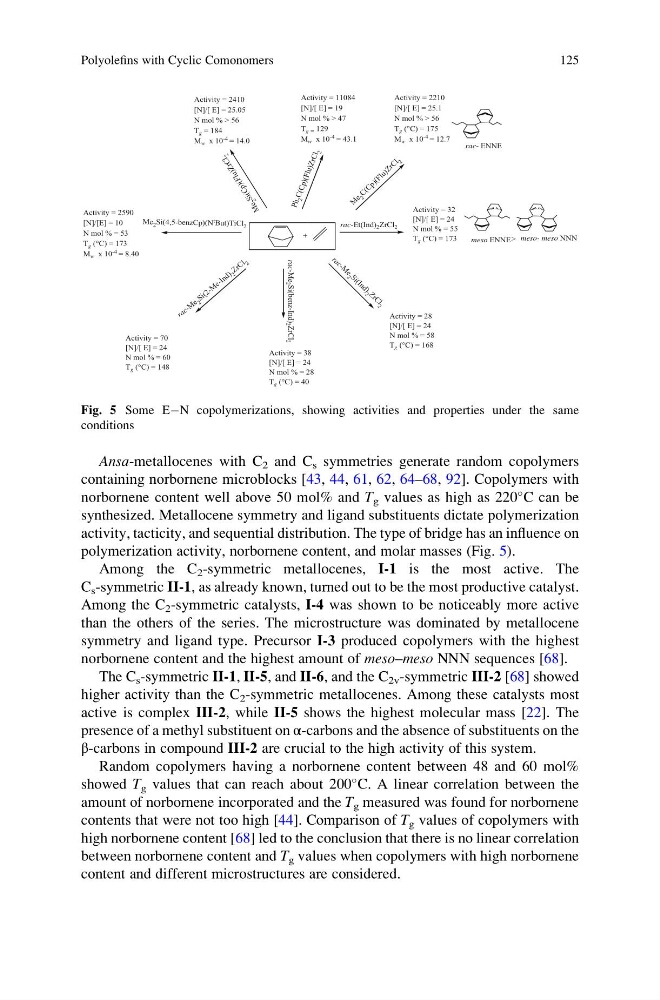
Ansa-metallocenes with C 2 and C s symmetries generate random copolymers
containing norbornene microblocks [43, 44, 61, 62, 64–68, 92]. Copolymers with
norbornene content well above 50 mol% and T g values as high as 220
C can be
synthesized. Metallocene symmetry and ligand substituents dictate polymerization
activity, tacticity, and sequential distribution. The type of bridge has an influence on
polymerization activity, norbornene content, and molar masses (Fig. 5).
Among the C 2 -symmetric metallocenes, I-1 is the most active. The
C s -symmetric II-1, as already known, turned out to be the most productive catalyst.
Among the C 2 -symmetric catalysts, I-4 was shown to be noticeably more active
than the others of the series. The microstructure was dominated by metallocene
symmetry and ligand type. Precursor I-3 produced copolymers with the highest
norbornene content and the highest amount of meso–meso NNN sequences [68].
The C s -symmetric II-1, II-5, and II-6, and the C 2v -symmetric III-2 [68] showed
higher activity than the C 2 -symmetric metallocenes. Among these catalysts most
active is complex III-2, while II-5 shows the highest molecular mass [22]. The
presence of a methyl substituent on α-carbons and the absence of substituents on the
β-carbons in compound III-2 are crucial to the high activity of this system.
Random copolymers having a norbornene content between 48 and 60 mol%
showed T g values that can reach about 200
C. A linear correlation between the
amount of norbornene incorporated and the T g measured was found for norbornene
contents that were not too high [44]. Comparison of T g values of copolymers with
high norbornene content [68] led to the conclusion that there is no linear correlation
between norbornene content and T g values when copolymers with high norbornene
content and different microstructures are considered.
+
meso ENNE
rac-Et(Ind) 2 ZrCl 2
meso- meso NNN
>
M
e
2
C ( C p ) ( F l u ) Z r C l 2
rac- ENNE
M
e 2
S
i(
C
p
)(
F
lu
)Z
rC
l 2
P h 2
C (C p) (F lu )Z rC l 2
Activity = 2210
[N]/[ E] = 25.1
N mol % > 56
T g (°C) = 175
M w x 10 -4 = 12.7
Activity = 11084
[N]/[ E] = 19
N mol % > 47
T g = 129
M w x 10 -4 = 43.1
Activity = 2410
[N]/[ E] = 25.05
N mol % > 56
T g = 184
M w x 10 -4 = 14.0
Activity = 32
[N]/[ E] = 24
N mol % = 55
T g (°C) = 173
r a c - M
e 2
S i ( I n d ) 2
Z r C l 2
Activity = 28
[N]/[ E] = 24
N mol % = 58
T g (°C) = 168
rac-Me 2 Si(benz-Ind) 2 ZrCl 2
Activity = 38
[N]/[ E] = 24
N mol % = 28
T g (°C) = 40
r a c - M
e 2 S i( 2 - M
e - I n d ) 2 Z r C l 2
Activity = 70
[N]/[ E] = 24
N mol % = 60
T g (°C) = 148
Me 2 Si(4,5-benzCp)(N t But)TiCl 2
Activity = 2590
[N]/[E] = 10
N mol % = 53
T g (°C) = 173
M w x 10 -4 = 8.40
Fig. 5 Some EÀN copolymerizations, showing activities and properties under the same
conditions
Polyolefins with Cyclic Comonomers
125
containing norbornene microblocks [43, 44, 61, 62, 64–68, 92]. Copolymers with
norbornene content well above 50 mol% and T g values as high as 220
C can be
synthesized. Metallocene symmetry and ligand substituents dictate polymerization
activity, tacticity, and sequential distribution. The type of bridge has an influence on
polymerization activity, norbornene content, and molar masses (Fig. 5).
Among the C 2 -symmetric metallocenes, I-1 is the most active. The
C s -symmetric II-1, as already known, turned out to be the most productive catalyst.
Among the C 2 -symmetric catalysts, I-4 was shown to be noticeably more active
than the others of the series. The microstructure was dominated by metallocene
symmetry and ligand type. Precursor I-3 produced copolymers with the highest
norbornene content and the highest amount of meso–meso NNN sequences [68].
The C s -symmetric II-1, II-5, and II-6, and the C 2v -symmetric III-2 [68] showed
higher activity than the C 2 -symmetric metallocenes. Among these catalysts most
active is complex III-2, while II-5 shows the highest molecular mass [22]. The
presence of a methyl substituent on α-carbons and the absence of substituents on the
β-carbons in compound III-2 are crucial to the high activity of this system.
Random copolymers having a norbornene content between 48 and 60 mol%
showed T g values that can reach about 200
C. A linear correlation between the
amount of norbornene incorporated and the T g measured was found for norbornene
contents that were not too high [44]. Comparison of T g values of copolymers with
high norbornene content [68] led to the conclusion that there is no linear correlation
between norbornene content and T g values when copolymers with high norbornene
content and different microstructures are considered.
+
meso ENNE
rac-Et(Ind) 2 ZrCl 2
meso- meso NNN
>
M
e
2
C ( C p ) ( F l u ) Z r C l 2
rac- ENNE
M
e 2
S
i(
C
p
)(
F
lu
)Z
rC
l 2
P h 2
C (C p) (F lu )Z rC l 2
Activity = 2210
[N]/[ E] = 25.1
N mol % > 56
T g (°C) = 175
M w x 10 -4 = 12.7
Activity = 11084
[N]/[ E] = 19
N mol % > 47
T g = 129
M w x 10 -4 = 43.1
Activity = 2410
[N]/[ E] = 25.05
N mol % > 56
T g = 184
M w x 10 -4 = 14.0
Activity = 32
[N]/[ E] = 24
N mol % = 55
T g (°C) = 173
r a c - M
e 2
S i ( I n d ) 2
Z r C l 2
Activity = 28
[N]/[ E] = 24
N mol % = 58
T g (°C) = 168
rac-Me 2 Si(benz-Ind) 2 ZrCl 2
Activity = 38
[N]/[ E] = 24
N mol % = 28
T g (°C) = 40
r a c - M
e 2 S i( 2 - M
e - I n d ) 2 Z r C l 2
Activity = 70
[N]/[ E] = 24
N mol % = 60
T g (°C) = 148
Me 2 Si(4,5-benzCp)(N t But)TiCl 2
Activity = 2590
[N]/[E] = 10
N mol % = 53
T g (°C) = 173
M w x 10 -4 = 8.40
Fig. 5 Some EÀN copolymerizations, showing activities and properties under the same
conditions
Polyolefins with Cyclic Comonomers
125