

Arndt et al. [58, 59] gathered information about norbornene insertion and dimer
and trimer microstructure by hydrooligomerization with metallocene catalysts
known to produce atactic, isotactic, and syndiotactic poly(α-olefins); isolation;
and characterization of model dimers and trimers. Norbornene was shown to
undergo cis-exo insertion into the metal–carbon bonds, and the different stereochemistry of oligomers (and polymers) was demonstrated [58, 59].
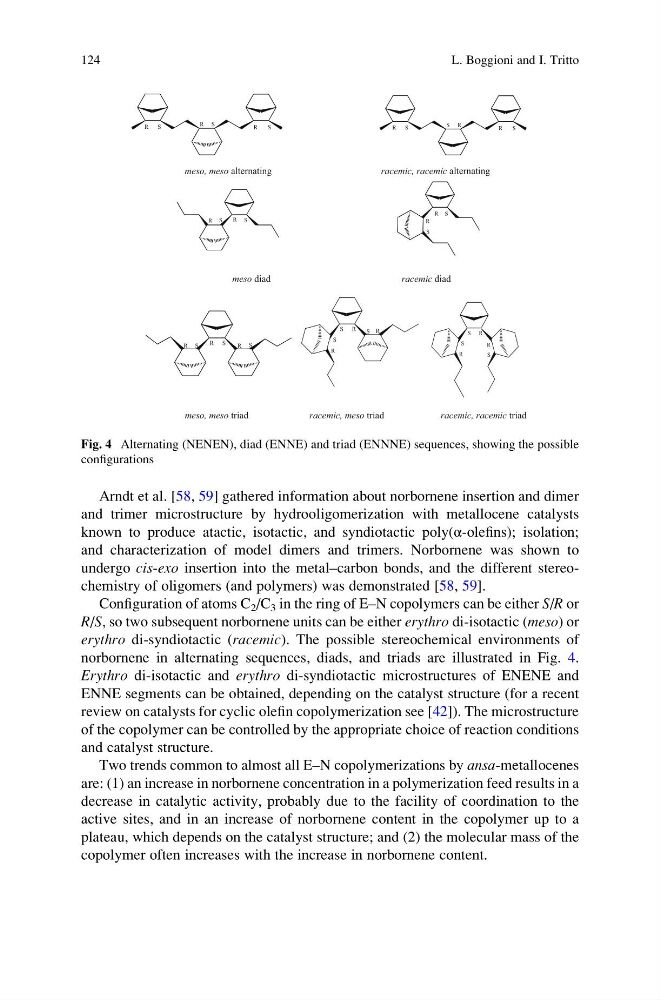
Configuration of atoms C 2 /C 3 in the ring of E–N copolymers can be either S/R or
R/S, so two subsequent norbornene units can be either erythro di-isotactic (meso) or
erythro di-syndiotactic (racemic). The possible stereochemical environments of
norbornene in alternating sequences, diads, and triads are illustrated in Fig. 4.
Erythro di-isotactic and erythro di-syndiotactic microstructures of ENENE and
ENNE segments can be obtained, depending on the catalyst structure (for a recent
review on catalysts for cyclic olefin copolymerization see [42]). The microstructure
of the copolymer can be controlled by the appropriate choice of reaction conditions
and catalyst structure.
Two trends common to almost all E–N copolymerizations by ansa-metallocenes
are: (1) an increase in norbornene concentration in a polymerization feed results in a
decrease in catalytic activity, probably due to the facility of coordination to the
active sites, and in an increase of norbornene content in the copolymer up to a
plateau, which depends on the catalyst structure; and (2) the molecular mass of the
copolymer often increases with the increase in norbornene content.
S R
S R
R
S
R S
S
R
R
S
R S
R
S
R
S
meso, meso alternating
racemic, racemic alternating
meso diad
racemic diad
meso, meso triad
racemic, meso triad
racemic, racemic triad
R S
R S
R S
S
R
R S
R S
R S
S R
R
S
R
S
Fig. 4 Alternating (NENEN), diad (ENNE) and triad (ENNNE) sequences, showing the possible
configurations
124
L. Boggioni and I. Tritto
and trimer microstructure by hydrooligomerization with metallocene catalysts
known to produce atactic, isotactic, and syndiotactic poly(α-olefins); isolation;
and characterization of model dimers and trimers. Norbornene was shown to
undergo cis-exo insertion into the metal–carbon bonds, and the different stereochemistry of oligomers (and polymers) was demonstrated [58, 59].
Configuration of atoms C 2 /C 3 in the ring of E–N copolymers can be either S/R or
R/S, so two subsequent norbornene units can be either erythro di-isotactic (meso) or
erythro di-syndiotactic (racemic). The possible stereochemical environments of
norbornene in alternating sequences, diads, and triads are illustrated in Fig. 4.
Erythro di-isotactic and erythro di-syndiotactic microstructures of ENENE and
ENNE segments can be obtained, depending on the catalyst structure (for a recent
review on catalysts for cyclic olefin copolymerization see [42]). The microstructure
of the copolymer can be controlled by the appropriate choice of reaction conditions
and catalyst structure.
Two trends common to almost all E–N copolymerizations by ansa-metallocenes
are: (1) an increase in norbornene concentration in a polymerization feed results in a
decrease in catalytic activity, probably due to the facility of coordination to the
active sites, and in an increase of norbornene content in the copolymer up to a
plateau, which depends on the catalyst structure; and (2) the molecular mass of the
copolymer often increases with the increase in norbornene content.
S R
S R
R
S
R S
S
R
R
S
R S
R
S
R
S
meso, meso alternating
racemic, racemic alternating
meso diad
racemic diad
meso, meso triad
racemic, meso triad
racemic, racemic triad
R S
R S
R S
S
R
R S
R S
R S
S R
R
S
R
S
Fig. 4 Alternating (NENEN), diad (ENNE) and triad (ENNNE) sequences, showing the possible
configurations
124
L. Boggioni and I. Tritto