

First of all, the relatively low number of total citations is somewhat surprising.
Of course, we should realize that the number of active scientists has increased
exponentially since the times when H.S. wrote his papers and, therefore, the citation
frequency of important papers has increased in terms of their absolute numbers in
modern times. However, we can safely compare the impact (in terms of citations
received) internally among the papers of H.S. as they are relevant to different
subjects or topics. Six out of his ten most cited papers refer to synthetic organic
chemistry and have nothing to do with macromolecules. Noteworthy is the impact
of his work in organo-phosphorous chemistry; his papers are still cited today as a
key reference. Compared to over 1,000 citations that his paper on phosphine
methylene derivatives and phosphinimine has obtained, his 1920 paper on polymerization (considered a cornerstone paper by science historians) has merely drawn
125 citations to date. Even some of the papers together with Ruzicka on insecticides
are cited more frequently. Another fact that needs mentioning is that monographs
played a much more important role in earlier times than they do today. Staudinger
laid ground to his fame as a synthetic organic chemist by his book on ketenes, a
class of organic compounds that he had first found and explored. As such, it does
not appear in the citation index on which much of today’s academic evaluation is
based. It may be deplorable, but it is a fact.
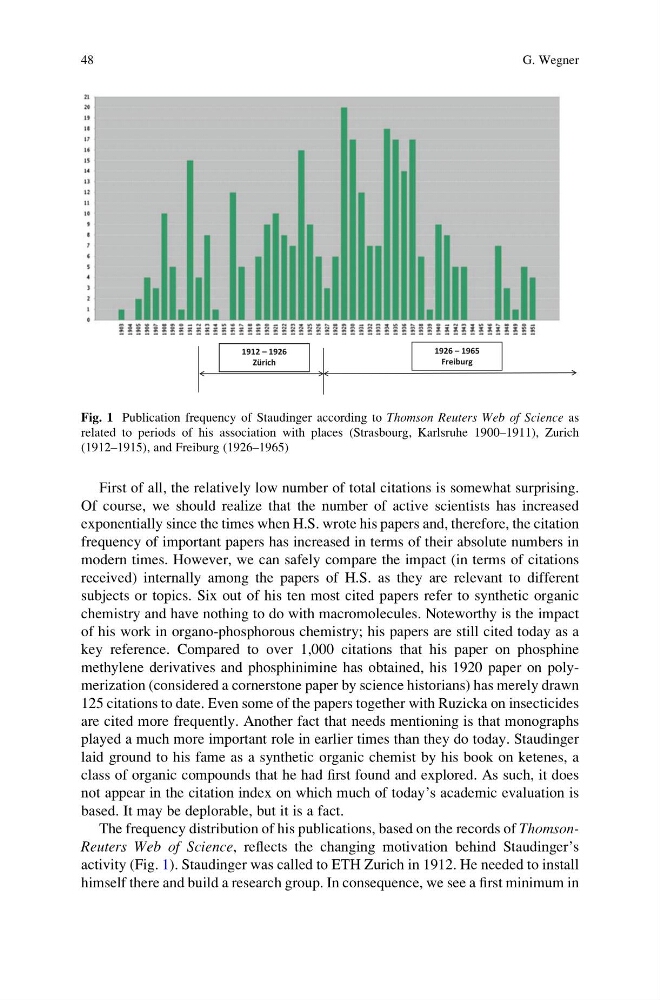
The frequency distribution of his publications, based on the records of ThomsonReuters Web of Science, reflects the changing motivation behind Staudinger’s
activity (Fig. 1). Staudinger was called to ETH Zurich in 1912. He needed to install
himself there and build a research group. In consequence, we see a first minimum in
1912 – 1926
Zürich
1926 – 1965
Freiburg
Fig. 1 Publication frequency of Staudinger according to Thomson Reuters Web of Science as
related to periods of his association with places (Strasbourg, Karlsruhe 1900–1911), Zurich
(1912–1915), and Freiburg (1926–1965)
48
G. Wegner
Of course, we should realize that the number of active scientists has increased
exponentially since the times when H.S. wrote his papers and, therefore, the citation
frequency of important papers has increased in terms of their absolute numbers in
modern times. However, we can safely compare the impact (in terms of citations
received) internally among the papers of H.S. as they are relevant to different
subjects or topics. Six out of his ten most cited papers refer to synthetic organic
chemistry and have nothing to do with macromolecules. Noteworthy is the impact
of his work in organo-phosphorous chemistry; his papers are still cited today as a
key reference. Compared to over 1,000 citations that his paper on phosphine
methylene derivatives and phosphinimine has obtained, his 1920 paper on polymerization (considered a cornerstone paper by science historians) has merely drawn
125 citations to date. Even some of the papers together with Ruzicka on insecticides
are cited more frequently. Another fact that needs mentioning is that monographs
played a much more important role in earlier times than they do today. Staudinger
laid ground to his fame as a synthetic organic chemist by his book on ketenes, a
class of organic compounds that he had first found and explored. As such, it does
not appear in the citation index on which much of today’s academic evaluation is
based. It may be deplorable, but it is a fact.
The frequency distribution of his publications, based on the records of ThomsonReuters Web of Science, reflects the changing motivation behind Staudinger’s
activity (Fig. 1). Staudinger was called to ETH Zurich in 1912. He needed to install
himself there and build a research group. In consequence, we see a first minimum in
1912 – 1926
Zürich
1926 – 1965
Freiburg
Fig. 1 Publication frequency of Staudinger according to Thomson Reuters Web of Science as
related to periods of his association with places (Strasbourg, Karlsruhe 1900–1911), Zurich
(1912–1915), and Freiburg (1926–1965)
48
G. Wegner