

Many of Staudinger’s students took the lead in industrial polymer research,
among them prominent directors like Adolf Steinhofer at BASF AG, Hans Batzer
at Ciba-Geigy AG, Gerhard Bier at Hoechst AG, and Ernst Trommsdorff at Ro ¨hm
& Haas AG. When the University of Mainz was founded after World War II, the
two chairs of physical and of organic chemistry were taken by G.V. Schulz, who did
his habilitation in Freiburg, and by Werner Kern who was a former Ph.D. student of
Hermann Staudinger. Later, two other former Staudinger students joined the Mainz
faculty, namely Helmut Ringsdorf and R.C. Schulz. In an early version of a
public–private partnership, Staudinger rallied prominent representatives and
research directors of polymer industries in an association (Fo ¨rderverein fu ¨r
Makromolekulare Chemie e.V.), supporting and advising the activities of
Staudinger’s institute in Freiburg.
In order to communicate polymer research results, Staudinger founded the first
polymer journal, Journal fu ¨r Makromolekulare Chemie (Journal of Macromolecular Chemistry), in 1943 as a new branch of the Journal fu ¨r praktische Chemie
(Journal for Practical Chemistry), for which he had served as the editor-in-chief
since 1939 with the Barth publishers in Leipzig, Germany. In the postwar time, at
the beginning of the cold war, Freiburg in the French zone, was cut off from access
to East Germany, which was occupied by the Russian army. Therefore,
Staudinger’s journal was published under the new name of Die Makromolekulare
Chemie (Macromolecular Chemistry) by the publishers Wepf & Co. in Basel,
Switzerland. Today this journal is renamed Macromolecular Chemistry and Physics and, together with a family of sister journals, is published by Wiley. In several
textbooks published by Staudinger, among them the “bible” of polymer chemistry
entitled Makromolekulare Chemie und Biologie (Macromolecular Chemistry and
Biology) [21], are taught the basic principles of polymer sciences, serving for
decades as an entry to the fascinating world of macromolecular chemistry.
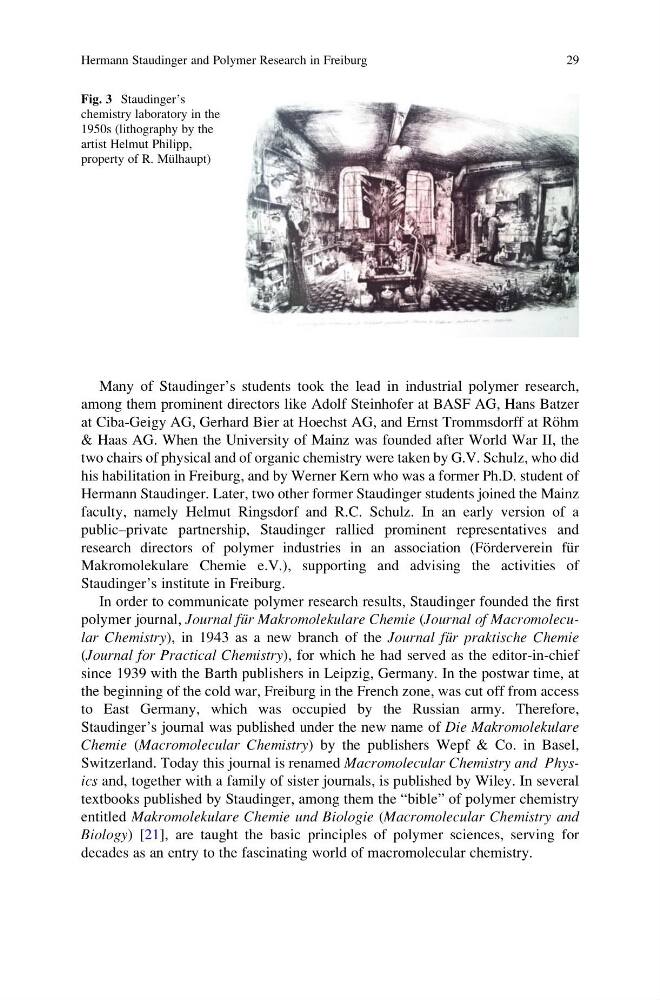
Fig. 3 Staudinger’s
chemistry laboratory in the
1950s (lithography by the
artist Helmut Philipp,
property of R. Mu ¨lhaupt)
Hermann Staudinger and Polymer Research in Freiburg
29
among them prominent directors like Adolf Steinhofer at BASF AG, Hans Batzer
at Ciba-Geigy AG, Gerhard Bier at Hoechst AG, and Ernst Trommsdorff at Ro ¨hm
& Haas AG. When the University of Mainz was founded after World War II, the
two chairs of physical and of organic chemistry were taken by G.V. Schulz, who did
his habilitation in Freiburg, and by Werner Kern who was a former Ph.D. student of
Hermann Staudinger. Later, two other former Staudinger students joined the Mainz
faculty, namely Helmut Ringsdorf and R.C. Schulz. In an early version of a
public–private partnership, Staudinger rallied prominent representatives and
research directors of polymer industries in an association (Fo ¨rderverein fu ¨r
Makromolekulare Chemie e.V.), supporting and advising the activities of
Staudinger’s institute in Freiburg.
In order to communicate polymer research results, Staudinger founded the first
polymer journal, Journal fu ¨r Makromolekulare Chemie (Journal of Macromolecular Chemistry), in 1943 as a new branch of the Journal fu ¨r praktische Chemie
(Journal for Practical Chemistry), for which he had served as the editor-in-chief
since 1939 with the Barth publishers in Leipzig, Germany. In the postwar time, at
the beginning of the cold war, Freiburg in the French zone, was cut off from access
to East Germany, which was occupied by the Russian army. Therefore,
Staudinger’s journal was published under the new name of Die Makromolekulare
Chemie (Macromolecular Chemistry) by the publishers Wepf & Co. in Basel,
Switzerland. Today this journal is renamed Macromolecular Chemistry and Physics and, together with a family of sister journals, is published by Wiley. In several
textbooks published by Staudinger, among them the “bible” of polymer chemistry
entitled Makromolekulare Chemie und Biologie (Macromolecular Chemistry and
Biology) [21], are taught the basic principles of polymer sciences, serving for
decades as an entry to the fascinating world of macromolecular chemistry.
Fig. 3 Staudinger’s
chemistry laboratory in the
1950s (lithography by the
artist Helmut Philipp,
property of R. Mu ¨lhaupt)
Hermann Staudinger and Polymer Research in Freiburg
29