

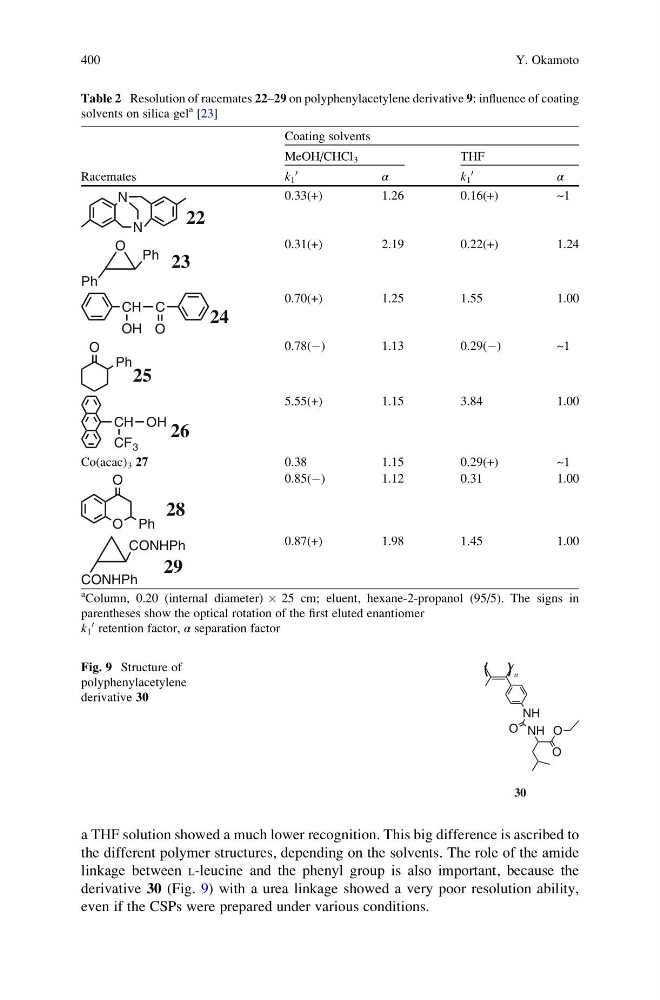
a THF solution showed a much lower recognition. This big difference is ascribed to
the different polymer structures, depending on the solvents. The role of the amide
linkage between L-leucine and the phenyl group is also important, because the
derivative 30 (Fig. 9) with a urea linkage showed a very poor resolution ability,
even if the CSPs were prepared under various conditions.
Table 2 Resolution of racemates 22–29 on polyphenylacetylene derivative 9: influence of coating
solvents on silica gel
a [23]
Racemates
Coating solvents
MeOH/CHCl 3
THF
k 1
0
α
k 1
0
α
N
N
22
0.33(+)
1.26
0.16(+)
~1
O Ph
Ph
23
0.31(+)
2.19
0.22(+)
1.24
CH
OH
C
O
24
0.70(+)
1.25
1.55
1.00
O
Ph
25
0.78(À)
1.13
0.29(À)
~ 1
CH OH
CF 3
26
5.55(+)
1.15
3.84
1.00
Co(acac) 3 27
0.38
1.15
0.29(+)
~1
Ph
O
O
28
0.85(À)
1.12
0.31
1.00
CONHPh
CONHPh
29
0.87(+)
1.98
1.45
1.00
a
Column, 0.20 (internal diameter) Â 25 cm; eluent, hexane-2-propanol (95/5). The signs in
parentheses show the optical rotation of the first eluted enantiomer
k 1
0 retention factor, α separation factor
NH
NH O
O
O
n
30
Fig. 9 Structure of
polyphenylacetylene
derivative 30
400
Y. Okamoto
the different polymer structures, depending on the solvents. The role of the amide
linkage between L-leucine and the phenyl group is also important, because the
derivative 30 (Fig. 9) with a urea linkage showed a very poor resolution ability,
even if the CSPs were prepared under various conditions.
Table 2 Resolution of racemates 22–29 on polyphenylacetylene derivative 9: influence of coating
solvents on silica gel
a [23]
Racemates
Coating solvents
MeOH/CHCl 3
THF
k 1
0
α
k 1
0
α
N
N
22
0.33(+)
1.26
0.16(+)
~1
O Ph
Ph
23
0.31(+)
2.19
0.22(+)
1.24
CH
OH
C
O
24
0.70(+)
1.25
1.55
1.00
O
Ph
25
0.78(À)
1.13
0.29(À)
~ 1
CH OH
CF 3
26
5.55(+)
1.15
3.84
1.00
Co(acac) 3 27
0.38
1.15
0.29(+)
~1
Ph
O
O
28
0.85(À)
1.12
0.31
1.00
CONHPh
CONHPh
29
0.87(+)
1.98
1.45
1.00
a
Column, 0.20 (internal diameter) Â 25 cm; eluent, hexane-2-propanol (95/5). The signs in
parentheses show the optical rotation of the first eluted enantiomer
k 1
0 retention factor, α separation factor
NH
NH O
O
O
n
30
Fig. 9 Structure of
polyphenylacetylene
derivative 30
400
Y. Okamoto