

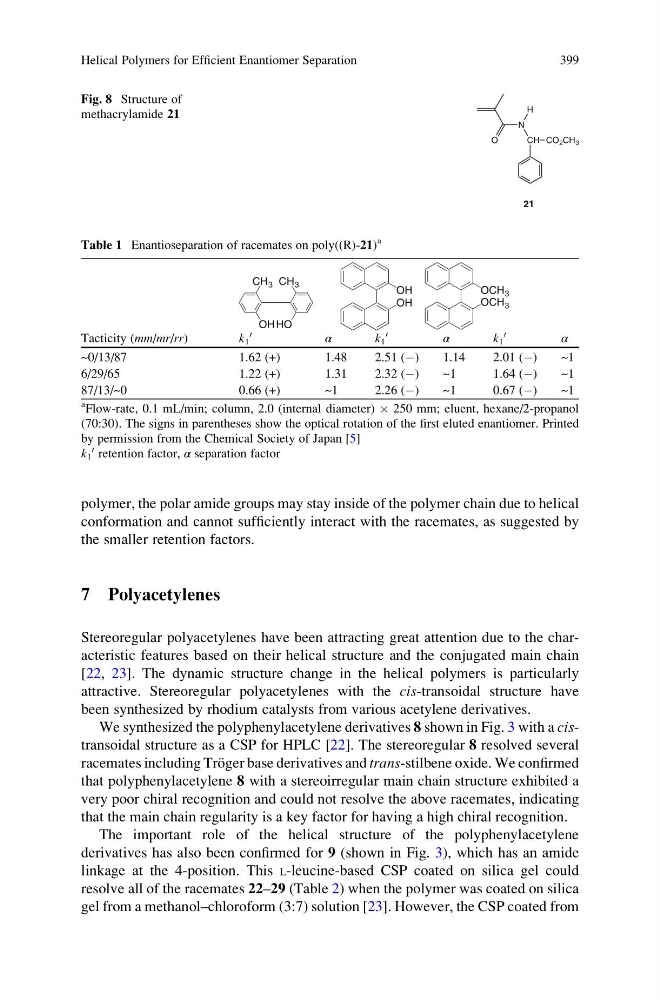
polymer, the polar amide groups may stay inside of the polymer chain due to helical
conformation and cannot sufficiently interact with the racemates, as suggested by
the smaller retention factors.
7 Polyacetylenes
Stereoregular polyacetylenes have been attracting great attention due to the characteristic features based on their helical structure and the conjugated main chain
[22, 23]. The dynamic structure change in the helical polymers is particularly
attractive. Stereoregular polyacetylenes with the cis-transoidal structure have
been synthesized by rhodium catalysts from various acetylene derivatives.
We synthesized the polyphenylacetylene derivatives 8 shown in Fig. 3 with a cistransoidal structure as a CSP for HPLC [22]. The stereoregular 8 resolved several
racemates including Tro ¨ger base derivatives and trans-stilbene oxide. We confirmed
that polyphenylacetylene 8 with a stereoirregular main chain structure exhibited a
very poor chiral recognition and could not resolve the above racemates, indicating
that the main chain regularity is a key factor for having a high chiral recognition.
The important role of the helical structure of the polyphenylacetylene
derivatives has also been confirmed for 9 (shown in Fig. 3), which has an amide
linkage at the 4-position. This L-leucine-based CSP coated on silica gel could
resolve all of the racemates 22–29 (Table 2) when the polymer was coated on silica
gel from a methanol–chloroform (3:7) solution [23]. However, the CSP coated from
O
N
H
CH CO 2 CH 3
21
Fig. 8 Structure of
methacrylamide 21
Table 1 Enantioseparation of racemates on poly((R)-21)
a
OCH 3
OCH 3
CH 3 CH 3
OH HO
OH
OH
Tacticity (mm/mr/rr)
k 1
0
α
k 1
0
α
k 1
0
α
~0/13/87
1.62 (+)
1.48
2.51 (À)
1.14
2.01 (À)
~1
6/29/65
1.22 (+)
1.31
2.32 (À)
~1
1.64 (À)
~1
87/13/~0
0.66 (+)
~1
2.26 (À)
~1
0.67 (À)
~1
a
Flow-rate, 0.1 mL/min; column, 2.0 (internal diameter) Â 250 mm; eluent, hexane/2-propanol
(70:30). The signs in parentheses show the optical rotation of the first eluted enantiomer. Printed
by permission from the Chemical Society of Japan [5]
k 1
0 retention factor, α separation factor
Helical Polymers for Efficient Enantiomer Separation
399
conformation and cannot sufficiently interact with the racemates, as suggested by
the smaller retention factors.
7 Polyacetylenes
Stereoregular polyacetylenes have been attracting great attention due to the characteristic features based on their helical structure and the conjugated main chain
[22, 23]. The dynamic structure change in the helical polymers is particularly
attractive. Stereoregular polyacetylenes with the cis-transoidal structure have
been synthesized by rhodium catalysts from various acetylene derivatives.
We synthesized the polyphenylacetylene derivatives 8 shown in Fig. 3 with a cistransoidal structure as a CSP for HPLC [22]. The stereoregular 8 resolved several
racemates including Tro ¨ger base derivatives and trans-stilbene oxide. We confirmed
that polyphenylacetylene 8 with a stereoirregular main chain structure exhibited a
very poor chiral recognition and could not resolve the above racemates, indicating
that the main chain regularity is a key factor for having a high chiral recognition.
The important role of the helical structure of the polyphenylacetylene
derivatives has also been confirmed for 9 (shown in Fig. 3), which has an amide
linkage at the 4-position. This L-leucine-based CSP coated on silica gel could
resolve all of the racemates 22–29 (Table 2) when the polymer was coated on silica
gel from a methanol–chloroform (3:7) solution [23]. However, the CSP coated from
O
N
H
CH CO 2 CH 3
21
Fig. 8 Structure of
methacrylamide 21
Table 1 Enantioseparation of racemates on poly((R)-21)
a
OCH 3
OCH 3
CH 3 CH 3
OH HO
OH
OH
Tacticity (mm/mr/rr)
k 1
0
α
k 1
0
α
k 1
0
α
~0/13/87
1.62 (+)
1.48
2.51 (À)
1.14
2.01 (À)
~1
6/29/65
1.22 (+)
1.31
2.32 (À)
~1
1.64 (À)
~1
87/13/~0
0.66 (+)
~1
2.26 (À)
~1
0.67 (À)
~1
a
Flow-rate, 0.1 mL/min; column, 2.0 (internal diameter) Â 250 mm; eluent, hexane/2-propanol
(70:30). The signs in parentheses show the optical rotation of the first eluted enantiomer. Printed
by permission from the Chemical Society of Japan [5]
k 1
0 retention factor, α separation factor
Helical Polymers for Efficient Enantiomer Separation
399