

2 Enantiomer Separation by HPLC
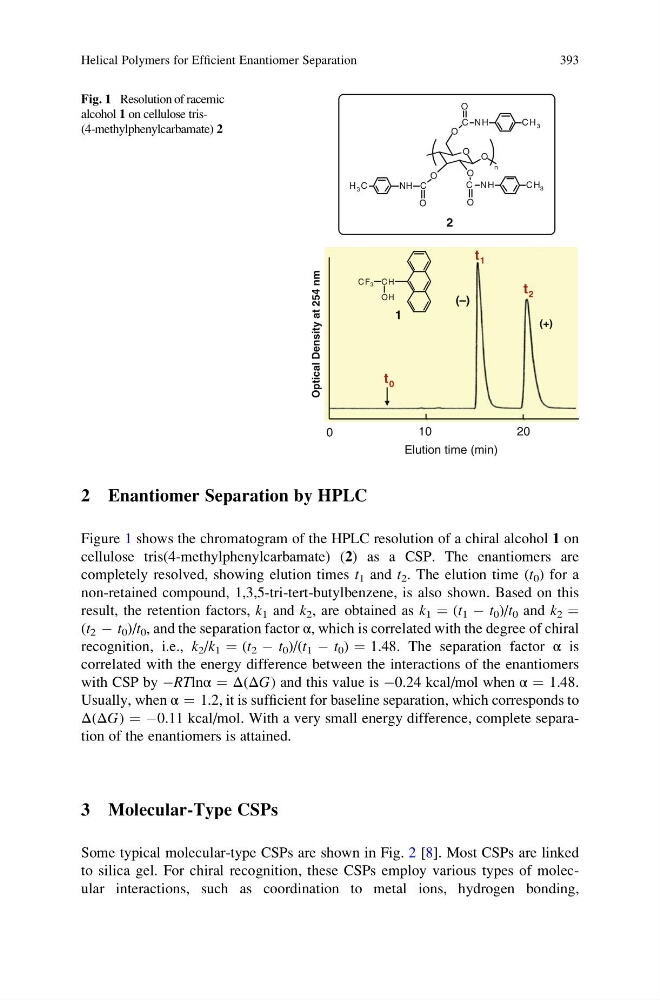
Figure 1 shows the chromatogram of the HPLC resolution of a chiral alcohol 1 on
cellulose tris(4-methylphenylcarbamate) (2) as a CSP. The enantiomers are
completely resolved, showing elution times t 1 and t 2 . The elution time (t 0 ) for a
non-retained compound, 1,3,5-tri-tert-butylbenzene, is also shown. Based on this
result, the retention factors, k 1 and k 2 , are obtained as k 1 ¼ (t 1 À t 0 )/t 0 and k 2 ¼
(t 2 À t 0 )/t 0 , and the separation factor α, which is correlated with the degree of chiral
recognition, i.e., k 2 /k 1 ¼ (t 2 À t 0 )/(t 1 À t 0 ) ¼ 1.48. The separation factor α is
correlated with the energy difference between the interactions of the enantiomers
with CSP by ÀRTlnα ¼ Δ(ΔG) and this value is À0.24 kcal/mol when α ¼ 1.48.
Usually, when α ¼ 1.2, it is sufficient for baseline separation, which corresponds to
Δ(ΔG) ¼ À0.11 kcal/mol. With a very small energy difference, complete separation of the enantiomers is attained.
3 Molecular-Type CSPs
Some typical molecular-type CSPs are shown in Fig. 2 [8]. Most CSPs are linked
to silica gel. For chiral recognition, these CSPs employ various types of molecular interactions, such as coordination to metal ions, hydrogen bonding,
O
O
O
O
O
H 3 C
CH 3
NH
NH
C
O
C
CH 3
C
O
O
NH
n
2
0
10
20
Elution time (min)
CH
CF 3
OH
Optical Density at 254 nm
t 1
t 2
t 0
(+)
1
Fig. 1 Resolution of racemic
alcohol 1 on cellulose tris(4-methylphenylcarbamate) 2
Helical Polymers for Efficient Enantiomer Separation
393
Figure 1 shows the chromatogram of the HPLC resolution of a chiral alcohol 1 on
cellulose tris(4-methylphenylcarbamate) (2) as a CSP. The enantiomers are
completely resolved, showing elution times t 1 and t 2 . The elution time (t 0 ) for a
non-retained compound, 1,3,5-tri-tert-butylbenzene, is also shown. Based on this
result, the retention factors, k 1 and k 2 , are obtained as k 1 ¼ (t 1 À t 0 )/t 0 and k 2 ¼
(t 2 À t 0 )/t 0 , and the separation factor α, which is correlated with the degree of chiral
recognition, i.e., k 2 /k 1 ¼ (t 2 À t 0 )/(t 1 À t 0 ) ¼ 1.48. The separation factor α is
correlated with the energy difference between the interactions of the enantiomers
with CSP by ÀRTlnα ¼ Δ(ΔG) and this value is À0.24 kcal/mol when α ¼ 1.48.
Usually, when α ¼ 1.2, it is sufficient for baseline separation, which corresponds to
Δ(ΔG) ¼ À0.11 kcal/mol. With a very small energy difference, complete separation of the enantiomers is attained.
3 Molecular-Type CSPs
Some typical molecular-type CSPs are shown in Fig. 2 [8]. Most CSPs are linked
to silica gel. For chiral recognition, these CSPs employ various types of molecular interactions, such as coordination to metal ions, hydrogen bonding,
O
O
O
O
O
H 3 C
CH 3
NH
NH
C
O
C
CH 3
C
O
O
NH
n
2
0
10
20
Elution time (min)
CH
CF 3
OH
Optical Density at 254 nm
t 1
t 2
t 0
(+)
1
Fig. 1 Resolution of racemic
alcohol 1 on cellulose tris(4-methylphenylcarbamate) 2
Helical Polymers for Efficient Enantiomer Separation
393