

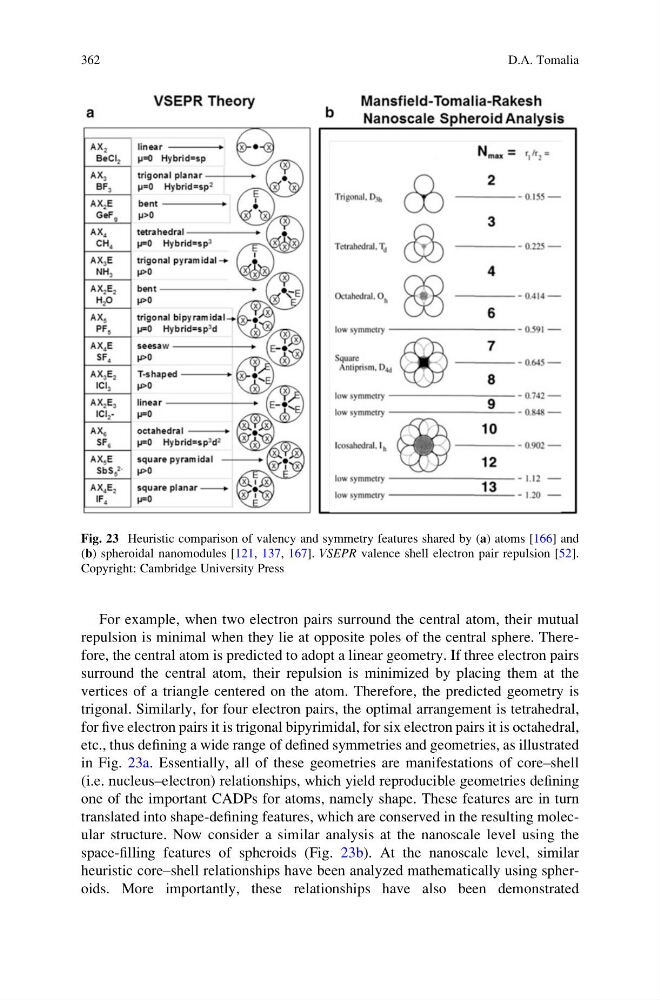
For example, when two electron pairs surround the central atom, their mutual
repulsion is minimal when they lie at opposite poles of the central sphere. Therefore, the central atom is predicted to adopt a linear geometry. If three electron pairs
surround the central atom, their repulsion is minimized by placing them at the
vertices of a triangle centered on the atom. Therefore, the predicted geometry is
trigonal. Similarly, for four electron pairs, the optimal arrangement is tetrahedral,
for five electron pairs it is trigonal bipyrimidal, for six electron pairs it is octahedral,
etc., thus defining a wide range of defined symmetries and geometries, as illustrated
in Fig. 23a. Essentially, all of these geometries are manifestations of core–shell
(i.e. nucleus–electron) relationships, which yield reproducible geometries defining
one of the important CADPs for atoms, namely shape. These features are in turn
translated into shape-defining features, which are conserved in the resulting molecular structure. Now consider a similar analysis at the nanoscale level using the
space-filling features of spheroids (Fig. 23b). At the nanoscale level, similar
heuristic core–shell relationships have been analyzed mathematically using spheroids. More importantly, these relationships have also been demonstrated
Fig. 23 Heuristic comparison of valency and symmetry features shared by (a) atoms [166] and
(b) spheroidal nanomodules [121, 137, 167]. VSEPR valence shell electron pair repulsion [52].
Copyright: Cambridge University Press
362
D.A. Tomalia
repulsion is minimal when they lie at opposite poles of the central sphere. Therefore, the central atom is predicted to adopt a linear geometry. If three electron pairs
surround the central atom, their repulsion is minimized by placing them at the
vertices of a triangle centered on the atom. Therefore, the predicted geometry is
trigonal. Similarly, for four electron pairs, the optimal arrangement is tetrahedral,
for five electron pairs it is trigonal bipyrimidal, for six electron pairs it is octahedral,
etc., thus defining a wide range of defined symmetries and geometries, as illustrated
in Fig. 23a. Essentially, all of these geometries are manifestations of core–shell
(i.e. nucleus–electron) relationships, which yield reproducible geometries defining
one of the important CADPs for atoms, namely shape. These features are in turn
translated into shape-defining features, which are conserved in the resulting molecular structure. Now consider a similar analysis at the nanoscale level using the
space-filling features of spheroids (Fig. 23b). At the nanoscale level, similar
heuristic core–shell relationships have been analyzed mathematically using spheroids. More importantly, these relationships have also been demonstrated
Fig. 23 Heuristic comparison of valency and symmetry features shared by (a) atoms [166] and
(b) spheroidal nanomodules [121, 137, 167]. VSEPR valence shell electron pair repulsion [52].
Copyright: Cambridge University Press
362
D.A. Tomalia