

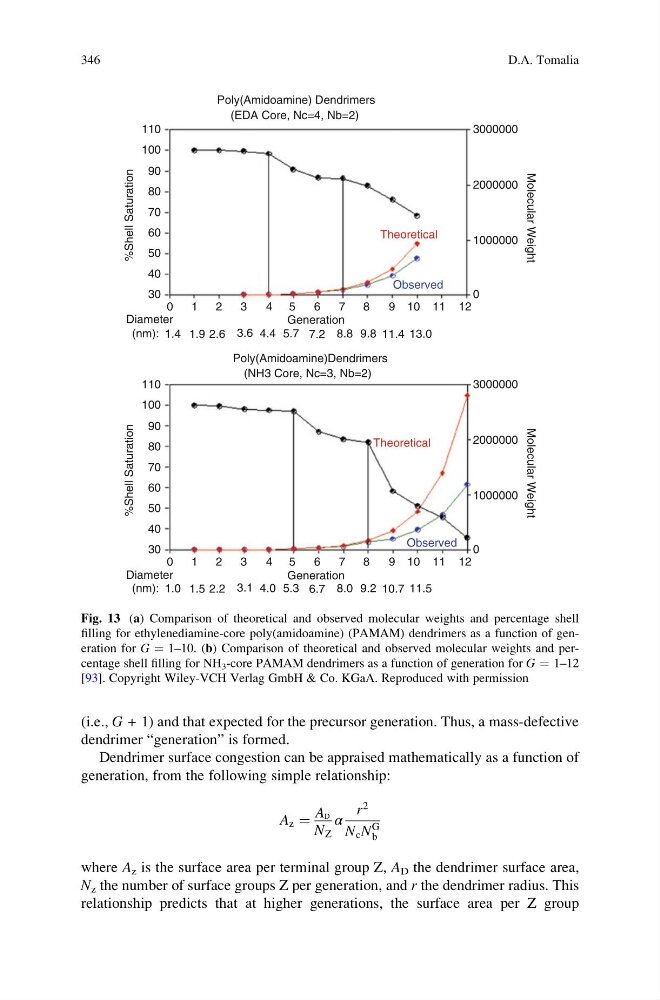
(i.e., G + 1) and that expected for the precursor generation. Thus, a mass-defective
dendrimer “generation” is formed.
Dendrimer surface congestion can be appraised mathematically as a function of
generation, from the following simple relationship:
A z ¼ A D
N Z
α
r
2
N c N
G
b
where A z is the surface area per terminal group Z, A D the dendrimer surface area,
N z the number of surface groups Z per generation, and r the dendrimer radius. This
relationship predicts that at higher generations, the surface area per Z group
110
Poly(Amidoamine) Dendrimers
(EDA Core, Nc=4, Nb=2)
%Shell Saturation
100
90
80
70
60
50
40
30
Poly(Amidoamine)Dendrimers
(NH3 Core, Nc=3, Nb=2)
1.4
Diameter
(nm):
1.9 2.6 3.6 4.4 5.7 7.2
Generation
8.8 9.8 11.4 13.0
0
1
2
3
4 5
6
7
8
9 10 11 12
0
1000000
Theoretical
Observed
2000000
Molecular Weight
3000000
110
%Shell Saturation
100
90
80
70
60
50
40
30
1.0
Diameter
(nm):
1.5 2.2 3.1 4.0 5.3 6.7
Generation
8.0 9.2 10.7 11.5
0
1
2
3
4 5
6
7
8
9 10 11 12
0
1000000
Theoretical
Observed
2000000
Molecular Weight
3000000
Fig. 13 (a) Comparison of theoretical and observed molecular weights and percentage shell
filling for ethylenediamine-core poly(amidoamine) (PAMAM) dendrimers as a function of generation for G ¼ 1–10. (b) Comparison of theoretical and observed molecular weights and percentage shell filling for NH 3 -core PAMAM dendrimers as a function of generation for G ¼ 1–12
[93]. Copyright Wiley-VCH Verlag GmbH & Co. KGaA. Reproduced with permission
346
D.A. Tomalia
dendrimer “generation” is formed.
Dendrimer surface congestion can be appraised mathematically as a function of
generation, from the following simple relationship:
A z ¼ A D
N Z
α
r
2
N c N
G
b
where A z is the surface area per terminal group Z, A D the dendrimer surface area,
N z the number of surface groups Z per generation, and r the dendrimer radius. This
relationship predicts that at higher generations, the surface area per Z group
110
Poly(Amidoamine) Dendrimers
(EDA Core, Nc=4, Nb=2)
%Shell Saturation
100
90
80
70
60
50
40
30
Poly(Amidoamine)Dendrimers
(NH3 Core, Nc=3, Nb=2)
1.4
Diameter
(nm):
1.9 2.6 3.6 4.4 5.7 7.2
Generation
8.8 9.8 11.4 13.0
0
1
2
3
4 5
6
7
8
9 10 11 12
0
1000000
Theoretical
Observed
2000000
Molecular Weight
3000000
110
%Shell Saturation
100
90
80
70
60
50
40
30
1.0
Diameter
(nm):
1.5 2.2 3.1 4.0 5.3 6.7
Generation
8.0 9.2 10.7 11.5
0
1
2
3
4 5
6
7
8
9 10 11 12
0
1000000
Theoretical
Observed
2000000
Molecular Weight
3000000
Fig. 13 (a) Comparison of theoretical and observed molecular weights and percentage shell
filling for ethylenediamine-core poly(amidoamine) (PAMAM) dendrimers as a function of generation for G ¼ 1–10. (b) Comparison of theoretical and observed molecular weights and percentage shell filling for NH 3 -core PAMAM dendrimers as a function of generation for G ¼ 1–12
[93]. Copyright Wiley-VCH Verlag GmbH & Co. KGaA. Reproduced with permission
346
D.A. Tomalia