

4.2 de Gennes Dense Packing: A Nanoscale Steric
Phenomenon Not Observed in Traditional Polymers
As a consequence of excluded volume associated with the core, interior, and surface
branch cells, steric congestion is expected to result due to tethered core connectivity. Furthermore, the number of dendrimer surface groups, Z, amplifies with each
subsequent generation. This occurs according to geometric branching laws, which
are related to core multiplicity (N c ) and branch cell multiplicity (N b ). These values
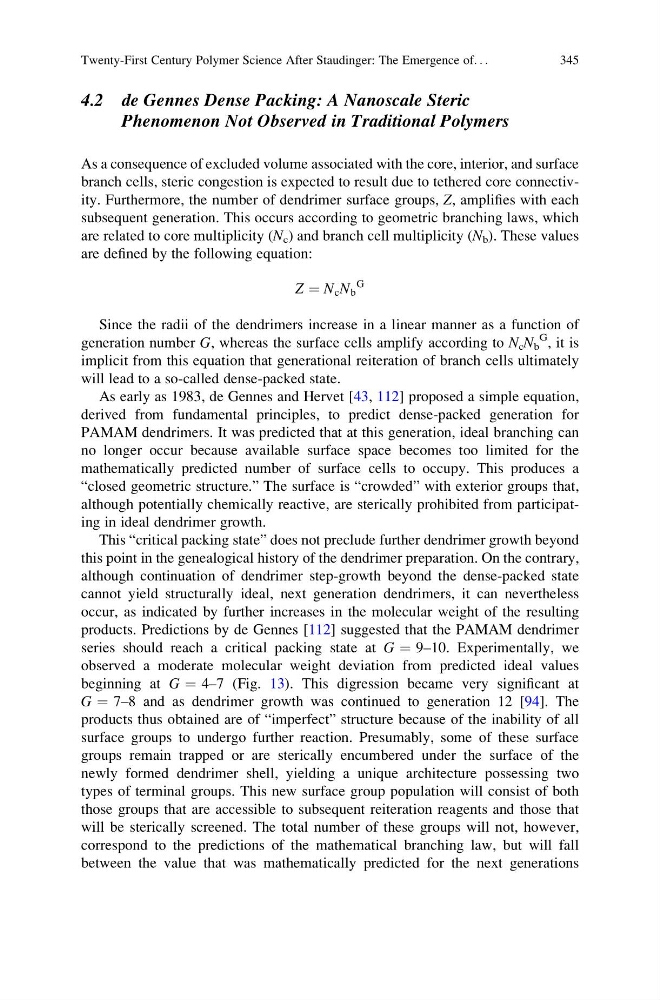
are defined by the following equation:
Z ¼ N c N b
G
Since the radii of the dendrimers increase in a linear manner as a function of
generation number G, whereas the surface cells amplify according to N c N b
G , it is
implicit from this equation that generational reiteration of branch cells ultimately
will lead to a so-called dense-packed state.
As early as 1983, de Gennes and Hervet [43, 112] proposed a simple equation,
derived from fundamental principles, to predict dense-packed generation for
PAMAM dendrimers. It was predicted that at this generation, ideal branching can
no longer occur because available surface space becomes too limited for the
mathematically predicted number of surface cells to occupy. This produces a
“closed geometric structure.” The surface is “crowded” with exterior groups that,
although potentially chemically reactive, are sterically prohibited from participating in ideal dendrimer growth.
This “critical packing state” does not preclude further dendrimer growth beyond
this point in the genealogical history of the dendrimer preparation. On the contrary,
although continuation of dendrimer step-growth beyond the dense-packed state
cannot yield structurally ideal, next generation dendrimers, it can nevertheless
occur, as indicated by further increases in the molecular weight of the resulting
products. Predictions by de Gennes [112] suggested that the PAMAM dendrimer
series should reach a critical packing state at G ¼ 9–10. Experimentally, we
observed a moderate molecular weight deviation from predicted ideal values
beginning at G ¼ 4–7 (Fig. 13). This digression became very significant at
G ¼ 7–8 and as dendrimer growth was continued to generation 12 [94]. The
products thus obtained are of “imperfect” structure because of the inability of all
surface groups to undergo further reaction. Presumably, some of these surface
groups remain trapped or are sterically encumbered under the surface of the
newly formed dendrimer shell, yielding a unique architecture possessing two
types of terminal groups. This new surface group population will consist of both
those groups that are accessible to subsequent reiteration reagents and those that
will be sterically screened. The total number of these groups will not, however,
correspond to the predictions of the mathematical branching law, but will fall
between the value that was mathematically predicted for the next generations
Twenty-First Century Polymer Science After Staudinger: The Emergence of. . .
345
Phenomenon Not Observed in Traditional Polymers
As a consequence of excluded volume associated with the core, interior, and surface
branch cells, steric congestion is expected to result due to tethered core connectivity. Furthermore, the number of dendrimer surface groups, Z, amplifies with each
subsequent generation. This occurs according to geometric branching laws, which
are related to core multiplicity (N c ) and branch cell multiplicity (N b ). These values
are defined by the following equation:
Z ¼ N c N b
G
Since the radii of the dendrimers increase in a linear manner as a function of
generation number G, whereas the surface cells amplify according to N c N b
G , it is
implicit from this equation that generational reiteration of branch cells ultimately
will lead to a so-called dense-packed state.
As early as 1983, de Gennes and Hervet [43, 112] proposed a simple equation,
derived from fundamental principles, to predict dense-packed generation for
PAMAM dendrimers. It was predicted that at this generation, ideal branching can
no longer occur because available surface space becomes too limited for the
mathematically predicted number of surface cells to occupy. This produces a
“closed geometric structure.” The surface is “crowded” with exterior groups that,
although potentially chemically reactive, are sterically prohibited from participating in ideal dendrimer growth.
This “critical packing state” does not preclude further dendrimer growth beyond
this point in the genealogical history of the dendrimer preparation. On the contrary,
although continuation of dendrimer step-growth beyond the dense-packed state
cannot yield structurally ideal, next generation dendrimers, it can nevertheless
occur, as indicated by further increases in the molecular weight of the resulting
products. Predictions by de Gennes [112] suggested that the PAMAM dendrimer
series should reach a critical packing state at G ¼ 9–10. Experimentally, we
observed a moderate molecular weight deviation from predicted ideal values
beginning at G ¼ 4–7 (Fig. 13). This digression became very significant at
G ¼ 7–8 and as dendrimer growth was continued to generation 12 [94]. The
products thus obtained are of “imperfect” structure because of the inability of all
surface groups to undergo further reaction. Presumably, some of these surface
groups remain trapped or are sterically encumbered under the surface of the
newly formed dendrimer shell, yielding a unique architecture possessing two
types of terminal groups. This new surface group population will consist of both
those groups that are accessible to subsequent reiteration reagents and those that
will be sterically screened. The total number of these groups will not, however,
correspond to the predictions of the mathematical branching law, but will fall
between the value that was mathematically predicted for the next generations
Twenty-First Century Polymer Science After Staudinger: The Emergence of. . .
345