

branched, and dendritic topologies differ substantially both in their covalent connectivity as well as in the terminal group to initiator site ratios. In spite of these
differences, these open, unlooped macromolecular assemblies clearly manifest
thermoplastic polymer-type behavior in contrast to the looped, bridged connectivity
associated with crosslinked, thermoset systems. In fact, it is now apparent that these
three “open assembly” topologies (i.e., linear, branched, and dendritic) represent a
graduated continuum of architectural intermediacy between thermoplastic and
thermoset behavior, as will be described later (Sect. 3.2).
In summary, classical polymer science has provided facile access to a vast
variety of polydispersed nanoscale structures, with some control over topology,
composition, and flexibility or rigidity. More recent advances, however, involving
“living polymerization” strategies [18, 19, 27] have produced substantially
enhanced control over macromolecular size distribution and dispersity. That withstanding, dendritic macromolecular chemistry still remains the major strategy and
route to unparalleled control over topology, composition, size, mass, shape, and
functional group placement. These features and properties truly distinguish the
many successful nanostructures found in nature [28] and as such are of keen interest
as synthetic nanomaterials and for many applications in nanomedicine.
3 The Dendritic State
3.1 History
The origins of the present three-dimensional (3D), dendritic branching concepts can
be traced back to the initial introduction of infinite network theory by Flory [29–32]
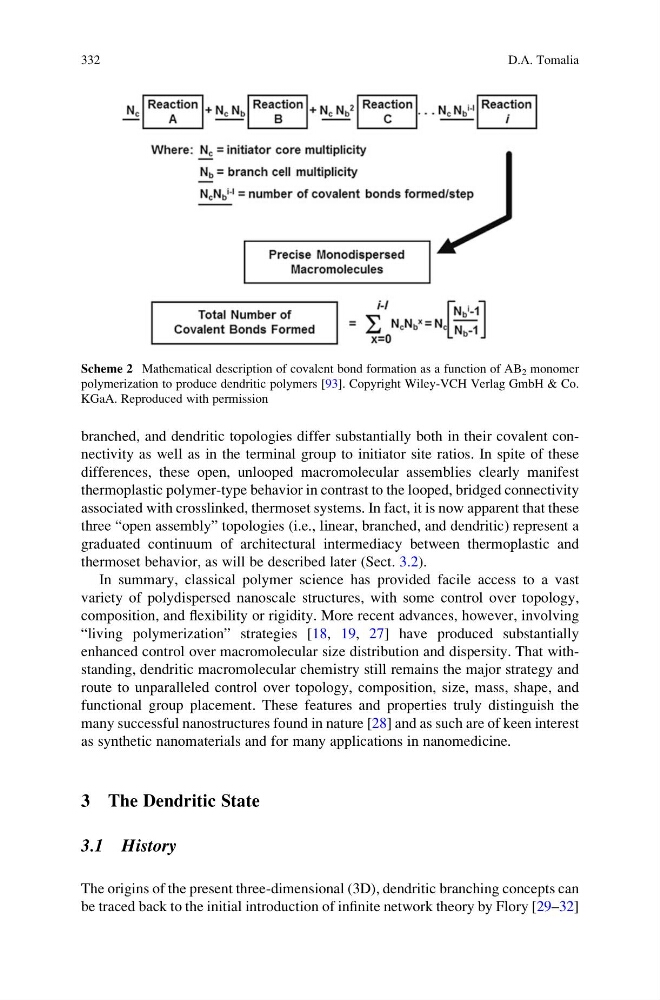
Scheme 2 Mathematical description of covalent bond formation as a function of AB 2 monomer
polymerization to produce dendritic polymers [93]. Copyright Wiley-VCH Verlag GmbH & Co.
KGaA. Reproduced with permission
332
D.A. Tomalia
differences, these open, unlooped macromolecular assemblies clearly manifest
thermoplastic polymer-type behavior in contrast to the looped, bridged connectivity
associated with crosslinked, thermoset systems. In fact, it is now apparent that these
three “open assembly” topologies (i.e., linear, branched, and dendritic) represent a
graduated continuum of architectural intermediacy between thermoplastic and
thermoset behavior, as will be described later (Sect. 3.2).
In summary, classical polymer science has provided facile access to a vast
variety of polydispersed nanoscale structures, with some control over topology,
composition, and flexibility or rigidity. More recent advances, however, involving
“living polymerization” strategies [18, 19, 27] have produced substantially
enhanced control over macromolecular size distribution and dispersity. That withstanding, dendritic macromolecular chemistry still remains the major strategy and
route to unparalleled control over topology, composition, size, mass, shape, and
functional group placement. These features and properties truly distinguish the
many successful nanostructures found in nature [28] and as such are of keen interest
as synthetic nanomaterials and for many applications in nanomedicine.
3 The Dendritic State
3.1 History
The origins of the present three-dimensional (3D), dendritic branching concepts can
be traced back to the initial introduction of infinite network theory by Flory [29–32]
Scheme 2 Mathematical description of covalent bond formation as a function of AB 2 monomer
polymerization to produce dendritic polymers [93]. Copyright Wiley-VCH Verlag GmbH & Co.
KGaA. Reproduced with permission
332
D.A. Tomalia