

by chain reactions, ring-opening reactions, or polycondensation schemes. These
propagation schemes and products are recognized as class I, linear or class III,
branched architectures. Alternatively, using combinations and permutations of
divalent AB-type monomers and/or AB n , A n B polyvalent, branch cell-type monomers
produces class II, crosslinked (bridged) architectures.
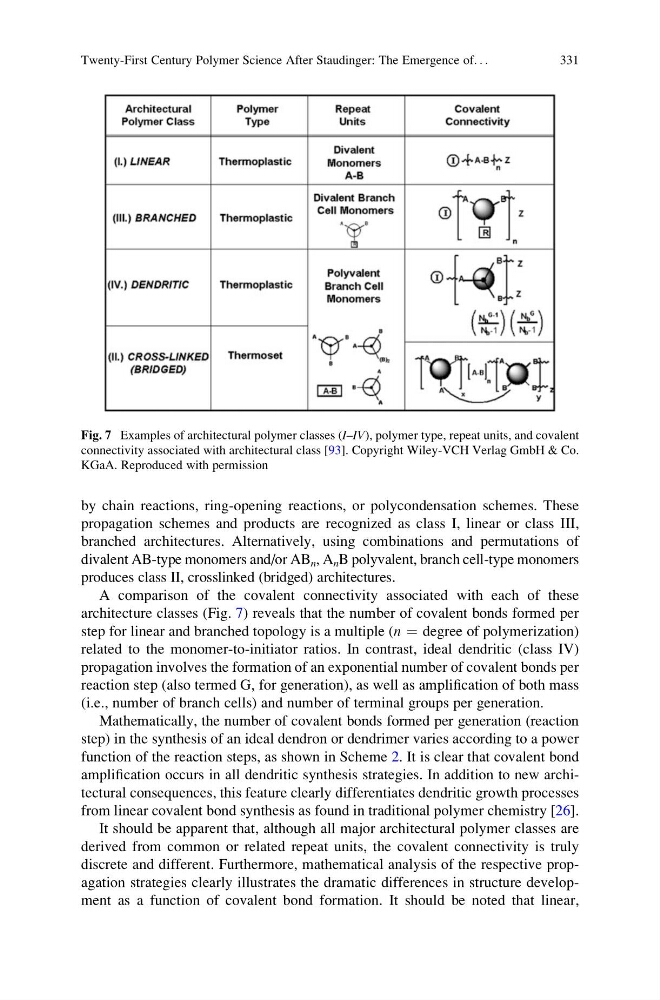
A comparison of the covalent connectivity associated with each of these
architecture classes (Fig. 7) reveals that the number of covalent bonds formed per
step for linear and branched topology is a multiple (n ¼ degree of polymerization)
related to the monomer-to-initiator ratios. In contrast, ideal dendritic (class IV)
propagation involves the formation of an exponential number of covalent bonds per
reaction step (also termed G, for generation), as well as amplification of both mass
(i.e., number of branch cells) and number of terminal groups per generation.
Mathematically, the number of covalent bonds formed per generation (reaction
step) in the synthesis of an ideal dendron or dendrimer varies according to a power
function of the reaction steps, as shown in Scheme 2. It is clear that covalent bond
amplification occurs in all dendritic synthesis strategies. In addition to new architectural consequences, this feature clearly differentiates dendritic growth processes
from linear covalent bond synthesis as found in traditional polymer chemistry [26].
It should be apparent that, although all major architectural polymer classes are
derived from common or related repeat units, the covalent connectivity is truly
discrete and different. Furthermore, mathematical analysis of the respective propagation strategies clearly illustrates the dramatic differences in structure development as a function of covalent bond formation. It should be noted that linear,
Fig. 7 Examples of architectural polymer classes (I–IV), polymer type, repeat units, and covalent
connectivity associated with architectural class [93]. Copyright Wiley-VCH Verlag GmbH & Co.
KGaA. Reproduced with permission
Twenty-First Century Polymer Science After Staudinger: The Emergence of. . .
331
propagation schemes and products are recognized as class I, linear or class III,
branched architectures. Alternatively, using combinations and permutations of
divalent AB-type monomers and/or AB n , A n B polyvalent, branch cell-type monomers
produces class II, crosslinked (bridged) architectures.
A comparison of the covalent connectivity associated with each of these
architecture classes (Fig. 7) reveals that the number of covalent bonds formed per
step for linear and branched topology is a multiple (n ¼ degree of polymerization)
related to the monomer-to-initiator ratios. In contrast, ideal dendritic (class IV)
propagation involves the formation of an exponential number of covalent bonds per
reaction step (also termed G, for generation), as well as amplification of both mass
(i.e., number of branch cells) and number of terminal groups per generation.
Mathematically, the number of covalent bonds formed per generation (reaction
step) in the synthesis of an ideal dendron or dendrimer varies according to a power
function of the reaction steps, as shown in Scheme 2. It is clear that covalent bond
amplification occurs in all dendritic synthesis strategies. In addition to new architectural consequences, this feature clearly differentiates dendritic growth processes
from linear covalent bond synthesis as found in traditional polymer chemistry [26].
It should be apparent that, although all major architectural polymer classes are
derived from common or related repeat units, the covalent connectivity is truly
discrete and different. Furthermore, mathematical analysis of the respective propagation strategies clearly illustrates the dramatic differences in structure development as a function of covalent bond formation. It should be noted that linear,
Fig. 7 Examples of architectural polymer classes (I–IV), polymer type, repeat units, and covalent
connectivity associated with architectural class [93]. Copyright Wiley-VCH Verlag GmbH & Co.
KGaA. Reproduced with permission
Twenty-First Century Polymer Science After Staudinger: The Emergence of. . .
331