

Field-effect transistor (FET) hole mobilities exceeding 3 V cm
2 s
À1 have been
obtained and these were shown to be strongly sensitive to the molecular weight of
the hexadecyl-substituted copolymers. Solid state NMR was used to assess the
supramolecular organization of the conjugated chains. The
1
H 2D DQ NMR spectra
clearly revealed the relevant packing contacts, confirming the expected π–π stacking
for the polymer backbone. The packing of the donor and the acceptor groups,
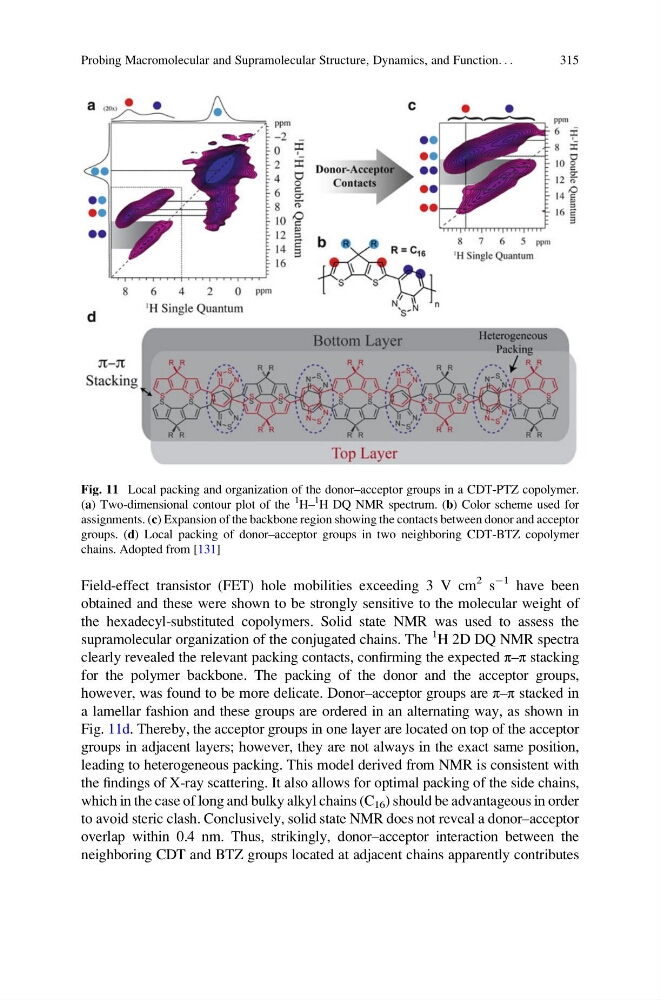
however, was found to be more delicate. Donor–acceptor groups are π–π stacked in
a lamellar fashion and these groups are ordered in an alternating way, as shown in
Fig. 11d. Thereby, the acceptor groups in one layer are located on top of the acceptor
groups in adjacent layers; however, they are not always in the exact same position,
leading to heterogeneous packing. This model derived from NMR is consistent with
the findings of X-ray scattering. It also allows for optimal packing of the side chains,
which in the case of long and bulky alkyl chains (C 16 ) should be advantageous in order
to avoid steric clash. Conclusively, solid state NMR does not reveal a donor–acceptor
overlap within 0.4 nm. Thus, strikingly, donor–acceptor interaction between the
neighboring CDT and BTZ groups located at adjacent chains apparently contributes
Fig. 11 Local packing and organization of the donor–acceptor groups in a CDT-PTZ copolymer.
(a) Two-dimensional contour plot of the
1
H–
1
H DQ NMR spectrum. (b) Color scheme used for
assignments. (c) Expansion of the backbone region showing the contacts between donor and acceptor
groups. (d) Local packing of donor–acceptor groups in two neighboring CDT-BTZ copolymer
chains. Adopted from [131]
Probing Macromolecular and Supramolecular Structure, Dynamics, and Function. . .
315
2 s
À1 have been
obtained and these were shown to be strongly sensitive to the molecular weight of
the hexadecyl-substituted copolymers. Solid state NMR was used to assess the
supramolecular organization of the conjugated chains. The
1
H 2D DQ NMR spectra
clearly revealed the relevant packing contacts, confirming the expected π–π stacking
for the polymer backbone. The packing of the donor and the acceptor groups,
however, was found to be more delicate. Donor–acceptor groups are π–π stacked in
a lamellar fashion and these groups are ordered in an alternating way, as shown in
Fig. 11d. Thereby, the acceptor groups in one layer are located on top of the acceptor
groups in adjacent layers; however, they are not always in the exact same position,
leading to heterogeneous packing. This model derived from NMR is consistent with
the findings of X-ray scattering. It also allows for optimal packing of the side chains,
which in the case of long and bulky alkyl chains (C 16 ) should be advantageous in order
to avoid steric clash. Conclusively, solid state NMR does not reveal a donor–acceptor
overlap within 0.4 nm. Thus, strikingly, donor–acceptor interaction between the
neighboring CDT and BTZ groups located at adjacent chains apparently contributes
Fig. 11 Local packing and organization of the donor–acceptor groups in a CDT-PTZ copolymer.
(a) Two-dimensional contour plot of the
1
H–
1
H DQ NMR spectrum. (b) Color scheme used for
assignments. (c) Expansion of the backbone region showing the contacts between donor and acceptor
groups. (d) Local packing of donor–acceptor groups in two neighboring CDT-BTZ copolymer
chains. Adopted from [131]
Probing Macromolecular and Supramolecular Structure, Dynamics, and Function. . .
315