

order. The specific organization of the macromolecules depends on the processing
conditions. X-ray diffraction (XRD), which is well established in structure elucidation, requires high order, like that of single crystals, if atomic resolution is sought.
From a fiber diagram, often employed in polymer science [53], only information
about the relative assembly on a crystallographic lattice, or chain-to-chain and π–π
stacking distances, can be derived. Thus, a “multi-technique” approach is required to
fully elucidate such structures.
Along these lines, we recently introduced a new systematic strategy for revealing
the local packing in such polymer systems [122]. Our strategy makes use of the space
group (i.e., one of the first steps in a conventional approach to solve a crystal
structure), distance constraints from
1
H DQ NMR, and chemical shifts. These experimental results are unified by quantum-chemical calculations, enabling the verification of specific packing models in silico and quantification of π-stacking effects.
In order to illustrate the potential of our strategy, we chose poly(3-hexyl-thiophene)
(P3HT) as a prominent example. It is one of the most frequently studied semiconducting polymers because of its widespread applications in organic electronic
devices, resulting from its facile processability, high charge-carrier mobility (up to
0.1 Vcm
2 s
À1
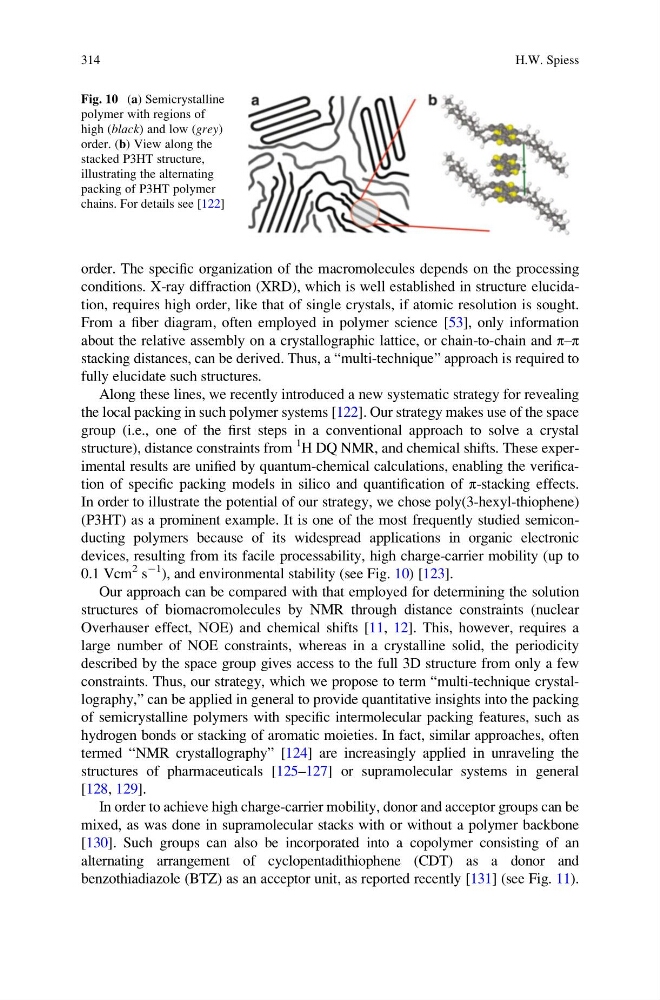
), and environmental stability (see Fig. 10) [123].
Our approach can be compared with that employed for determining the solution
structures of biomacromolecules by NMR through distance constraints (nuclear
Overhauser effect, NOE) and chemical shifts [11, 12]. This, however, requires a
large number of NOE constraints, whereas in a crystalline solid, the periodicity
described by the space group gives access to the full 3D structure from only a few
constraints. Thus, our strategy, which we propose to term “multi-technique crystallography,” can be applied in general to provide quantitative insights into the packing
of semicrystalline polymers with specific intermolecular packing features, such as
hydrogen bonds or stacking of aromatic moieties. In fact, similar approaches, often
termed “NMR crystallography” [124] are increasingly applied in unraveling the
structures of pharmaceuticals [125–127] or supramolecular systems in general
[128, 129].
In order to achieve high charge-carrier mobility, donor and acceptor groups can be
mixed, as was done in supramolecular stacks with or without a polymer backbone
[130]. Such groups can also be incorporated into a copolymer consisting of an
alternating arrangement of cyclopentadithiophene (CDT) as a donor and
benzothiadiazole (BTZ) as an acceptor unit, as reported recently [131] (see Fig. 11).
Fig. 10 (a) Semicrystalline
polymer with regions of
high (black) and low (grey)
order. (b) View along the
stacked P3HT structure,
illustrating the alternating
packing of P3HT polymer
chains. For details see [122]
314
H.W. Spiess
conditions. X-ray diffraction (XRD), which is well established in structure elucidation, requires high order, like that of single crystals, if atomic resolution is sought.
From a fiber diagram, often employed in polymer science [53], only information
about the relative assembly on a crystallographic lattice, or chain-to-chain and π–π
stacking distances, can be derived. Thus, a “multi-technique” approach is required to
fully elucidate such structures.
Along these lines, we recently introduced a new systematic strategy for revealing
the local packing in such polymer systems [122]. Our strategy makes use of the space
group (i.e., one of the first steps in a conventional approach to solve a crystal
structure), distance constraints from
1
H DQ NMR, and chemical shifts. These experimental results are unified by quantum-chemical calculations, enabling the verification of specific packing models in silico and quantification of π-stacking effects.
In order to illustrate the potential of our strategy, we chose poly(3-hexyl-thiophene)
(P3HT) as a prominent example. It is one of the most frequently studied semiconducting polymers because of its widespread applications in organic electronic
devices, resulting from its facile processability, high charge-carrier mobility (up to
0.1 Vcm
2 s
À1
), and environmental stability (see Fig. 10) [123].
Our approach can be compared with that employed for determining the solution
structures of biomacromolecules by NMR through distance constraints (nuclear
Overhauser effect, NOE) and chemical shifts [11, 12]. This, however, requires a
large number of NOE constraints, whereas in a crystalline solid, the periodicity
described by the space group gives access to the full 3D structure from only a few
constraints. Thus, our strategy, which we propose to term “multi-technique crystallography,” can be applied in general to provide quantitative insights into the packing
of semicrystalline polymers with specific intermolecular packing features, such as
hydrogen bonds or stacking of aromatic moieties. In fact, similar approaches, often
termed “NMR crystallography” [124] are increasingly applied in unraveling the
structures of pharmaceuticals [125–127] or supramolecular systems in general
[128, 129].
In order to achieve high charge-carrier mobility, donor and acceptor groups can be
mixed, as was done in supramolecular stacks with or without a polymer backbone
[130]. Such groups can also be incorporated into a copolymer consisting of an
alternating arrangement of cyclopentadithiophene (CDT) as a donor and
benzothiadiazole (BTZ) as an acceptor unit, as reported recently [131] (see Fig. 11).
Fig. 10 (a) Semicrystalline
polymer with regions of
high (black) and low (grey)
order. (b) View along the
stacked P3HT structure,
illustrating the alternating
packing of P3HT polymer
chains. For details see [122]
314
H.W. Spiess