

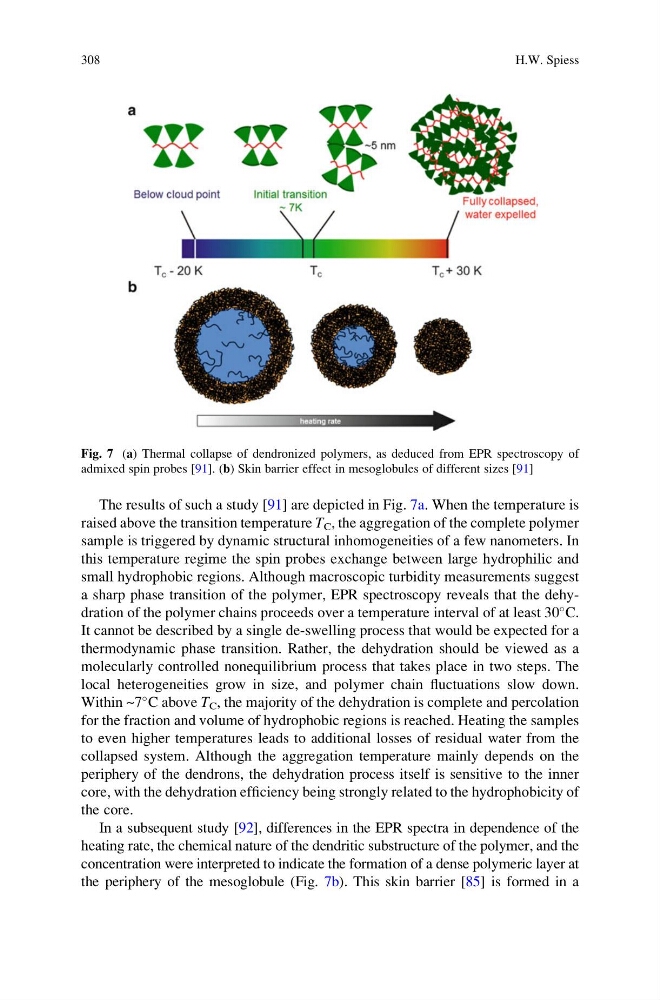
The results of such a study [91] are depicted in Fig. 7a. When the temperature is
raised above the transition temperature T C , the aggregation of the complete polymer
sample is triggered by dynamic structural inhomogeneities of a few nanometers. In
this temperature regime the spin probes exchange between large hydrophilic and
small hydrophobic regions. Although macroscopic turbidity measurements suggest
a sharp phase transition of the polymer, EPR spectroscopy reveals that the dehydration of the polymer chains proceeds over a temperature interval of at least 30
C.
It cannot be described by a single de-swelling process that would be expected for a
thermodynamic phase transition. Rather, the dehydration should be viewed as a
molecularly controlled nonequilibrium process that takes place in two steps. The
local heterogeneities grow in size, and polymer chain fluctuations slow down.
Within ~7
C above T C , the majority of the dehydration is complete and percolation
for the fraction and volume of hydrophobic regions is reached. Heating the samples
to even higher temperatures leads to additional losses of residual water from the
collapsed system. Although the aggregation temperature mainly depends on the
periphery of the dendrons, the dehydration process itself is sensitive to the inner
core, with the dehydration efficiency being strongly related to the hydrophobicity of
the core.
In a subsequent study [92], differences in the EPR spectra in dependence of the
heating rate, the chemical nature of the dendritic substructure of the polymer, and the
concentration were interpreted to indicate the formation of a dense polymeric layer at
the periphery of the mesoglobule (Fig. 7b). This skin barrier [85] is formed in a
Fig. 7 (a) Thermal collapse of dendronized polymers, as deduced from EPR spectroscopy of
admixed spin probes [91]. (b) Skin barrier effect in mesoglobules of different sizes [91]
308
H.W. Spiess
raised above the transition temperature T C , the aggregation of the complete polymer
sample is triggered by dynamic structural inhomogeneities of a few nanometers. In
this temperature regime the spin probes exchange between large hydrophilic and
small hydrophobic regions. Although macroscopic turbidity measurements suggest
a sharp phase transition of the polymer, EPR spectroscopy reveals that the dehydration of the polymer chains proceeds over a temperature interval of at least 30
C.
It cannot be described by a single de-swelling process that would be expected for a
thermodynamic phase transition. Rather, the dehydration should be viewed as a
molecularly controlled nonequilibrium process that takes place in two steps. The
local heterogeneities grow in size, and polymer chain fluctuations slow down.
Within ~7
C above T C , the majority of the dehydration is complete and percolation
for the fraction and volume of hydrophobic regions is reached. Heating the samples
to even higher temperatures leads to additional losses of residual water from the
collapsed system. Although the aggregation temperature mainly depends on the
periphery of the dendrons, the dehydration process itself is sensitive to the inner
core, with the dehydration efficiency being strongly related to the hydrophobicity of
the core.
In a subsequent study [92], differences in the EPR spectra in dependence of the
heating rate, the chemical nature of the dendritic substructure of the polymer, and the
concentration were interpreted to indicate the formation of a dense polymeric layer at
the periphery of the mesoglobule (Fig. 7b). This skin barrier [85] is formed in a
Fig. 7 (a) Thermal collapse of dendronized polymers, as deduced from EPR spectroscopy of
admixed spin probes [91]. (b) Skin barrier effect in mesoglobules of different sizes [91]
308
H.W. Spiess