

oligoethyleneglycol (OEG) helped to shed more light on the phase separation because
they exhibit fast and fully reversible as well as particularly sharp transitions, as
observed in turbidity measurements [88]. These dendronized polymers with terminal
ethoxy groups are soluble in water. Their LCSTs lie in a physiologically interesting
temperature range between 30 and 36
C and mainly depend on the periphery of the
dendrons.
There are indications, however, that such thermal responses proceed by via the
formation of structural inhomogeneities of variable lifetimes on the nanometer scale
that are still poorly understood. Indeed, this topic has been identified as one of the
major challenges of current research in the macromolecular sciences [89]. The
structure and lifetime of these local inhomogeneities will obviously influence the
aspired function, for instance drug delivery. Magnetic resonance techniques, as
intrinsically local methods, are particularly suited to probe structural inhomogeneities
of functional macromolecules in general [14, 21] For instance, with multidimensional
NMR, the lifetime of dynamic heterogeneities in polymer melts in the vicinity of the
glass transition was identified as early as 1991 [90].
A particularly simple way of studying the molecular environment of thermoresponsive dendronized polymers, which undergo a thermal transition, utilizes conventional continuous wave (CW) EPR spectroscopy on nitroxide radicals, as
paramagnetic tracer molecules [21]. As noted above, such spin probes are sensitive
to the local viscosity, which will give rise to changes in the rotational correlation
time and to the local polarity/hydrophilicity [21, 22]. The latter affects the electronic structure of the radical and changes the spectral parameters, specifically the
g-factor and the hyperfine coupling constant to
14 N. The amphiphilic radical
2,2,6,6-tetramethylpiperidine-1-oxyl (TEMPO) is especially suited to sample both
hydrophobic and hydrophilic regions and also mimics a small molecule to be
delivered by the dendronized polymer.
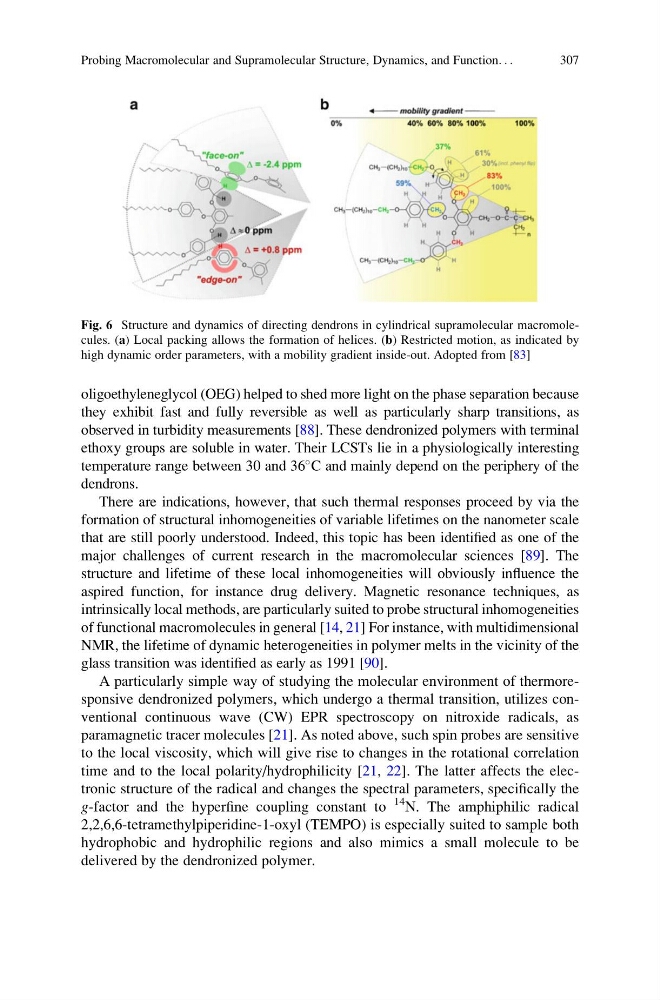
Fig. 6 Structure and dynamics of directing dendrons in cylindrical supramolecular macromolecules. (a) Local packing allows the formation of helices. (b) Restricted motion, as indicated by
high dynamic order parameters, with a mobility gradient inside-out. Adopted from [83]
Probing Macromolecular and Supramolecular Structure, Dynamics, and Function. . .
307
they exhibit fast and fully reversible as well as particularly sharp transitions, as
observed in turbidity measurements [88]. These dendronized polymers with terminal
ethoxy groups are soluble in water. Their LCSTs lie in a physiologically interesting
temperature range between 30 and 36
C and mainly depend on the periphery of the
dendrons.
There are indications, however, that such thermal responses proceed by via the
formation of structural inhomogeneities of variable lifetimes on the nanometer scale
that are still poorly understood. Indeed, this topic has been identified as one of the
major challenges of current research in the macromolecular sciences [89]. The
structure and lifetime of these local inhomogeneities will obviously influence the
aspired function, for instance drug delivery. Magnetic resonance techniques, as
intrinsically local methods, are particularly suited to probe structural inhomogeneities
of functional macromolecules in general [14, 21] For instance, with multidimensional
NMR, the lifetime of dynamic heterogeneities in polymer melts in the vicinity of the
glass transition was identified as early as 1991 [90].
A particularly simple way of studying the molecular environment of thermoresponsive dendronized polymers, which undergo a thermal transition, utilizes conventional continuous wave (CW) EPR spectroscopy on nitroxide radicals, as
paramagnetic tracer molecules [21]. As noted above, such spin probes are sensitive
to the local viscosity, which will give rise to changes in the rotational correlation
time and to the local polarity/hydrophilicity [21, 22]. The latter affects the electronic structure of the radical and changes the spectral parameters, specifically the
g-factor and the hyperfine coupling constant to
14 N. The amphiphilic radical
2,2,6,6-tetramethylpiperidine-1-oxyl (TEMPO) is especially suited to sample both
hydrophobic and hydrophilic regions and also mimics a small molecule to be
delivered by the dendronized polymer.
Fig. 6 Structure and dynamics of directing dendrons in cylindrical supramolecular macromolecules. (a) Local packing allows the formation of helices. (b) Restricted motion, as indicated by
high dynamic order parameters, with a mobility gradient inside-out. Adopted from [83]
Probing Macromolecular and Supramolecular Structure, Dynamics, and Function. . .
307