

more compact size of the polyrotaxanes is particularly remarkable, given the fact
that their molecular weights are over twice that of the parent threads. In order to
confirm this surprising result, we used atomic force microscopy (AFM) to image
individual polymer chains, which were drop-cast from dilute DMF solutions onto
highly ordered pyrolitic graphite (HOPG) substrates. Representative AFM images,
cross-sectional heights, and fitted histograms of the measured lengths for the largest
pair of polymers 453NPEN 3 and 453NPR
4m+ are shown in Fig. 7. Indeed, the two
polymers show distinct differences in their dimensionality. The rotaxane polymer
453NPR
4m+ shows a decrease in length and corresponding increase in height and
width compared to the parent thread 453NPE(N 3 ) 2 . The fitted histograms that plot
molecular lengths in Fig. 7 show that the polyrotaxane is almost 10 nm shorter on
average than its counterpart thread. The AFM results suggest that the CBPQT
4+
rings cause the polymer backbone to compress along its long axis, while expanding
along the other two axes. This picture of a shorter, fatter macromolecule is fully
consistent with the hypothesis of a highly folded conformation analogous to those
observed in the solid state (Sect. 2), which maximizes the stabilizing [C–H Á Á Á O]
and D–A π-stacking interactions within these polyelectrolytes.
What began as a highly efficient approach to the synthesis of a new class of
mechanically interlocked macromolecules set the stage, not only for the controllable fabrication of intricate nanoscale molecular architectures, but also for the
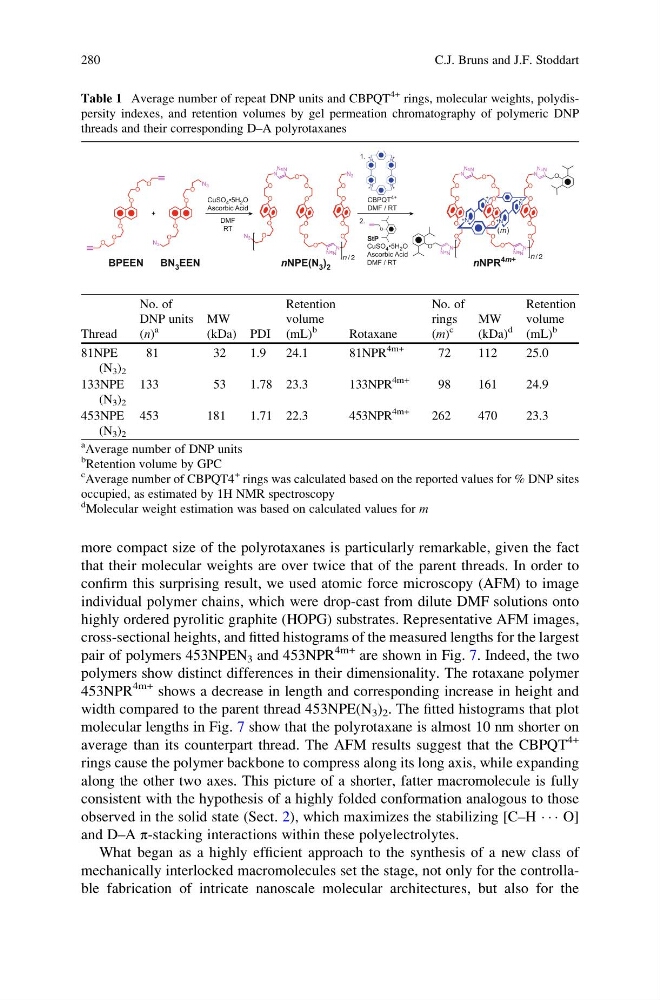
Table 1 Average number of repeat DNP units and CBPQT
4+ rings, molecular weights, polydispersity indexes, and retention volumes by gel permeation chromatography of polymeric DNP
threads and their corresponding D–A polyrotaxanes
Thread
No. of
DNP units
(n)
a
MW
(kDa) PDI
Retention
volume
(mL)
b
Rotaxane
No. of
rings
(m)
c
MW
(kDa)
d
Retention
volume
(mL)
b
81NPE
(N 3 ) 2
81
32
1.9
24.1
81NPR
4m+
72
112
25.0
133NPE
(N 3 ) 2
133
53
1.78 23.3
133NPR
4m+
98
161
24.9
453NPE
(N 3 ) 2
453
181
1.71 22.3
453NPR
4m+
262
470
23.3
a
Average number of DNP units
b
Retention volume by GPC
c
Average number of CBPQT4
+ rings was calculated based on the reported values for % DNP sites
occupied, as estimated by 1H NMR spectroscopy
d
Molecular weight estimation was based on calculated values for m
280
C.J. Bruns and J.F. Stoddart
that their molecular weights are over twice that of the parent threads. In order to
confirm this surprising result, we used atomic force microscopy (AFM) to image
individual polymer chains, which were drop-cast from dilute DMF solutions onto
highly ordered pyrolitic graphite (HOPG) substrates. Representative AFM images,
cross-sectional heights, and fitted histograms of the measured lengths for the largest
pair of polymers 453NPEN 3 and 453NPR
4m+ are shown in Fig. 7. Indeed, the two
polymers show distinct differences in their dimensionality. The rotaxane polymer
453NPR
4m+ shows a decrease in length and corresponding increase in height and
width compared to the parent thread 453NPE(N 3 ) 2 . The fitted histograms that plot
molecular lengths in Fig. 7 show that the polyrotaxane is almost 10 nm shorter on
average than its counterpart thread. The AFM results suggest that the CBPQT
4+
rings cause the polymer backbone to compress along its long axis, while expanding
along the other two axes. This picture of a shorter, fatter macromolecule is fully
consistent with the hypothesis of a highly folded conformation analogous to those
observed in the solid state (Sect. 2), which maximizes the stabilizing [C–H Á Á Á O]
and D–A π-stacking interactions within these polyelectrolytes.
What began as a highly efficient approach to the synthesis of a new class of
mechanically interlocked macromolecules set the stage, not only for the controllable fabrication of intricate nanoscale molecular architectures, but also for the
Table 1 Average number of repeat DNP units and CBPQT
4+ rings, molecular weights, polydispersity indexes, and retention volumes by gel permeation chromatography of polymeric DNP
threads and their corresponding D–A polyrotaxanes
Thread
No. of
DNP units
(n)
a
MW
(kDa) PDI
Retention
volume
(mL)
b
Rotaxane
No. of
rings
(m)
c
MW
(kDa)
d
Retention
volume
(mL)
b
81NPE
(N 3 ) 2
81
32
1.9
24.1
81NPR
4m+
72
112
25.0
133NPE
(N 3 ) 2
133
53
1.78 23.3
133NPR
4m+
98
161
24.9
453NPE
(N 3 ) 2
453
181
1.71 22.3
453NPR
4m+
262
470
23.3
a
Average number of DNP units
b
Retention volume by GPC
c
Average number of CBPQT4
+ rings was calculated based on the reported values for % DNP sites
occupied, as estimated by 1H NMR spectroscopy
d
Molecular weight estimation was based on calculated values for m
280
C.J. Bruns and J.F. Stoddart