

2.2 Infinite-Chain Lattice of D–A Oligo-Pseudorotaxanes
Although high molecular weight (HMW) polymers are exceedingly difficult to
obtain as macroscopic single crystals because of diffusion limitations, chain entanglements, and heterogeneous length distributions, it has been demonstrated [108]
that their crystal structures can be discerned by single crystal analysis of their smallmolecule homologues. When we lengthened the glycol-bridged DNP oligomers
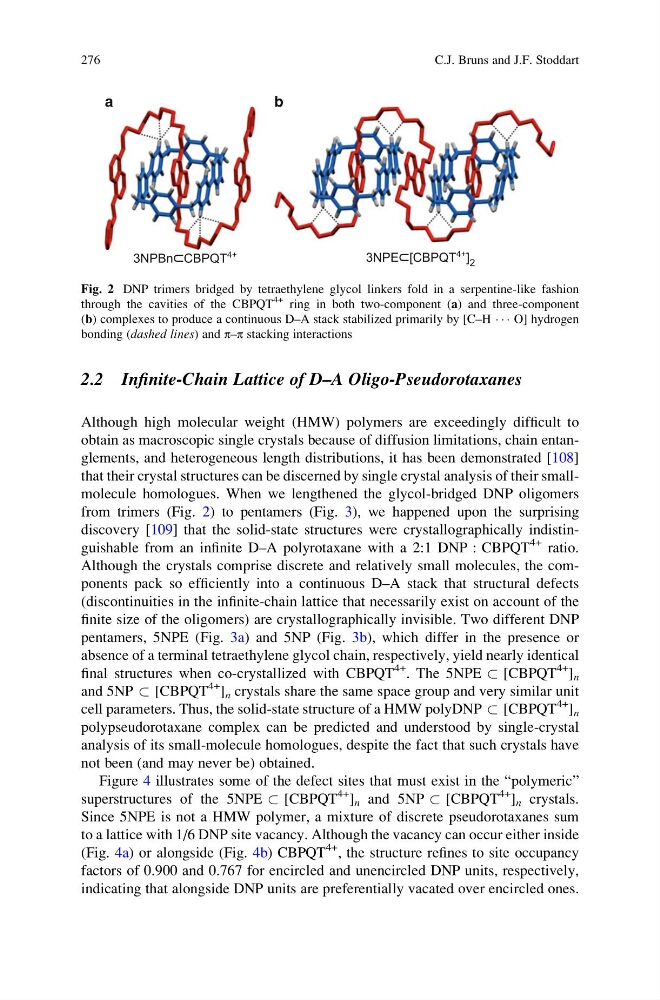
from trimers (Fig. 2) to pentamers (Fig. 3), we happened upon the surprising
discovery [109] that the solid-state structures were crystallographically indistinguishable from an infinite D–A polyrotaxane with a 2:1 DNP : CBPQT
4+ ratio.
Although the crystals comprise discrete and relatively small molecules, the components pack so efficiently into a continuous D–A stack that structural defects
(discontinuities in the infinite-chain lattice that necessarily exist on account of the
finite size of the oligomers) are crystallographically invisible. Two different DNP
pentamers, 5NPE (Fig. 3a) and 5NP (Fig. 3b), which differ in the presence or
absence of a terminal tetraethylene glycol chain, respectively, yield nearly identical
final structures when co-crystallized with CBPQT
4+ . The 5NPE & [CBPQT
4+ ] n
and 5NP & [CBPQT
4+ ] n crystals share the same space group and very similar unit
cell parameters. Thus, the solid-state structure of a HMW polyDNP & [CBPQT
4+ ] n
polypseudorotaxane complex can be predicted and understood by single-crystal
analysis of its small-molecule homologues, despite the fact that such crystals have
not been (and may never be) obtained.
Figure 4 illustrates some of the defect sites that must exist in the “polymeric”
superstructures of the 5NPE & [CBPQT
4+ ] n and 5NP & [CBPQT
4+ ] n crystals.
Since 5NPE is not a HMW polymer, a mixture of discrete pseudorotaxanes sum
to a lattice with 1/6 DNP site vacancy. Although the vacancy can occur either inside
(Fig. 4a) or alongside (Fig. 4b) CBPQT
4+ , the structure refines to site occupancy
factors of 0.900 and 0.767 for encircled and unencircled DNP units, respectively,
indicating that alongside DNP units are preferentially vacated over encircled ones.
a
b
Fig. 2 DNP trimers bridged by tetraethylene glycol linkers fold in a serpentine-like fashion
through the cavities of the CBPQT
4+ ring in both two-component (a) and three-component
(b) complexes to produce a continuous D–A stack stabilized primarily by [C–H Á Á Á O] hydrogen
bonding (dashed lines) and π–π stacking interactions
276
C.J. Bruns and J.F. Stoddart
Although high molecular weight (HMW) polymers are exceedingly difficult to
obtain as macroscopic single crystals because of diffusion limitations, chain entanglements, and heterogeneous length distributions, it has been demonstrated [108]
that their crystal structures can be discerned by single crystal analysis of their smallmolecule homologues. When we lengthened the glycol-bridged DNP oligomers
from trimers (Fig. 2) to pentamers (Fig. 3), we happened upon the surprising
discovery [109] that the solid-state structures were crystallographically indistinguishable from an infinite D–A polyrotaxane with a 2:1 DNP : CBPQT
4+ ratio.
Although the crystals comprise discrete and relatively small molecules, the components pack so efficiently into a continuous D–A stack that structural defects
(discontinuities in the infinite-chain lattice that necessarily exist on account of the
finite size of the oligomers) are crystallographically invisible. Two different DNP
pentamers, 5NPE (Fig. 3a) and 5NP (Fig. 3b), which differ in the presence or
absence of a terminal tetraethylene glycol chain, respectively, yield nearly identical
final structures when co-crystallized with CBPQT
4+ . The 5NPE & [CBPQT
4+ ] n
and 5NP & [CBPQT
4+ ] n crystals share the same space group and very similar unit
cell parameters. Thus, the solid-state structure of a HMW polyDNP & [CBPQT
4+ ] n
polypseudorotaxane complex can be predicted and understood by single-crystal
analysis of its small-molecule homologues, despite the fact that such crystals have
not been (and may never be) obtained.
Figure 4 illustrates some of the defect sites that must exist in the “polymeric”
superstructures of the 5NPE & [CBPQT
4+ ] n and 5NP & [CBPQT
4+ ] n crystals.
Since 5NPE is not a HMW polymer, a mixture of discrete pseudorotaxanes sum
to a lattice with 1/6 DNP site vacancy. Although the vacancy can occur either inside
(Fig. 4a) or alongside (Fig. 4b) CBPQT
4+ , the structure refines to site occupancy
factors of 0.900 and 0.767 for encircled and unencircled DNP units, respectively,
indicating that alongside DNP units are preferentially vacated over encircled ones.
a
b
Fig. 2 DNP trimers bridged by tetraethylene glycol linkers fold in a serpentine-like fashion
through the cavities of the CBPQT
4+ ring in both two-component (a) and three-component
(b) complexes to produce a continuous D–A stack stabilized primarily by [C–H Á Á Á O] hydrogen
bonding (dashed lines) and π–π stacking interactions
276
C.J. Bruns and J.F. Stoddart