

produced results that inspired the subsequent development of the interlaced
foldamers described in Sects. 2.2 and 3. The crystal structures depicted in Fig. 2
demonstrate that the flexible tetraethylene glycol chains employed to connect the
adjacent DNP units form multiple [C–H Á Á Á O] interactions with the α-BIPY
2+
protons, while allowing the unencircled DNP units to extend a D–A mixed stack
by docking alongside of CBPQT
4+ . Rather than competing with one another, the
important [C–H Á Á Á O] and π–π interactions participate in a mutually beneficial
relationship wherein the natural curvature of the glycol chains works synergistically
with the stacking of aromatic recognition units to stabilize the complexes. The
solid-state structure of the two-component pseudorotaxane 3NPBn & CBPQT
4+
(Fig. 2a) was obtained [106] in 1994, whereas that of the three-component complex
3NPE & [CBPQT
4+ ] 2 (Fig. 2b) came [107] much later while carrying out the
solution-state work described in Sect. 3. It is also noteworthy that both 3NPBn &
CBPQT
4+ and 3NPE & [CBPQT
4+ ] 2 crystallize with secondary structures that
utilize all of the available recognition units in a D–A stack; no π-electron donors
or acceptors are located in isolation from a counterpart recognition site of the
opposite kind. Although each of these complexes maintains an internal D–A
stack, they do not pack in register with other complexes so as to extend the stack
indefinitely.
a
b
c
d
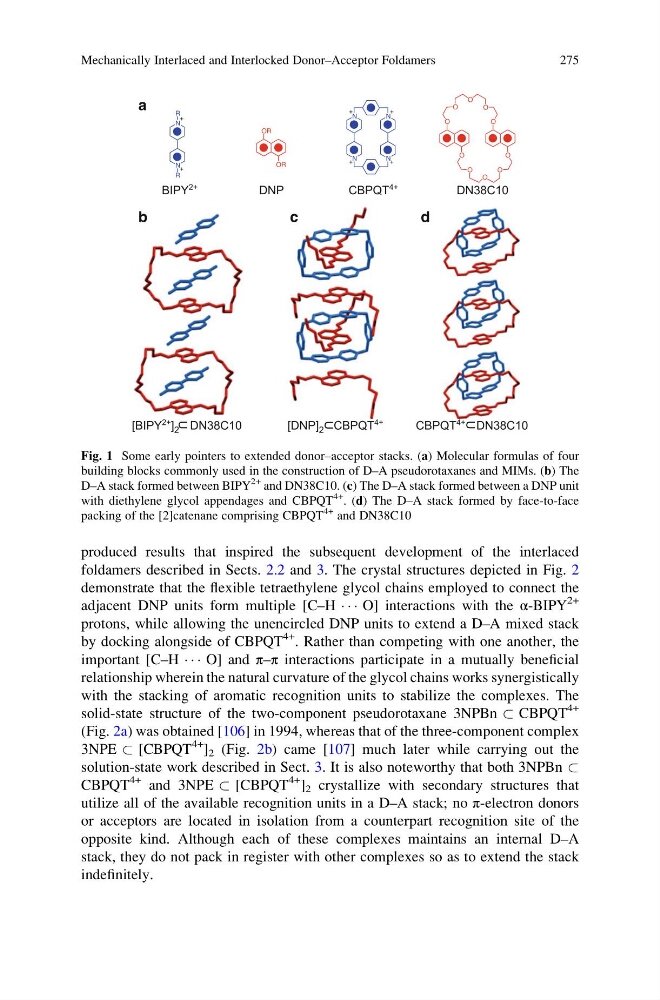
Fig. 1 Some early pointers to extended donor–acceptor stacks. (a) Molecular formulas of four
building blocks commonly used in the construction of D–A pseudorotaxanes and MIMs. (b) The
D–A stack formed between BIPY
2+ and DN38C10. (c) The D–A stack formed between a DNP unit
with diethylene glycol appendages and CBPQT
4+ . (d) The D–A stack formed by face-to-face
packing of the [2]catenane comprising CBPQT
4+ and DN38C10
Mechanically Interlaced and Interlocked Donor–Acceptor Foldamers
275
foldamers described in Sects. 2.2 and 3. The crystal structures depicted in Fig. 2
demonstrate that the flexible tetraethylene glycol chains employed to connect the
adjacent DNP units form multiple [C–H Á Á Á O] interactions with the α-BIPY
2+
protons, while allowing the unencircled DNP units to extend a D–A mixed stack
by docking alongside of CBPQT
4+ . Rather than competing with one another, the
important [C–H Á Á Á O] and π–π interactions participate in a mutually beneficial
relationship wherein the natural curvature of the glycol chains works synergistically
with the stacking of aromatic recognition units to stabilize the complexes. The
solid-state structure of the two-component pseudorotaxane 3NPBn & CBPQT
4+
(Fig. 2a) was obtained [106] in 1994, whereas that of the three-component complex
3NPE & [CBPQT
4+ ] 2 (Fig. 2b) came [107] much later while carrying out the
solution-state work described in Sect. 3. It is also noteworthy that both 3NPBn &
CBPQT
4+ and 3NPE & [CBPQT
4+ ] 2 crystallize with secondary structures that
utilize all of the available recognition units in a D–A stack; no π-electron donors
or acceptors are located in isolation from a counterpart recognition site of the
opposite kind. Although each of these complexes maintains an internal D–A
stack, they do not pack in register with other complexes so as to extend the stack
indefinitely.
a
b
c
d
Fig. 1 Some early pointers to extended donor–acceptor stacks. (a) Molecular formulas of four
building blocks commonly used in the construction of D–A pseudorotaxanes and MIMs. (b) The
D–A stack formed between BIPY
2+ and DN38C10. (c) The D–A stack formed between a DNP unit
with diethylene glycol appendages and CBPQT
4+ . (d) The D–A stack formed by face-to-face
packing of the [2]catenane comprising CBPQT
4+ and DN38C10
Mechanically Interlaced and Interlocked Donor–Acceptor Foldamers
275