

safe and efficient artificial gene carriers [35]. Moreover, the complexation of metal
ions to the core-forming backbone has been used for constructing various polymeric
micelles [49–51]. Platinum anticancer drugs incorporated into polymeric micelles
by this method showed extended circulation in the bloodstream and enhanced
accumulation and efficacy against solid tumors [50, 51]. The creation of multiple
hydrogen bonds between the core-forming blocks, as occurs in base pairs in DNA
and RNA in biological systems, can also spontaneously form micelles in aqueous
solution [52]. Moreover, the polyanion of PEG-b-polyanion copolymers has been
used for controlling the growth of calcium phosphate crystals in the core of
micelles, while the PEG shell avoids aggregation of the particles [53].
Because of the diversity of intermolecular forces for self-assembly and the dense
PEG palisade, which can eliminate the aggregation of otherwise agglomerating
supramolecular systems, these supramolecular assemblies also represent a useful
platform for studying the mechanistic details of the molecular interactions that
stabilize highly ordered states and folding of proteins, which is a central goal of
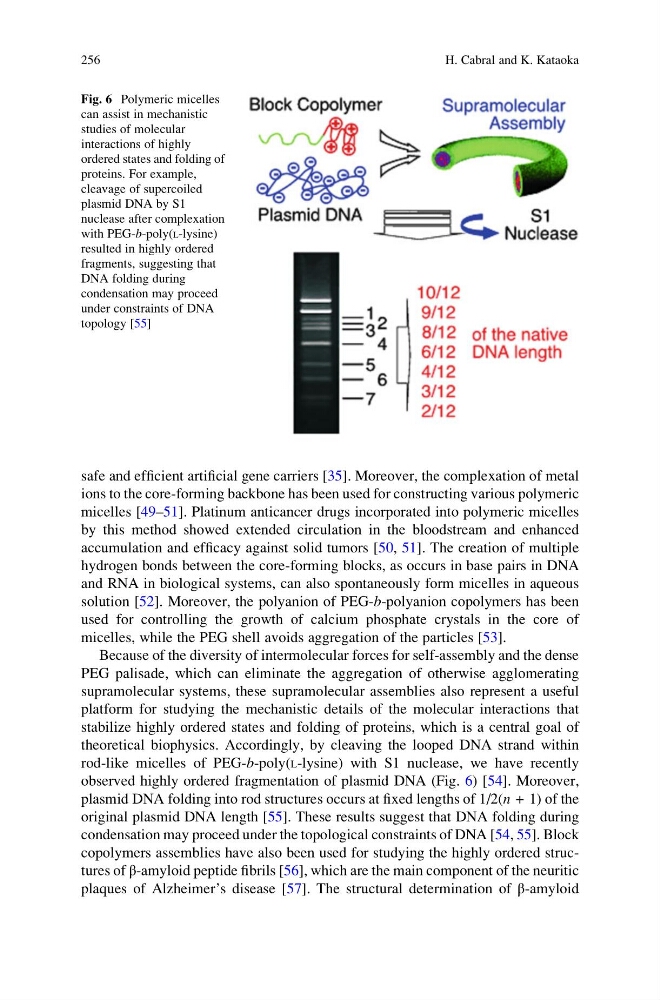
theoretical biophysics. Accordingly, by cleaving the looped DNA strand within
rod-like micelles of PEG-b-poly(L-lysine) with S1 nuclease, we have recently
observed highly ordered fragmentation of plasmid DNA (Fig. 6) [54]. Moreover,
plasmid DNA folding into rod structures occurs at fixed lengths of 1/2(n + 1) of the
original plasmid DNA length [55]. These results suggest that DNA folding during
condensation may proceed under the topological constraints of DNA [54, 55]. Block
copolymers assemblies have also been used for studying the highly ordered structures of β-amyloid peptide fibrils [56], which are the main component of the neuritic
plaques of Alzheimer’s disease [57]. The structural determination of β-amyloid
Fig. 6 Polymeric micelles
can assist in mechanistic
studies of molecular
interactions of highly
ordered states and folding of
proteins. For example,
cleavage of supercoiled
plasmid DNA by S1
nuclease after complexation
with PEG-b-poly(L-lysine)
resulted in highly ordered
fragments, suggesting that
DNA folding during
condensation may proceed
under constraints of DNA
topology [55]
256
H. Cabral and K. Kataoka
ions to the core-forming backbone has been used for constructing various polymeric
micelles [49–51]. Platinum anticancer drugs incorporated into polymeric micelles
by this method showed extended circulation in the bloodstream and enhanced
accumulation and efficacy against solid tumors [50, 51]. The creation of multiple
hydrogen bonds between the core-forming blocks, as occurs in base pairs in DNA
and RNA in biological systems, can also spontaneously form micelles in aqueous
solution [52]. Moreover, the polyanion of PEG-b-polyanion copolymers has been
used for controlling the growth of calcium phosphate crystals in the core of
micelles, while the PEG shell avoids aggregation of the particles [53].
Because of the diversity of intermolecular forces for self-assembly and the dense
PEG palisade, which can eliminate the aggregation of otherwise agglomerating
supramolecular systems, these supramolecular assemblies also represent a useful
platform for studying the mechanistic details of the molecular interactions that
stabilize highly ordered states and folding of proteins, which is a central goal of
theoretical biophysics. Accordingly, by cleaving the looped DNA strand within
rod-like micelles of PEG-b-poly(L-lysine) with S1 nuclease, we have recently
observed highly ordered fragmentation of plasmid DNA (Fig. 6) [54]. Moreover,
plasmid DNA folding into rod structures occurs at fixed lengths of 1/2(n + 1) of the
original plasmid DNA length [55]. These results suggest that DNA folding during
condensation may proceed under the topological constraints of DNA [54, 55]. Block
copolymers assemblies have also been used for studying the highly ordered structures of β-amyloid peptide fibrils [56], which are the main component of the neuritic
plaques of Alzheimer’s disease [57]. The structural determination of β-amyloid
Fig. 6 Polymeric micelles
can assist in mechanistic
studies of molecular
interactions of highly
ordered states and folding of
proteins. For example,
cleavage of supercoiled
plasmid DNA by S1
nuclease after complexation
with PEG-b-poly(L-lysine)
resulted in highly ordered
fragments, suggesting that
DNA folding during
condensation may proceed
under constraints of DNA
topology [55]
256
H. Cabral and K. Kataoka