

receptors expressed at diseased sites and a selective cleavable spacer for triggered
drug release. Moreover, the model includes the controlled distribution of the
carriers in the body, as macromolecules larger than the molecular weight of the
threshold for glomerular filtration (42–50 kDa) have reduced clearance through
kidneys, while the nonspecific resorption enhancer (Fig. 1) avoids unspecific
interaction with components of the reticuloendothelial system.
During the late 1970s and early 1980s, Jindr ˇich Kopec ˇek and Ruth Duncan
reported several polymer–drug conjugates based on Kopec ˇek’s poly(hydroxypropyl
methacrylamide) (PHPMA) copolymers [14]. PHPMA present several points in
common with the Ringsdorf model because it is hydrophilic, nonimmunogenic,
nontoxic, its side groups can be modified for incorporating transport systems and
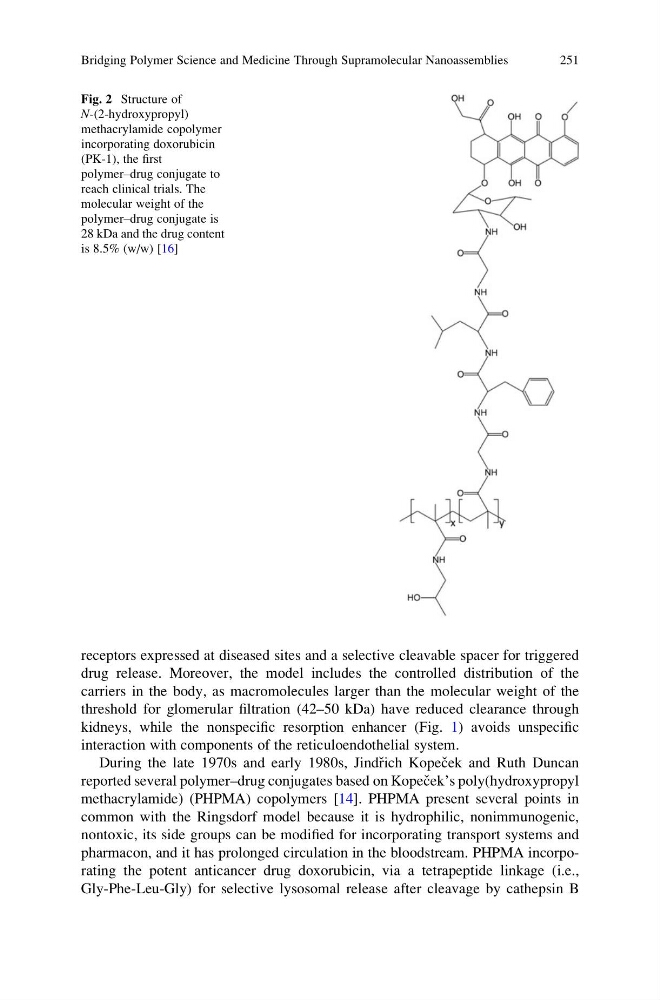
pharmacon, and it has prolonged circulation in the bloodstream. PHPMA incorporating the potent anticancer drug doxorubicin, via a tetrapeptide linkage (i.e.,
Gly-Phe-Leu-Gly) for selective lysosomal release after cleavage by cathepsin B
Fig. 2 Structure of
N-(2-hydroxypropyl)
methacrylamide copolymer
incorporating doxorubicin
(PK-1), the first
polymer–drug conjugate to
reach clinical trials. The
molecular weight of the
polymer–drug conjugate is
28 kDa and the drug content
is 8.5% (w/w) [16]
Bridging Polymer Science and Medicine Through Supramolecular Nanoassemblies
251
drug release. Moreover, the model includes the controlled distribution of the
carriers in the body, as macromolecules larger than the molecular weight of the
threshold for glomerular filtration (42–50 kDa) have reduced clearance through
kidneys, while the nonspecific resorption enhancer (Fig. 1) avoids unspecific
interaction with components of the reticuloendothelial system.
During the late 1970s and early 1980s, Jindr ˇich Kopec ˇek and Ruth Duncan
reported several polymer–drug conjugates based on Kopec ˇek’s poly(hydroxypropyl
methacrylamide) (PHPMA) copolymers [14]. PHPMA present several points in
common with the Ringsdorf model because it is hydrophilic, nonimmunogenic,
nontoxic, its side groups can be modified for incorporating transport systems and
pharmacon, and it has prolonged circulation in the bloodstream. PHPMA incorporating the potent anticancer drug doxorubicin, via a tetrapeptide linkage (i.e.,
Gly-Phe-Leu-Gly) for selective lysosomal release after cleavage by cathepsin B
Fig. 2 Structure of
N-(2-hydroxypropyl)
methacrylamide copolymer
incorporating doxorubicin
(PK-1), the first
polymer–drug conjugate to
reach clinical trials. The
molecular weight of the
polymer–drug conjugate is
28 kDa and the drug content
is 8.5% (w/w) [16]
Bridging Polymer Science and Medicine Through Supramolecular Nanoassemblies
251