

From Hermann Staudinger’s 1920s pioneering article, “U ¨ ber Polymerisation” (“On
polymerization”) [1], and his definition of macromolecules, covering both synthetic
and natural polymers, to the present, macromolecules have taken a central role in
the growth and well-being of our society, with applications ranging from aeronautics to art to medicine. Since his early work, Staudinger stressed the importance of
macromolecules in biology, which he highlighted in the final paragraphs of his
Nobel lecture in December 1953 [2] and throughout his career, by attempting to
bridge polymer science and the biosciences.
From the beginnings of polymer science, synthetic macromolecules were associated with biomedicine as structural and functional materials, such as bone
cements [3], heart valves [4], sutures [5], implantable depots for controlling the
release rate of pharmaceuticals [6], or plasma expanders [7]. These applications
demonstrated the wieldy interface of synthetic polymers and biological tissues, and
the potential for developing biocompatible and biodegradable pharmacologically
active macromolecular agents. By tailoring the composition and structural parameters of such pharmacologically active polymers (for example, by copolymerizing
hydrophilic, hydrophobic, and bioactive monomers), the precise modulation of
their biological activity can be achieved. Early approaches for polymeric drugs
such as poly(ethylene sulfonate) [8] and poly(divinyl ether-co-maleic anhydride)
(DIVEMA) [9] had been configured for showing potent biological activity, but their
toxicity impeded their clinical use as therapeutics [9, 10]. It was Helmut Ringsdorf,
former student and research assistant of Staudinger at the University of Freiburg,
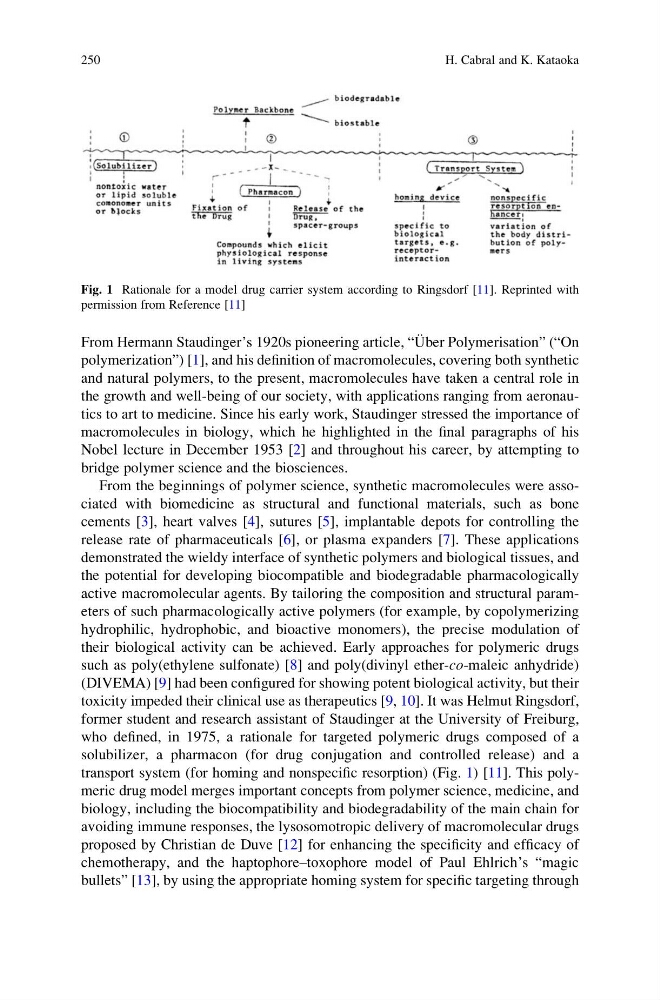
who defined, in 1975, a rationale for targeted polymeric drugs composed of a
solubilizer, a pharmacon (for drug conjugation and controlled release) and a
transport system (for homing and nonspecific resorption) (Fig. 1) [11]. This polymeric drug model merges important concepts from polymer science, medicine, and
biology, including the biocompatibility and biodegradability of the main chain for
avoiding immune responses, the lysosomotropic delivery of macromolecular drugs
proposed by Christian de Duve [12] for enhancing the specificity and efficacy of
chemotherapy, and the haptophore–toxophore model of Paul Ehlrich’s “magic
bullets” [13], by using the appropriate homing system for specific targeting through
Fig. 1 Rationale for a model drug carrier system according to Ringsdorf [11]. Reprinted with
permission from Reference [11]
250
H. Cabral and K. Kataoka
polymerization”) [1], and his definition of macromolecules, covering both synthetic
and natural polymers, to the present, macromolecules have taken a central role in
the growth and well-being of our society, with applications ranging from aeronautics to art to medicine. Since his early work, Staudinger stressed the importance of
macromolecules in biology, which he highlighted in the final paragraphs of his
Nobel lecture in December 1953 [2] and throughout his career, by attempting to
bridge polymer science and the biosciences.
From the beginnings of polymer science, synthetic macromolecules were associated with biomedicine as structural and functional materials, such as bone
cements [3], heart valves [4], sutures [5], implantable depots for controlling the
release rate of pharmaceuticals [6], or plasma expanders [7]. These applications
demonstrated the wieldy interface of synthetic polymers and biological tissues, and
the potential for developing biocompatible and biodegradable pharmacologically
active macromolecular agents. By tailoring the composition and structural parameters of such pharmacologically active polymers (for example, by copolymerizing
hydrophilic, hydrophobic, and bioactive monomers), the precise modulation of
their biological activity can be achieved. Early approaches for polymeric drugs
such as poly(ethylene sulfonate) [8] and poly(divinyl ether-co-maleic anhydride)
(DIVEMA) [9] had been configured for showing potent biological activity, but their
toxicity impeded their clinical use as therapeutics [9, 10]. It was Helmut Ringsdorf,
former student and research assistant of Staudinger at the University of Freiburg,
who defined, in 1975, a rationale for targeted polymeric drugs composed of a
solubilizer, a pharmacon (for drug conjugation and controlled release) and a
transport system (for homing and nonspecific resorption) (Fig. 1) [11]. This polymeric drug model merges important concepts from polymer science, medicine, and
biology, including the biocompatibility and biodegradability of the main chain for
avoiding immune responses, the lysosomotropic delivery of macromolecular drugs
proposed by Christian de Duve [12] for enhancing the specificity and efficacy of
chemotherapy, and the haptophore–toxophore model of Paul Ehlrich’s “magic
bullets” [13], by using the appropriate homing system for specific targeting through
Fig. 1 Rationale for a model drug carrier system according to Ringsdorf [11]. Reprinted with
permission from Reference [11]
250
H. Cabral and K. Kataoka