

donor-to-acceptor ratio is modified. Combining four hexatopic panels with twelve
90
acceptors also generates truncated tetrahedra [52].
The large cuboctahedron also contains trigonal faces, which link together with
idealized 108
angles. As seen with 2D metallacycles, the theoretical angularity of
building blocks is not rigorously maintained due to the distortions of the metal
coordination environment and the bends and twists accommodated by organic
moieties. As such, combining planar, tritopic 120
building blocks with ditopic
109.5
tectons in a twelve to eight ratio affords molecular cuboctahedra [53].
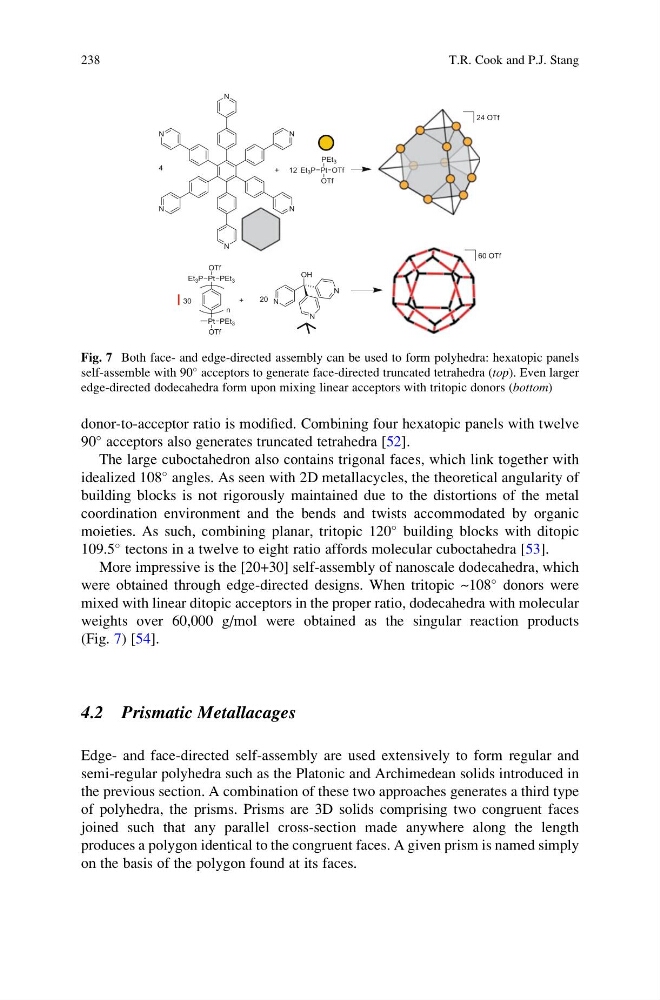
More impressive is the [20+30] self-assembly of nanoscale dodecahedra, which
were obtained through edge-directed designs. When tritopic ~108
donors were
mixed with linear ditopic acceptors in the proper ratio, dodecahedra with molecular
weights over 60,000 g/mol were obtained as the singular reaction products
(Fig. 7) [54].
4.2 Prismatic Metallacages
Edge- and face-directed self-assembly are used extensively to form regular and
semi-regular polyhedra such as the Platonic and Archimedean solids introduced in
the previous section. A combination of these two approaches generates a third type
of polyhedra, the prisms. Prisms are 3D solids comprising two congruent faces
joined such that any parallel cross-section made anywhere along the length
produces a polygon identical to the congruent faces. A given prism is named simply
on the basis of the polygon found at its faces.
Fig. 7 Both face- and edge-directed assembly can be used to form polyhedra: hexatopic panels
self-assemble with 90
acceptors to generate face-directed truncated tetrahedra (top). Even larger
edge-directed dodecahedra form upon mixing linear acceptors with tritopic donors (bottom)
238
T.R. Cook and P.J. Stang
90
acceptors also generates truncated tetrahedra [52].
The large cuboctahedron also contains trigonal faces, which link together with
idealized 108
angles. As seen with 2D metallacycles, the theoretical angularity of
building blocks is not rigorously maintained due to the distortions of the metal
coordination environment and the bends and twists accommodated by organic
moieties. As such, combining planar, tritopic 120
building blocks with ditopic
109.5
tectons in a twelve to eight ratio affords molecular cuboctahedra [53].
More impressive is the [20+30] self-assembly of nanoscale dodecahedra, which
were obtained through edge-directed designs. When tritopic ~108
donors were
mixed with linear ditopic acceptors in the proper ratio, dodecahedra with molecular
weights over 60,000 g/mol were obtained as the singular reaction products
(Fig. 7) [54].
4.2 Prismatic Metallacages
Edge- and face-directed self-assembly are used extensively to form regular and
semi-regular polyhedra such as the Platonic and Archimedean solids introduced in
the previous section. A combination of these two approaches generates a third type
of polyhedra, the prisms. Prisms are 3D solids comprising two congruent faces
joined such that any parallel cross-section made anywhere along the length
produces a polygon identical to the congruent faces. A given prism is named simply
on the basis of the polygon found at its faces.
Fig. 7 Both face- and edge-directed assembly can be used to form polyhedra: hexatopic panels
self-assemble with 90
acceptors to generate face-directed truncated tetrahedra (top). Even larger
edge-directed dodecahedra form upon mixing linear acceptors with tritopic donors (bottom)
238
T.R. Cook and P.J. Stang