

After establishing a number of novel 2D metallacycles through directionalbonding methods, Stang and coworkers applied their expertise to the smallest of
these highly symmetric cages, the truncated tetrahedron. Upon mixing four planar
tritopic building blocks with 120
angularity with six ditopic 90
tectons, the planar
panels orient themselves as the faces of a truncated tetrahedron. This face-directed
assembly was demonstrated with a number of different molecular precursors,
further proving that the nature of the donor and acceptor can be freely swapped to
give complementary cages without significant synthetic redesign of the selfassembly process [50, 51]. Although tritopic panels are suitable for face-directed
truncated tetrahedron assembly, a hexatopic panel may also be used provided the
Fig. 6 The Platonic solids thought to be the building blocks of the classical elements: tetrahedron
(fire), cube (earth), octahedron (air), icosahedron (water), and dodecahedron (universe)
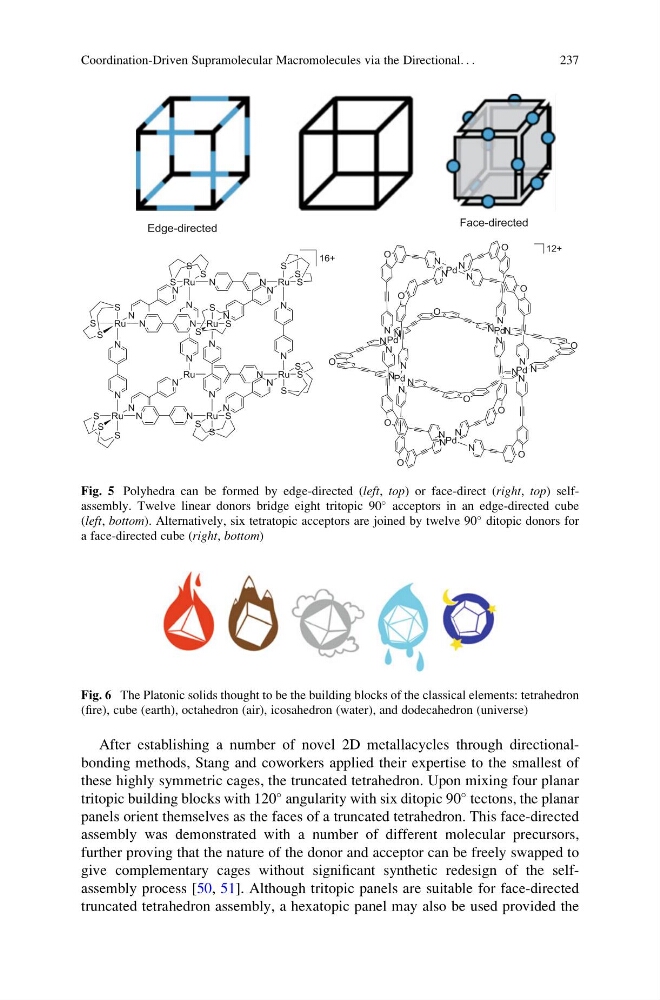
Fig. 5 Polyhedra can be formed by edge-directed (left, top) or face-direct (right, top) selfassembly. Twelve linear donors bridge eight tritopic 90
acceptors in an edge-directed cube
(left, bottom). Alternatively, six tetratopic acceptors are joined by twelve 90
ditopic donors for
a face-directed cube (right, bottom)
Coordination-Driven Supramolecular Macromolecules via the Directional. . .
237
these highly symmetric cages, the truncated tetrahedron. Upon mixing four planar
tritopic building blocks with 120
angularity with six ditopic 90
tectons, the planar
panels orient themselves as the faces of a truncated tetrahedron. This face-directed
assembly was demonstrated with a number of different molecular precursors,
further proving that the nature of the donor and acceptor can be freely swapped to
give complementary cages without significant synthetic redesign of the selfassembly process [50, 51]. Although tritopic panels are suitable for face-directed
truncated tetrahedron assembly, a hexatopic panel may also be used provided the
Fig. 6 The Platonic solids thought to be the building blocks of the classical elements: tetrahedron
(fire), cube (earth), octahedron (air), icosahedron (water), and dodecahedron (universe)
Fig. 5 Polyhedra can be formed by edge-directed (left, top) or face-direct (right, top) selfassembly. Twelve linear donors bridge eight tritopic 90
acceptors in an edge-directed cube
(left, bottom). Alternatively, six tetratopic acceptors are joined by twelve 90
ditopic donors for
a face-directed cube (right, bottom)
Coordination-Driven Supramolecular Macromolecules via the Directional. . .
237