

self-assembly of a single, self-complementary building block containing both donor
and acceptor sites, [(Cp) 2 Ti(C 6 H 5 -4-py)] 4 (OTf) 4 [27].
The modular nature of coordination-driven self-assembly of SCCs allowed the
rapid evolution of pioneering structural studies to deliver materials of increasing
complexity. For instance, shortly after establishing routes to molecular squares,
techniques to introduce chirality were explored, either through pendant chiral
auxiliary groups as capping ligands [28], the use of ditopic diaza ligands of specific
symmetry [29], or incorporating chiral coordination environments about the metal
nodes [30]. Likewise, the use of mononuclear metal nodes based on capped square
or octahedral coordination geometries is not a rigorous requirement but rather one
of convenience. When the requisite 90
angle can be encoded by different means,
for instance by using two cis sites of a dinuclear paddlewheel motif, octanuclear
squares may be obtained, such as those based on the Mo 2 (DArF) 3
+ anion (DArF ¼
N,N
0 -diarylformamidinate) fragment bridged by ditopic dicarboxylate anions [31].
3 Triangles, Hexagons, and Other 2D Metallacycles
Although the fewer number of sides of a triangle compared with a square suggests a
simpler design, the addition of triangular SCCs to the library of known structures
occurred some years after the pioneering work on squares. An early example of a
[3+3] triangle, comprising three ditopic 60
tectons and three linear building
blocks, is found in the self-assembly of 4,7-phenanthroline with palladated
1,2,4,5-tetrakis(n-butylthiomethyl)benzene or 1,2,4,5-tetrakis(phenylthiomethyl)
benzene, which acts as a linear acceptor [32]. A complementary assembly in
which a linear donor is combined with a 60
acceptor has been achieved upon
mixing 4,4
0 -bipy with 2,9-diplatinatedphenanthrene acceptor (Fig. 4) [33]. The
existence of square/triangle equilibria for certain combinations of linear and 90
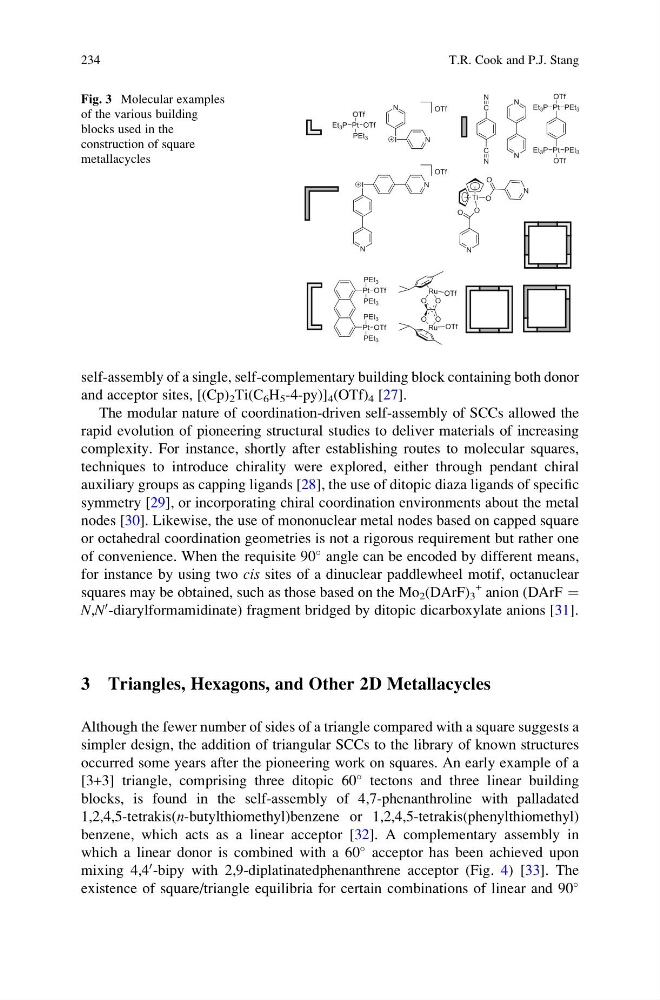
Fig. 3 Molecular examples
of the various building
blocks used in the
construction of square
metallacycles
234
T.R. Cook and P.J. Stang
and acceptor sites, [(Cp) 2 Ti(C 6 H 5 -4-py)] 4 (OTf) 4 [27].
The modular nature of coordination-driven self-assembly of SCCs allowed the
rapid evolution of pioneering structural studies to deliver materials of increasing
complexity. For instance, shortly after establishing routes to molecular squares,
techniques to introduce chirality were explored, either through pendant chiral
auxiliary groups as capping ligands [28], the use of ditopic diaza ligands of specific
symmetry [29], or incorporating chiral coordination environments about the metal
nodes [30]. Likewise, the use of mononuclear metal nodes based on capped square
or octahedral coordination geometries is not a rigorous requirement but rather one
of convenience. When the requisite 90
angle can be encoded by different means,
for instance by using two cis sites of a dinuclear paddlewheel motif, octanuclear
squares may be obtained, such as those based on the Mo 2 (DArF) 3
+ anion (DArF ¼
N,N
0 -diarylformamidinate) fragment bridged by ditopic dicarboxylate anions [31].
3 Triangles, Hexagons, and Other 2D Metallacycles
Although the fewer number of sides of a triangle compared with a square suggests a
simpler design, the addition of triangular SCCs to the library of known structures
occurred some years after the pioneering work on squares. An early example of a
[3+3] triangle, comprising three ditopic 60
tectons and three linear building
blocks, is found in the self-assembly of 4,7-phenanthroline with palladated
1,2,4,5-tetrakis(n-butylthiomethyl)benzene or 1,2,4,5-tetrakis(phenylthiomethyl)
benzene, which acts as a linear acceptor [32]. A complementary assembly in
which a linear donor is combined with a 60
acceptor has been achieved upon
mixing 4,4
0 -bipy with 2,9-diplatinatedphenanthrene acceptor (Fig. 4) [33]. The
existence of square/triangle equilibria for certain combinations of linear and 90
Fig. 3 Molecular examples
of the various building
blocks used in the
construction of square
metallacycles
234
T.R. Cook and P.J. Stang