

reversible metal–ligand coordination provides a mechanism for “self-healing” in
these system, a process by which the ongoing formation and dissociation of
oligomeric intermediates eventually corrects these defective orientations. As
such, coordination-driven self-assembly is most effective under thermodynamic
control, where any and all kinetic intermediates ultimately funnel to a single,
thermodynamic product. Since the angularity, stoichiometry, and size of the
precursors were selected with the demands of a given target shape in mind, the
target SCC geometry is enthalpically favored. Furthermore, the discrete nature of
an SCC provides an entropic impetus over undesirable polymeric products, which
would minimize the total number of molecules formed (Fig. 2). A second caveat
that must be considered in the design of SCCs arises from molecular distortions that
can occur even when using the most rigid of functional groups. Rotations about
bonds, deviations from idealized coordination geometries, and other deviances can
alter the theoretical angularities of building blocks. This is particularly apparent
when considering the solid state structure of certain SCCs. Recently, a de novobased computational method was introduced by Young and Hay that addresses
these distortions [3]. Although the authors present their computational approach in
contrast to the directional bonding method, in reality it is a useful enhancement
rather than a new approach entirely. As it better identifies the encoded angularities
of the precursors found in distorted SCCs, it serves to illustrate the power and
versatility of directional bonding: a method that can be applied for simple systems
with a basic understanding of geometry yet also lends itself to contemporary
computational sophistication in order to explore more complex scaffolds in the
context of molecular distortions.
Herein, recent advances in coordination-driven self-assembly are discussed in the
context of the historical foundation of the directional bonding approach and its use to
furnish supramolecular coordination complexes [4–8]. In the interest of brevity, this
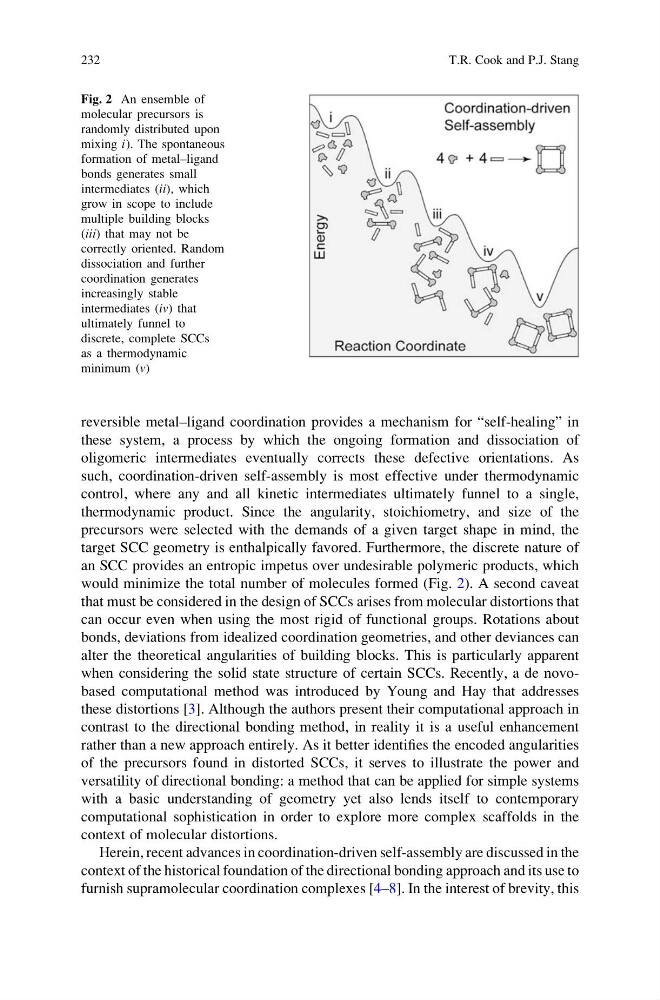
Fig. 2 An ensemble of
molecular precursors is
randomly distributed upon
mixing i). The spontaneous
formation of metal–ligand
bonds generates small
intermediates (ii), which
grow in scope to include
multiple building blocks
(iii) that may not be
correctly oriented. Random
dissociation and further
coordination generates
increasingly stable
intermediates (iv) that
ultimately funnel to
discrete, complete SCCs
as a thermodynamic
minimum (v)
232
T.R. Cook and P.J. Stang
these system, a process by which the ongoing formation and dissociation of
oligomeric intermediates eventually corrects these defective orientations. As
such, coordination-driven self-assembly is most effective under thermodynamic
control, where any and all kinetic intermediates ultimately funnel to a single,
thermodynamic product. Since the angularity, stoichiometry, and size of the
precursors were selected with the demands of a given target shape in mind, the
target SCC geometry is enthalpically favored. Furthermore, the discrete nature of
an SCC provides an entropic impetus over undesirable polymeric products, which
would minimize the total number of molecules formed (Fig. 2). A second caveat
that must be considered in the design of SCCs arises from molecular distortions that
can occur even when using the most rigid of functional groups. Rotations about
bonds, deviations from idealized coordination geometries, and other deviances can
alter the theoretical angularities of building blocks. This is particularly apparent
when considering the solid state structure of certain SCCs. Recently, a de novobased computational method was introduced by Young and Hay that addresses
these distortions [3]. Although the authors present their computational approach in
contrast to the directional bonding method, in reality it is a useful enhancement
rather than a new approach entirely. As it better identifies the encoded angularities
of the precursors found in distorted SCCs, it serves to illustrate the power and
versatility of directional bonding: a method that can be applied for simple systems
with a basic understanding of geometry yet also lends itself to contemporary
computational sophistication in order to explore more complex scaffolds in the
context of molecular distortions.
Herein, recent advances in coordination-driven self-assembly are discussed in the
context of the historical foundation of the directional bonding approach and its use to
furnish supramolecular coordination complexes [4–8]. In the interest of brevity, this
Fig. 2 An ensemble of
molecular precursors is
randomly distributed upon
mixing i). The spontaneous
formation of metal–ligand
bonds generates small
intermediates (ii), which
grow in scope to include
multiple building blocks
(iii) that may not be
correctly oriented. Random
dissociation and further
coordination generates
increasingly stable
intermediates (iv) that
ultimately funnel to
discrete, complete SCCs
as a thermodynamic
minimum (v)
232
T.R. Cook and P.J. Stang