

without the bounds of natural serendipity. As such, molecules that would otherwise
never combine by random chance can be brought together using solvents and
conditions that would be unheard of outside of the chemist’s domain, with exacting
control over the various parameters that affect a reaction. With this level of control
also comes the realization that the favorable properties of the weak interactions
found in natural macromolecules are preserved in metal–ligand interactions, which
also provide a means to control directionality.
Specific transition metals afford predictable and controllable coordination
geometries that facilitate manipulation of the arrangement and number of substitutionally labile sites at a given metal center, thus imparting spatial control over
Lewis-acidic “acceptor” building blocks. Likewise, the orientation and directionality of multiple Lewis-basic sites can be tuned using rigid organic moieties such as
phenyl, ethenyl, and ethynyl groups, providing a route for the rational design of
“donor” precursors. These complementary donor and acceptor molecules interact
through the spontaneous formation of metal–ligand bonds. Careful considerations
regarding the directionalities of the building blocks and the stoichiometries of
mixing allow the self-assembly reactions of single, discrete metallacycles or
metallacages known as supramolecular coordination complexes (SCCs).
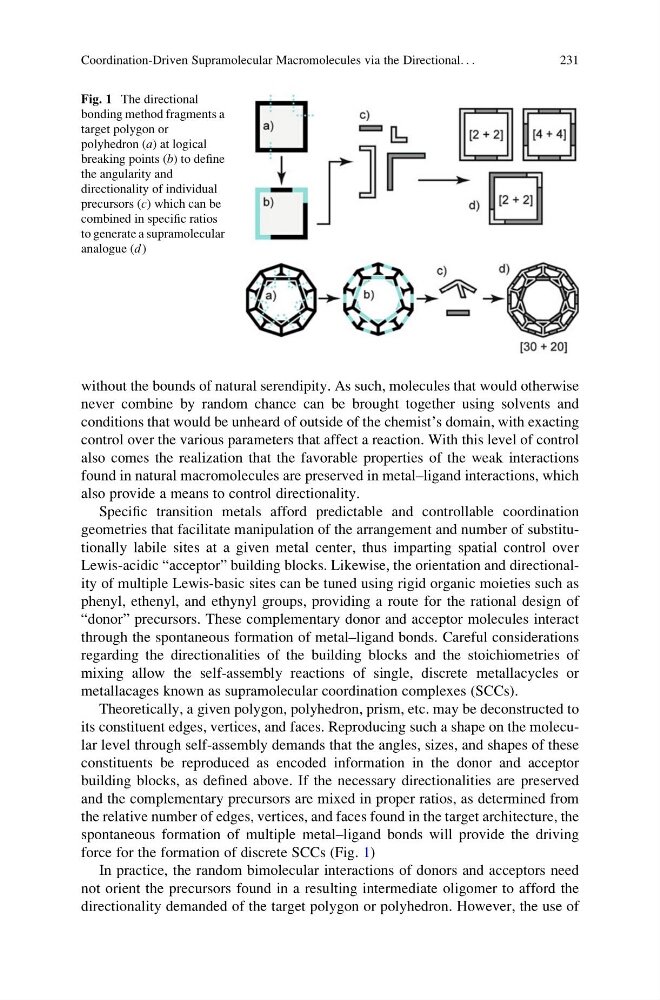
Theoretically, a given polygon, polyhedron, prism, etc. may be deconstructed to
its constituent edges, vertices, and faces. Reproducing such a shape on the molecular level through self-assembly demands that the angles, sizes, and shapes of these
constituents be reproduced as encoded information in the donor and acceptor
building blocks, as defined above. If the necessary directionalities are preserved
and the complementary precursors are mixed in proper ratios, as determined from
the relative number of edges, vertices, and faces found in the target architecture, the
spontaneous formation of multiple metal–ligand bonds will provide the driving
force for the formation of discrete SCCs (Fig. 1)
In practice, the random bimolecular interactions of donors and acceptors need
not orient the precursors found in a resulting intermediate oligomer to afford the
directionality demanded of the target polygon or polyhedron. However, the use of
Fig. 1 The directional
bonding method fragments a
target polygon or
polyhedron (a) at logical
breaking points (b) to define
the angularity and
directionality of individual
precursors (c) which can be
combined in specific ratios
to generate a supramolecular
analogue (d )
Coordination-Driven Supramolecular Macromolecules via the Directional. . .
231
never combine by random chance can be brought together using solvents and
conditions that would be unheard of outside of the chemist’s domain, with exacting
control over the various parameters that affect a reaction. With this level of control
also comes the realization that the favorable properties of the weak interactions
found in natural macromolecules are preserved in metal–ligand interactions, which
also provide a means to control directionality.
Specific transition metals afford predictable and controllable coordination
geometries that facilitate manipulation of the arrangement and number of substitutionally labile sites at a given metal center, thus imparting spatial control over
Lewis-acidic “acceptor” building blocks. Likewise, the orientation and directionality of multiple Lewis-basic sites can be tuned using rigid organic moieties such as
phenyl, ethenyl, and ethynyl groups, providing a route for the rational design of
“donor” precursors. These complementary donor and acceptor molecules interact
through the spontaneous formation of metal–ligand bonds. Careful considerations
regarding the directionalities of the building blocks and the stoichiometries of
mixing allow the self-assembly reactions of single, discrete metallacycles or
metallacages known as supramolecular coordination complexes (SCCs).
Theoretically, a given polygon, polyhedron, prism, etc. may be deconstructed to
its constituent edges, vertices, and faces. Reproducing such a shape on the molecular level through self-assembly demands that the angles, sizes, and shapes of these
constituents be reproduced as encoded information in the donor and acceptor
building blocks, as defined above. If the necessary directionalities are preserved
and the complementary precursors are mixed in proper ratios, as determined from
the relative number of edges, vertices, and faces found in the target architecture, the
spontaneous formation of multiple metal–ligand bonds will provide the driving
force for the formation of discrete SCCs (Fig. 1)
In practice, the random bimolecular interactions of donors and acceptors need
not orient the precursors found in a resulting intermediate oligomer to afford the
directionality demanded of the target polygon or polyhedron. However, the use of
Fig. 1 The directional
bonding method fragments a
target polygon or
polyhedron (a) at logical
breaking points (b) to define
the angularity and
directionality of individual
precursors (c) which can be
combined in specific ratios
to generate a supramolecular
analogue (d )
Coordination-Driven Supramolecular Macromolecules via the Directional. . .
231