

changed independently. The PX–JX 2 device is an example of such a two-state
sequence-dependent device: It switches its shape by a rotation through a half-turn
from the PX conformation to the JX 2 conformation; the portions of the PX and JX 2
motifs that contain toeholds [14] are flanked by nicks that enable them to be
exchanged to produce a robust device [15]. Figure 10 illustrates the first nanoscale
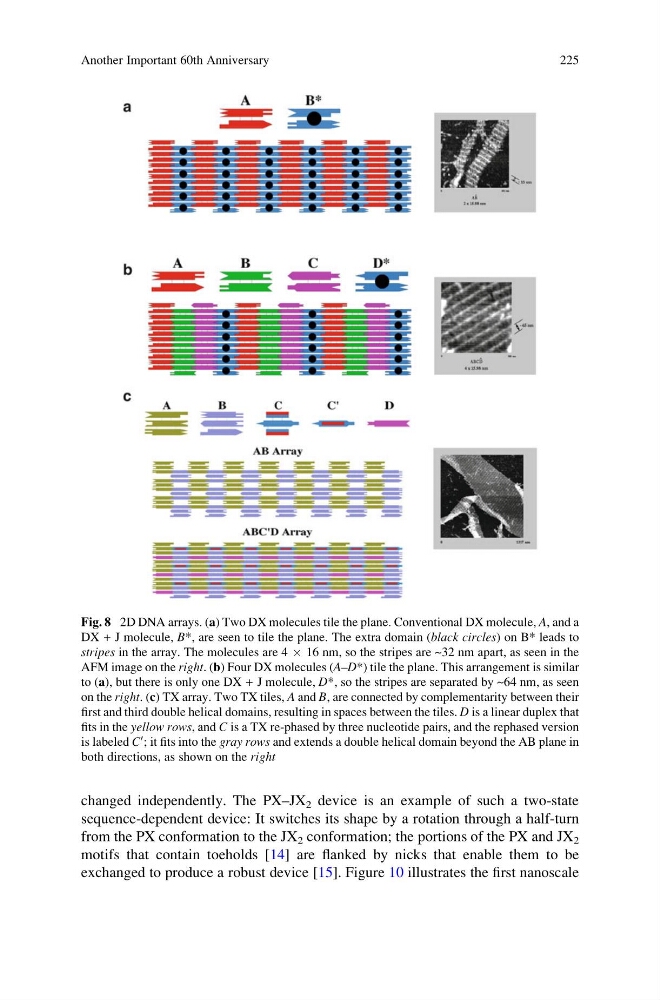
Fig. 8 2D DNA arrays. (a) Two DX molecules tile the plane. Conventional DX molecule, A, and a
DX + J molecule, B*, are seen to tile the plane. The extra domain (black circles) on B* leads to
stripes in the array. The molecules are 4 Â 16 nm, so the stripes are ~32 nm apart, as seen in the
AFM image on the right. (b) Four DX molecules (A–D*) tile the plane. This arrangement is similar
to (a), but there is only one DX + J molecule, D*, so the stripes are separated by ~64 nm, as seen
on the right. (c) TX array. Two TX tiles, A and B, are connected by complementarity between their
first and third double helical domains, resulting in spaces between the tiles. D is a linear duplex that
fits in the yellow rows, and C is a TX re-phased by three nucleotide pairs, and the rephased version
is labeled C
0 ; it fits into the gray rows and extends a double helical domain beyond the AB plane in
both directions, as shown on the right
Another Important 60th Anniversary
225
sequence-dependent device: It switches its shape by a rotation through a half-turn
from the PX conformation to the JX 2 conformation; the portions of the PX and JX 2
motifs that contain toeholds [14] are flanked by nicks that enable them to be
exchanged to produce a robust device [15]. Figure 10 illustrates the first nanoscale
Fig. 8 2D DNA arrays. (a) Two DX molecules tile the plane. Conventional DX molecule, A, and a
DX + J molecule, B*, are seen to tile the plane. The extra domain (black circles) on B* leads to
stripes in the array. The molecules are 4 Â 16 nm, so the stripes are ~32 nm apart, as seen in the
AFM image on the right. (b) Four DX molecules (A–D*) tile the plane. This arrangement is similar
to (a), but there is only one DX + J molecule, D*, so the stripes are separated by ~64 nm, as seen
on the right. (c) TX array. Two TX tiles, A and B, are connected by complementarity between their
first and third double helical domains, resulting in spaces between the tiles. D is a linear duplex that
fits in the yellow rows, and C is a TX re-phased by three nucleotide pairs, and the rephased version
is labeled C
0 ; it fits into the gray rows and extends a double helical domain beyond the AB plane in
both directions, as shown on the right
Another Important 60th Anniversary
225