

structure was established by X-ray diffraction and by vibrational and solid-state NMR
spectroscopy. Small-angle X-ray scattering indicated a characteristic spacing of
3.6 nm perpendicular to the crystal mat. Although we obtained no direct evidence
of surface confinement of the Glu residues, the long spacing is consistent with the
calculated fold-to-fold distance of 2.8 nm and the additional volume required by Glu
residues at the folds. When we increased the separation between the Glu residues, the
long period spacing increased and the intersheet spacing decreased, as expected.
We believe that these experiments represent a significant advance in the level of
control that can be achieved in the engineering of crystal structure in synthetic
macromolecules.
2.2 Smectic Liquid Crystals from Monodisperse
Rod-Like Polymers
Rod-like polymers often form nematic liquid crystal phases in which the chains
assume orientational, but not positional, molecular order. We wondered whether
it might be possible to engineer smectic phases in such systems by narrowing the
chain-length distribution through genetic control. We chose as a model system poly
(γ-benzyl-α,L-glutamate) (PBLG), a helical rod-like polymer that forms nematic,
cholesteric, and columnar phases in its conventional polydisperse form [14–17]. We
expressed two variants of poly(α,L-glutamic acid) in bacterial cells and esterified the
side chains of each polymer to produce monodisperse PBLGs with degrees of
polymerization (DP) of 76 and 94.
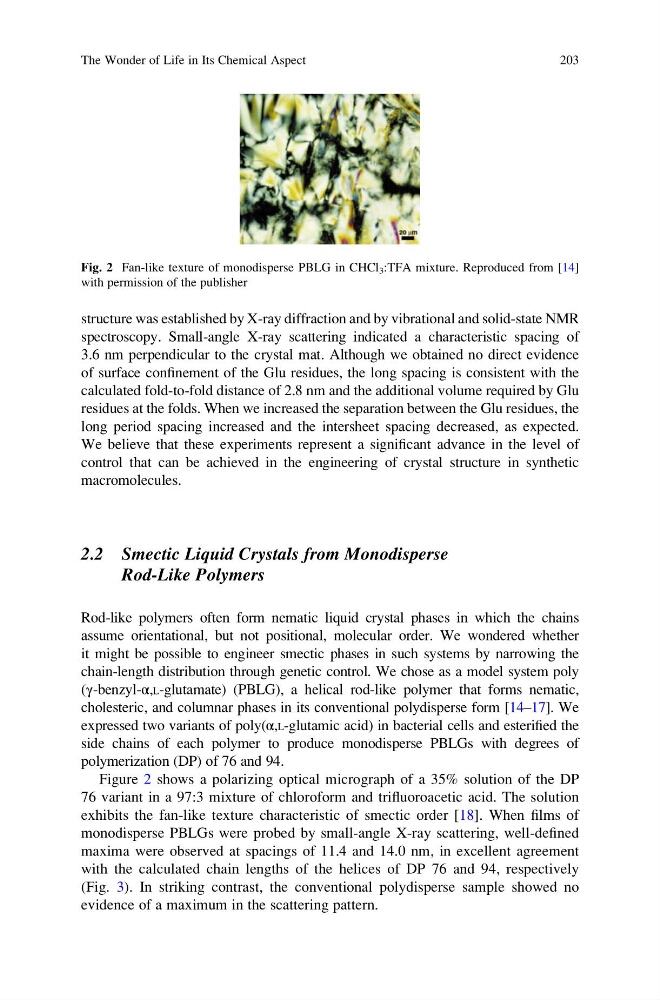
Figure 2 shows a polarizing optical micrograph of a 35% solution of the DP
76 variant in a 97:3 mixture of chloroform and trifluoroacetic acid. The solution
exhibits the fan-like texture characteristic of smectic order [18]. When films of
monodisperse PBLGs were probed by small-angle X-ray scattering, well-defined
maxima were observed at spacings of 11.4 and 14.0 nm, in excellent agreement
with the calculated chain lengths of the helices of DP 76 and 94, respectively
(Fig. 3). In striking contrast, the conventional polydisperse sample showed no
evidence of a maximum in the scattering pattern.
Fig. 2 Fan-like texture of monodisperse PBLG in CHCl 3 :TFA mixture. Reproduced from [14]
with permission of the publisher
The Wonder of Life in Its Chemical Aspect
203
spectroscopy. Small-angle X-ray scattering indicated a characteristic spacing of
3.6 nm perpendicular to the crystal mat. Although we obtained no direct evidence
of surface confinement of the Glu residues, the long spacing is consistent with the
calculated fold-to-fold distance of 2.8 nm and the additional volume required by Glu
residues at the folds. When we increased the separation between the Glu residues, the
long period spacing increased and the intersheet spacing decreased, as expected.
We believe that these experiments represent a significant advance in the level of
control that can be achieved in the engineering of crystal structure in synthetic
macromolecules.
2.2 Smectic Liquid Crystals from Monodisperse
Rod-Like Polymers
Rod-like polymers often form nematic liquid crystal phases in which the chains
assume orientational, but not positional, molecular order. We wondered whether
it might be possible to engineer smectic phases in such systems by narrowing the
chain-length distribution through genetic control. We chose as a model system poly
(γ-benzyl-α,L-glutamate) (PBLG), a helical rod-like polymer that forms nematic,
cholesteric, and columnar phases in its conventional polydisperse form [14–17]. We
expressed two variants of poly(α,L-glutamic acid) in bacterial cells and esterified the
side chains of each polymer to produce monodisperse PBLGs with degrees of
polymerization (DP) of 76 and 94.
Figure 2 shows a polarizing optical micrograph of a 35% solution of the DP
76 variant in a 97:3 mixture of chloroform and trifluoroacetic acid. The solution
exhibits the fan-like texture characteristic of smectic order [18]. When films of
monodisperse PBLGs were probed by small-angle X-ray scattering, well-defined
maxima were observed at spacings of 11.4 and 14.0 nm, in excellent agreement
with the calculated chain lengths of the helices of DP 76 and 94, respectively
(Fig. 3). In striking contrast, the conventional polydisperse sample showed no
evidence of a maximum in the scattering pattern.
Fig. 2 Fan-like texture of monodisperse PBLG in CHCl 3 :TFA mixture. Reproduced from [14]
with permission of the publisher
The Wonder of Life in Its Chemical Aspect
203